
Diesel Repair Warranty: Fleet Cost Per Mile Guide (2026)

A diesel repair warranty for fleets isn’t just a safety net for mechanical failure; it’s a strategic financial tool that determines whether your operation stays profitable or bleeds cash on the side of I-15. Many fleet managers view warranties as a legal formality, but in 2026, they are the primary lever for stabilizing your cost per mile. When a single engine overhaul can exceed $35,000, the difference between a vague corporate policy and a master-crafted guarantee is the difference between a predictable quarter and a budget crisis.
We understand the frustration of watching a truck sit idle for weeks while waiting on a distant corporate office to approve a claim. You need fast turnarounds and clear terms that don’t leave you with unexpected out-of-pocket expenses. This guide outlines how a robust diesel repair warranty for fleets provides the peace of mind you need to operate across the Wasatch Front with confidence. We’ll explore the impact of the Federal Motor Vehicle Right to Repair Act, how to navigate the latest emissions standards, and why a trusted partner in Springville is essential for protecting your bottom line.
Key Takeaways
- Transform unpredictable repair expenses into fixed costs by integrating a strategic diesel repair warranty for fleets into your financial planning.
- Distinguish between high-accountability shop-backed warranties and bureaucratic third-party plans to ensure faster turnaround times on critical repairs.
- Use our audit checklist to verify that your repair partner possesses the specific diagnostic tools and labor guarantees required for modern diesel management.
- Discover how proactive, warranty-backed maintenance reduces total downtime and stabilizes your fleet’s cost per mile across the Wasatch Front.
- Learn why a local master craftsman in Springville offers a more reliable promise of durability than generic corporate service centers.
Why Warranty Coverage is the Backbone of Modern Fleet Management
In contract law, a warranty is a promise that a product or service will perform to a specific standard for a set duration. For logistics professionals, a diesel repair warranty for fleets is a contractual guarantee of part performance and labor integrity. It represents a shift from the old days of “fix it when it breaks” to a disciplined, warranty-backed maintenance model. In 2026, this approach is essential. It ensures that every dollar you invest in your equipment is protected against premature failure or defective workmanship. We don’t just repair engines; we provide a foundation for reliable operation.
Technical uncertainty is a primary source of stress for fleet managers. When a truck goes down, it triggers a domino effect that impacts your entire supply chain. One unexpected mechanical failure can lead to missed delivery windows and jeopardized customer contracts. A robust warranty mitigates this risk by providing a clear, predictable path to resolution. It removes the guesswork from the equation. You know exactly who is accountable and that the cost of the correction is already covered. This peace of mind allows you to focus on moving freight rather than managing shop crises.
The True Cost of Out-of-Warranty Failures
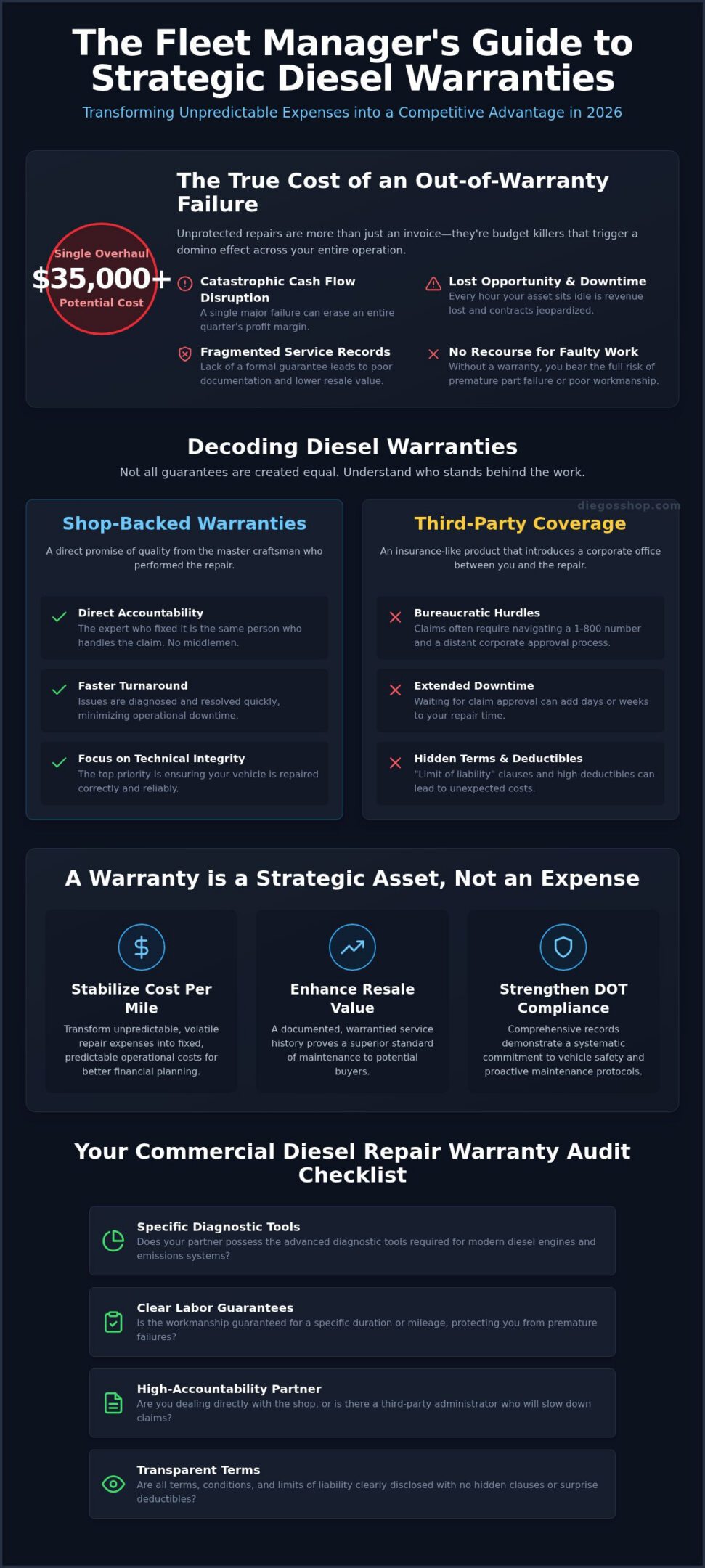
Out-of-pocket repairs are more than just an invoice; they are budget killers that disrupt cash flow. Beyond the immediate shop bill, you face lost opportunity costs while your asset sits idle. For smaller operations, a single major engine failure can erase an entire quarter’s profit margin. Research indicates that engine rebuilds can exceed $35,000 in 2026, making an unprotected failure a catastrophic financial event. Furthermore, relying on un-warrantied repairs often leads to inconsistent maintenance records. Without a formal guarantee, there is less incentive for a shop to document the fine details of the work, which leaves you with a fragmented history of your vehicle’s health.
Warranty as an Asset, Not an Expense
Smart fleet owners view their service history as a value-add for the business. Documented warrantied service significantly enhances the resale value of your vehicles because it proves the work was performed by a master craftsman using high-quality parts. It shows a potential buyer that the truck has been held to a superior standard of accountability. These records are also vital for proving DOT compliance. They demonstrate a systematic commitment to vehicle safety and proactive maintenance protocols. A diesel repair warranty for fleets serves as a strategic hedge against inflationary parts and labor costs by locking in the value of today’s repairs against future market volatility.
Decoding Diesel Warranties: Shop-Backed Repairs vs. Third-Party Coverage
Choosing the right diesel repair warranty for fleets involves understanding who actually stands behind the work when a component fails. There are two primary paths: shop-backed warranties and third-party extended coverage. A shop-backed warranty provides direct accountability. The master craftsman who performed the repair is the same person who handles the claim. This eliminates the middleman and ensures that the technical integrity of the vehicle remains the top priority. In contrast, third-party warranties function more like insurance products. While they offer a national safety net for long-haul routes, they often introduce bureaucratic hurdles that can extend downtime.
Compliance with Federal Warranty Law requires clear disclosure of terms, yet many fleet managers still fall into the “hidden terms” trap. Common pitfalls include restrictive “limit of liability” clauses or high deductibles that eat into the savings of the coverage. It’s also vital to recognize that medium-duty fleets, such as those running Ford or Isuzu trucks, require different warranty structures than heavy-duty OTR rigs. Medium-duty vehicles often face stop-and-go stresses that lead to different failure patterns, making a one-size-fits-all corporate policy less effective than a tailored local agreement.
The Accountability Factor
Personal accountability is the hallmark of a quality repair. When you work with a local partner like Diego’s Shop in Springville, you aren’t navigating a 1-800 claims line. You’re talking to the experts who know your equipment’s history. This direct relationship typically results in a much faster turnaround. You should also verify if a policy offers “parts and labor” coverage or merely “parts-only.” A parts-only warranty leaves you responsible for the expensive labor hours required to swap the component, which can still result in a massive bill. We believe a true promise of quality must cover the work itself, not just the hardware.
Navigating Coverage Limitations
No warranty covers everything. Most agreements distinguish between workmanship defects and standard wear-and-tear. Components like brake pads or filters are rarely covered because their failure is expected over time. However, the most critical factor in keeping your warranty valid is your service record. If you skip scheduled oil changes or ignore sensor alerts, a provider can legally deny your claim. Maintaining a rigorous fleet maintenance guide is the best way to ensure your coverage remains intact. If you want to see how a master-level shop handles these details, you can explore our approach to warrantied repair work to see the difference that professional accountability makes.
The Financial Impact: Using Warranties to Stabilize Fleet Cost Per Mile (CPM)
Cost Per Mile (CPM) is the ultimate metric for measuring the health of your logistics operation. It distills every expense, from fuel to labor, into a single number that determines your profitability. For many Utah County fleets, repair costs are the most volatile variable in this equation. A diesel repair warranty for fleets changes this dynamic by converting unpredictable repair spikes into fixed, manageable expenses. Instead of bracing for a $15,000 transmission failure that could cripple your monthly cash flow, you operate with a stabilized budget. This predictability is what separates a growing fleet from one that is constantly fighting for survival.
Operational stability depends on minimizing what we call the “Repair Volatility Index.” Fleets without comprehensive warranty coverage often experience wild swings in their monthly spend. Consider a scenario involving 10 medium-duty trucks, such as Ford F-550s or Isuzu N-Series, operating over a three-year period. In a non-warrantied fleet, a single month might see three turbocharger failures and a fuel system overhaul. In 2026, industry data shows turbocharger replacements can cost up to $4,000 each. Without protection, your CPM for that month would skyrocket, potentially exceeding your revenue per mile and forcing you to dip into credit lines to keep the wheels turning.
Calculating Your Warranty-Adjusted CPM
To find your true operating cost, you must include any warranty premiums and deductibles in your mileage formula. A simple way to calculate this is to add your annual warranty costs to your scheduled maintenance budget, then divide by your total annual miles. The break-even point occurs when the cost of the coverage is lower than the projected cost of major component failures. For example, if a warranty prevents even one engine rebuild, which can now exceed $35,000, it has paid for itself several times over. Choosing warrantied repair work acts as a strategic insurance policy against labor rate inflation, which has seen diesel mechanic rates climb to between $150 and $200 per hour in many regions.
Lifecycle Decisions and Warranty Data
Strategic fleet managers use warranty expiration dates as a pivot point for vehicle trade-ins. Data shows that maintenance costs for trucks 0 to 3 years old typically range from $0.08 to $0.12 per mile. Once a truck passes the seven-year mark or its warranty expires, those costs often jump to $0.22 per mile. By tracking these metrics, you can decide exactly when to cycle an asset out of your fleet before it becomes a financial liability. Additionally, maintaining detailed, warranty-backed service records can lower insurance premiums for Utah fleets. It proves to underwriters that your equipment is maintained to a master-craftsman standard, reducing the likelihood of accidents caused by mechanical failure. This level of documentation also makes fleet expansion financing easier to secure, as lenders view warranty-protected assets as lower-risk collateral.
Audit Checklist: What to Look for in a Commercial Diesel Repair Warranty
A diesel repair warranty for fleets is only as valuable as the technical mastery of the people standing behind it. Before signing any service agreement, you must audit the shop’s diagnostic capabilities. Modern engines from Cummins, Powerstroke, and Detroit Diesel require specialized software and hardware to identify root causes. If a shop relies on generic scanners, their warranty is a hollow promise because they lack the tools to ensure the repair is done right the first time. You should also demand a clear breakdown of labor coverage. Many policies only cover the physical component, leaving you to foot the bill for the extensive labor hours required for medium and heavy-duty repairs.
Claim friction is the hidden killer of fleet efficiency. Ask potential partners about their specific process for filing a claim and their average turnaround time for approvals. You don’t have time for a bureaucratic 1-800 line to debate the merits of a failed sensor. Additionally, consider the shop’s network. If your vehicle operates beyond Springville or the Wasatch Front, you need to know if the warranty is portable or if the shop has a protocol for coordinating repairs with out-of-area specialists. Clear protocols prevent long-distance breakdowns from becoming financial disasters.
Vetting the Shop’s Expertise
ASE certification serves as a baseline for competency, but it isn’t the ceiling for master-level service. When auditing a shop, ask about their specific preventive maintenance inspection protocols. A superior partner uses these inspections to identify potential failures before they require a warranty claim. This proactive approach keeps your trucks on the road and your budget predictable. It’s about catching the issue in the shop, not on the shoulder of the highway. For a comprehensive look at what to expect from a professional service provider, review our diesel engine repair guide.
The ‘Master Craftsman’ Standard
Identifying a shop that takes personal pride in durability is essential for long-term fleet health. This standard is evident in the quality of the components they choose to install. Installing subpar, generic hardware is a common shortcut that leads to premature failure and denied claims. We emphasize using high-quality diesel parts that meet or exceed OEM specifications to ensure the work lasts well beyond the warranty period. Transparent communication is the final piece of the puzzle. You should receive clear documentation of all warrantied work and a straightforward explanation of your coverage. If you’re ready to partner with a shop that values integrity and master-level skill, contact Diego’s Shop to discuss your fleet’s needs.
Diego’s Shop: Professional Warrantied Repairs for Wasatch Front Fleets
At Diego’s Shop, we define our service by the master-craftsman standard. Based in Springville, we serve as a specialized hub for fleets operating across the Wasatch Front. We understand that a diesel repair warranty for fleets is more than just paperwork; it’s a promise of durability and technical integrity. Our team maintains total control over complex mechanical situations, ensuring that every medium and heavy-duty vehicle, from a Kenworth long-hauler to a Ford F-550, receives specialized care. We don’t just fix symptoms. We address the root cause to ensure your equipment survives the demanding conditions of Utah County.
The Wasatch Front presents unique operational challenges that national warranty providers often overlook. Our region’s steep mountain grades and harsh winter salt applications accelerate wear on emissions systems and drivetrains. In 2026, maintaining a competitive edge requires a partner who understands how these local factors impact your cost per mile. We prioritize preventive maintenance as the ultimate warranty against downtime. By catching potential failures in the shop, we prevent the “domino effect” of roadside breakdowns that can jeopardize your customer contracts and driver safety.
Serving the Utah County Business Community
Our Springville location is strategically positioned to support logistics companies from Provo to Salt Lake City. We handle a diverse range of equipment, including OTR tractors, local dump trucks, and medium-duty delivery vans. Because we are a local, family-named shop, our personal accountability is baked into every invoice. You won’t deal with the bureaucratic delays typical of corporate centers. We build long-term partnerships based on honest communication and consistent results. When we perform warrantied repair work, we stand behind it with the pride of seasoned experts who know your business depends on our technical mastery.
Get Started with a Custom Fleet Service Plan
Every fleet has different needs based on its duty cycle and equipment age. We invite you to schedule an initial fleet audit and diagnostic session at our Springville facility. During this session, we perform a comprehensive review of your vehicles and provide a transparent quote for a custom service plan. We’ll explain our terms in detail, ensuring you understand exactly how a robust diesel repair warranty for fleets protects your bottom line. Our process is designed to be straightforward and high-accountability. The Diego’s Shop promise is simple: rugged reliability and professional peace of mind for every mile you drive.
Secure Your Fleet’s Financial Future on the Wasatch Front
A strategic diesel repair warranty for fleets is the most effective way to eliminate budget volatility and stabilize your cost per mile. By choosing shop-backed accountability over bureaucratic third-party plans, you ensure that your trucks spend more time on the road and less time waiting for claim approvals. Master-level diagnostics and proactive maintenance protocols prevent catastrophic failures before they happen, keeping your operations profitable across the entire Wasatch Front.
Don’t let unpredictable mechanical failures dictate your quarterly earnings. From our Springville location, we provide expert diagnostics for Peterbilt, Kenworth, and Ford fleets. We deliver master-level technical expertise with a focus on personal accountability that generic corporate centers simply can’t match. It’s time to transition to a disciplined, warranty-backed maintenance model that protects your bottom line and your drivers.
Take the next step toward rugged reliability. Contact Diego’s Shop for a Warrantied Fleet Maintenance Quote today and experience the peace of mind that comes with professional, local expertise.
Frequently Asked Questions
What does a typical diesel fleet repair warranty cover?
A standard diesel repair warranty for fleets covers the cost of replacement parts and the labor hours required to install them following a mechanical failure. Coverage typically includes major internal engine components, fuel injectors, and turbochargers. It’s a promise of durability. While wear items like brake pads are excluded, the core powertrain and technical management systems are protected to ensure long-term reliability.
How long do shop-backed warranties usually last for commercial trucks?
Shop-backed warranties generally vary based on the specific repair performed and the type of vehicle. For commercial fleets, these guarantees often span from six months to two years, or a specific mileage threshold. We focus on master-level technical expertise. Our warranties are designed to match the hardworking nature of your machinery. You should always verify the exact duration for your Peterbilt or Kenworth fleet during the initial diagnostic session.
Does preventive maintenance affect my diesel repair warranty?
Consistent preventive maintenance is essential for keeping any warranty valid. Most providers require documented proof that the vehicle has followed a rigorous service schedule to honor a claim. If a failure occurs due to neglected oil changes or ignored sensor alerts, the warranty can be voided. We prioritize comprehensive inspection protocols. This proactive approach ensures your coverage remains intact while significantly reducing the likelihood of ever needing a major repair.
What is the difference between a manufacturer’s warranty and a shop warranty?
A manufacturer’s warranty is provided by the OEM and typically covers new vehicles or factory-remanufactured parts. A shop warranty is a direct guarantee from the repair facility that performed the service. The primary difference is accountability. Working with a local expert in Springville eliminates bureaucratic hurdles. You receive faster turnaround times and a personal commitment to quality that national manufacturers often struggle to provide for older, out-of-warranty assets.
Can I get a warranty on repairs for older, high-mileage diesel trucks?
Yes, you can secure a diesel repair warranty for fleets even on older, high-mileage equipment. While the original factory coverage has expired, the specific repairs and parts installed by a master craftsman are still warrantied for performance and integrity. It’s a critical tool for success. We handle everything from OTR long-haulers to local dump trucks, ensuring that even your most seasoned assets remain protected and your cost per mile stays predictable.
How do I file a warranty claim if my truck breaks down outside of Utah?
Filing a claim for an out-of-state breakdown depends on the specific network of your warranty provider. For shop-backed warranties, you should contact the original repair facility immediately to coordinate diagnostics with a local shop in that area. We focus on building long-term partnerships. If your truck breaks down outside the Wasatch Front, we work to ensure the situation is managed professionally, maintaining total control over the technical resolution and the financial coverage.
Why do some diesel warranties exclude certain emissions components?
Emissions components like DPFs and SCR systems are often excluded or have shorter coverage periods because they’re highly sensitive to fuel quality and operating conditions. These systems face extreme thermal stress. They can fail due to external factors rather than workmanship defects. Modern diesel management requires specialized technical mastery to navigate these exclusions. We use advanced diagnostics to ensure these systems run efficiently, which helps prevent failures that fall outside standard coverage terms.
How much does adding an extended warranty typically add to my fleet CPM?
Adding a warranty typically increases your fixed operating costs by a small margin per mile, but it serves as a hedge against catastrophic variable expenses. While the premium represents an upfront cost, it prevents the massive financial spikes associated with engine rebuilds or transmission failures. It’s a strategic investment. This predictability allows for better cash flow management and more accurate long-term financial modeling. It ensures your fleet remains competitive in a volatile and demanding market.