
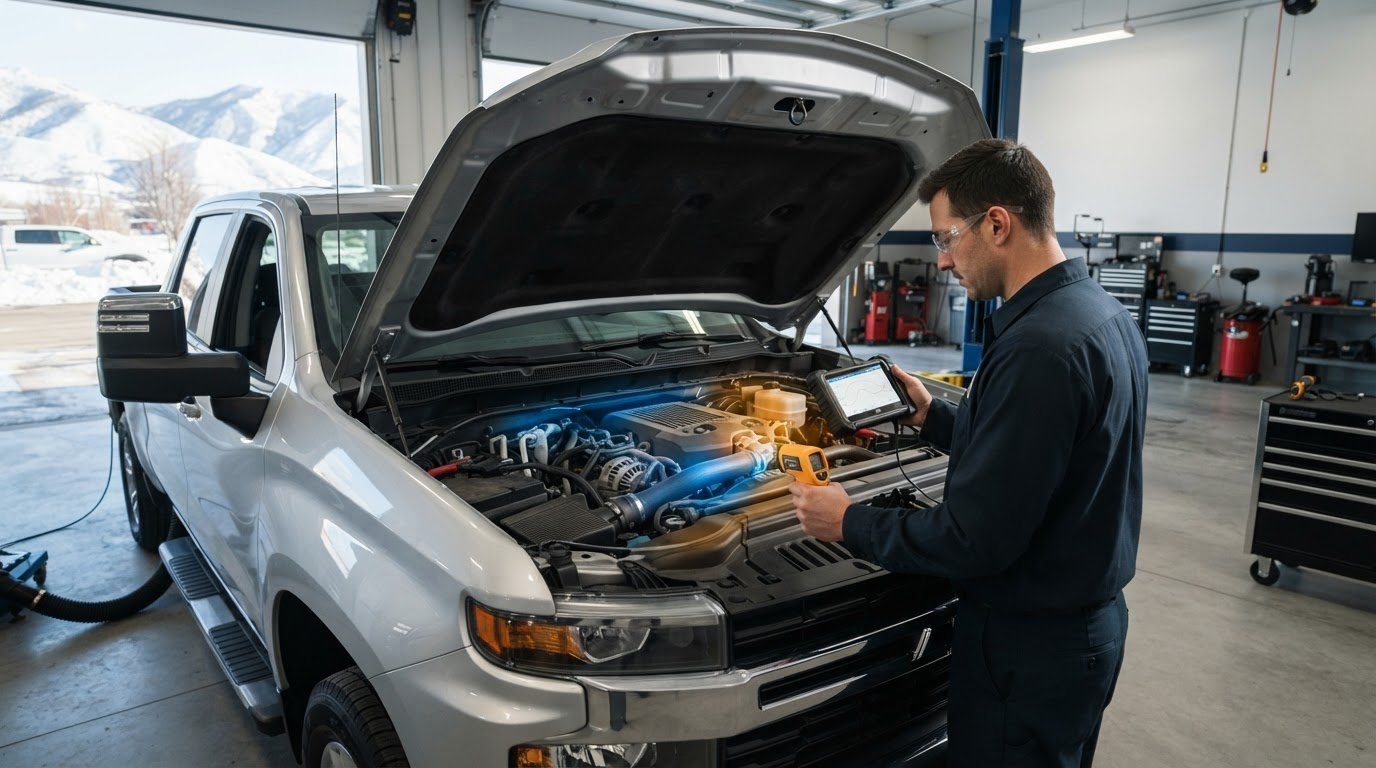
Diesel Engine Running Cold Problems: Causes, Checks, and Next Steps

What if a diesel that stays cool isn’t automatically pointing to a failed thermostat? Diesel engine running cold problems can have several causes, and how the temperature changes during warm-up often matters more than one low gauge reading. Replacing parts based on a guess can miss the real fault and leave the symptoms unresolved.
This guide explains why a diesel may not reach its normal operating temperature and what you can safely observe before arranging a repair. Warm-up behavior, driving conditions, warning lights, and other symptoms can help narrow the possibilities, but a dashboard reading alone isn’t a diagnosis.
We’ll cover common causes, practical checks, and signs that call for professional testing. Because modern diesel engines use electronic controls and emissions systems, persistent low temperatures may need specialist diagnosis. The goal is to help you choose an informed next step, not guess at parts.
Key Takeaways
- Learn how to distinguish slow warm-up in cold weather from a recurring low-temperature symptom.
- See why thermostat, coolant-circulation, sensor, and operating-condition issues can look alike.
- Use an observation checklist to record conditions and warning signs before arranging diagnosis.
- Understand why diesel engine running cold problems should be assessed by symptom patterns, not guessed at parts or additives.
- Find out what vehicle and repair details to share when seeking diesel help in Springville, Utah County, or the Wasatch Front.
Diesel Engine Running Cold Problems: Which Symptoms Matter?
A low temperature gauge can be concerning, but it doesn’t point to one automatic diagnosis. A diesel may warm slowly during a short drive in cold weather, or repeatedly stay unusually cool during ordinary use. Those patterns call for different levels of concern. Note what happens over a complete trip and whether it repeats, rather than relying on one glance at the dashboard.
Persistent cold running means the engine repeatedly appears to remain below its expected operating temperature under comparable driving conditions, rather than simply taking longer to warm up on a cold or short trip. There is no single temperature threshold that applies to every diesel. Compare the behavior with the vehicle manufacturer’s guidance.
What does a diesel engine running cold look or feel like?
The gauge might stay low, rise unusually slowly, or move unexpectedly. The cabin heater may take longer to deliver warm air, and you may notice a change in drivability. These observations can help describe the issue, but none proves a specific fault. Note whether the symptoms return on other drives.
Record details that give a technician a clearer picture:
- Ambient conditions, including whether the vehicle started in cold weather.
- How long you drove and whether the trip involved steady travel, stop-and-go traffic, or a heavier workload.
- How the gauge behaved from startup through the end of the drive.
- When the cabin heater began producing warm air, and whether its output changed.
- Any warning lights or messages, including when they appeared.
When can cold-weather warm-up be normal?
Warm-up behavior depends on ambient temperature, trip length, engine workload, and vehicle design. In a Utah winter, a short drive may end before the engine warms fully, but cold weather alone doesn’t explain every repeated low reading. A cold start can present particular challenges for diesel engines, including their reliance on compression heat. Compare recurring behavior with the manufacturer’s guidance for your vehicle.
If the gauge stays low only on brief trips in colder conditions but behaves differently on longer drives, record that context. If it remains unusually low across trips with different conditions, or heater and drivability concerns keep returning, arrange an assessment. The pattern helps guide the next checks without turning an observation into a parts diagnosis.
Why Does a Diesel Engine Keep Running Cold?
A diesel can appear to run cold for several reasons. The temperature-control system may not regulate coolant flow as intended, a sensor or circuit may report the wrong temperature, or driving conditions may not give the engine enough time or workload to warm up. These possibilities can produce similar gauge readings. The pattern helps prioritize checks but can’t confirm which component has failed.
A low temperature reading alone cannot identify the failed part. The engine may be warming too slowly, or the temperature indication may not match the engine’s actual condition. A technician can compare dashboard behavior with diagnostic data and other system checks to distinguish between them.
Could a thermostat cause a diesel engine to run cold?
A thermostat helps regulate coolant flow as the engine warms. It restricts circulation during warm-up, then opens to allow more coolant through the radiator as needed. If it’s stuck open, the engine may take longer to warm or continue running cooler than expected. That pattern makes the thermostat worth checking, but doesn’t prove it’s faulty. The NRC’s technical overview of Engine Cooling Systems describes the role of thermostats in diesel cooling systems. Vehicle-specific service information is still needed to assess a particular truck.
Other cooling-system conditions may also affect temperature behavior. A technician can assess coolant level and system condition, then use the vehicle’s service procedures to determine whether coolant flow and temperature regulation are working as designed. Don’t replace a thermostat based on a familiar symptom alone.
Can a coolant-temperature sensor or other system affect the reading?
Yes. A faulty coolant-temperature sensor, damaged wiring, or another circuit issue can send an inaccurate signal to the gauge or engine controls. The displayed temperature may not reflect how warm the engine actually is. Comparing the gauge with engine-control data and other diagnostic observations helps narrow the cause.
Emissions systems may also respond to engine-temperature information, but the effect depends on the vehicle and its control strategy. Warning lights or stored codes can provide useful clues, but they aren’t proof of a specific failed part. Diagnosis should follow the manufacturer’s procedures rather than a one-size-fits-all temperature assumption.
Because diesel engine running cold problems can involve overlapping mechanical and electronic symptoms, specialist assessment can help avoid guessing at parts or additives. If the low reading keeps returning, consider arranging diesel engine diagnostics to identify whether the issue involves actual warm-up, the temperature signal, or another system.
How to Tell Normal Cold-Weather Behavior from a Diesel Fault
Cold ambient conditions can contribute to slow warm-up, especially on a short trip. But recurring low-temperature symptoms shouldn’t be dismissed as normal just because the weather is cold. Compare what happens across trips to decide whether the concern needs further assessment.
| Observation | Occasional cold-weather slow warm-up | Repeated low-temperature symptom |
|---|---|---|
| Gauge behavior | May rise slowly on a cold start or brief drive. | Often stays low or behaves unusually across different trips. |
| Cabin heat | May take longer to warm, especially during a short trip. | Slow or inconsistent heat may recur along with the low reading. |
| Warning lights | No warning may appear, though its absence doesn’t confirm normal operation. | A recurring warning or message is useful information to share with a technician. |
| Trip conditions | More likely in cold weather, on short routes, or with light engine workload. | May continue on longer or varied trips, not just brief drives in cold conditions. |
| Recurrence | May not repeat when conditions or trip length change. | Returns under comparable conditions or across different drives. |
This comparison organizes observations; it doesn’t replace model-specific testing. A cold day may help explain one slow warm-up, but it doesn’t rule out a fault if the same pattern keeps returning.
Which observations help narrow down the cause?
Keep a brief log of ambient conditions, route length, engine load, and when the gauge starts to move. Note cabin-heat changes and warning messages as supporting clues, not stand-alone tests. For fleet vehicles, ask drivers to report whether the behavior repeats on similar routes. Consistent reports can help maintenance staff decide what to investigate next.
Could a cold-running complaint actually be a fuel problem?
Fuel gelling or restricted fuel flow in cold weather can cause separate operating symptoms, such as difficulty running smoothly. That’s different from a gauge that repeatedly indicates low engine temperature. Fuel additives aren’t a fix for a thermostat, sensor, or temperature-control concern, and guessing at products can distract from the real issue. Follow the vehicle manufacturer’s fuel guidance and seek professional assessment if symptoms persist.
Tracking these details helps separate cold-weather operating conditions from diesel engine running cold problems. Bring your observations to a qualified diesel technician rather than treating one reading, warning, or fuel symptom as a diagnosis.
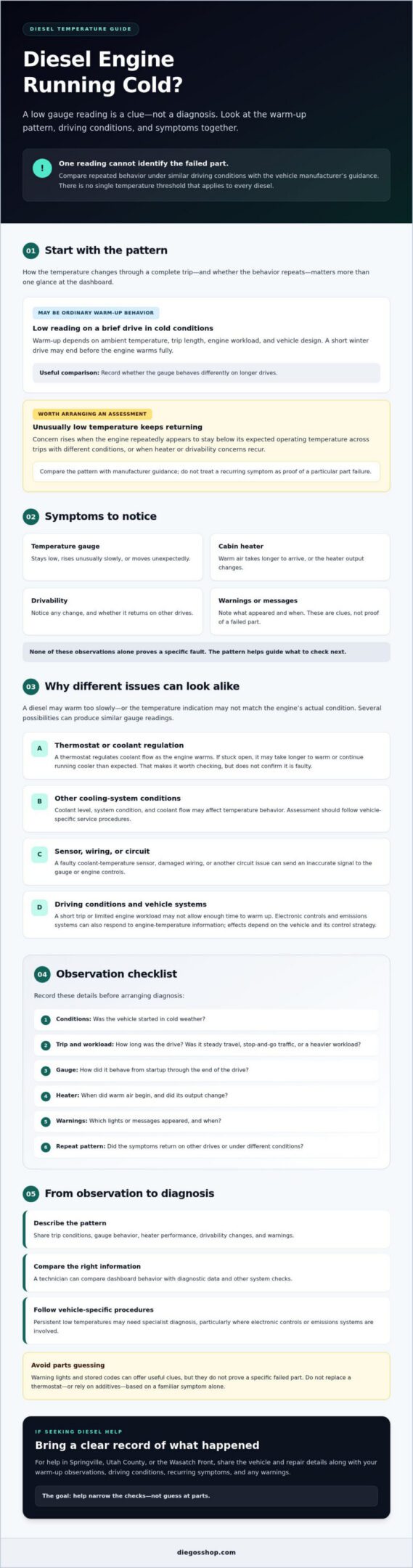
What Should You Check When a Diesel Engine Runs Cold?
Keep your checks observational. The goal is to give a technician a clear account of the symptom, not to diagnose a part yourself. Use this sequence to organize what you’ve seen before arranging service.
- Confirm the pattern. Watch the temperature gauge during normal driving. Note whether it stays low, rises slowly, or changes unexpectedly, and whether the behavior returns on another trip.
- Record the conditions. Note the outside conditions, trip length, route, engine workload, and when the gauge begins to move. Include changes in cabin heat or drivability as context.
- Review dashboard warnings. Write down any warning lights or messages and when they appeared. Don’t clear codes or ignore a warning in an attempt to see if it returns.
- Arrange diagnosis if the symptom persists. Repeated low readings, recurring symptoms, or warning messages warrant assessment. A technician can compare sensor data and cooling-system behavior with your vehicle’s specifications.
What can an owner safely observe before booking service?
Check the gauge and dashboard messages during regular use, and record what happens rather than relying on memory. You can also look for visible signs of a leak from a safe distance, but don’t touch hot components or remove the radiator or coolant-system cap while the engine is hot. Avoid replacing parts based only on a gauge reading or an online symptom checklist. For broader repair context, see this diesel engine repair guide.
When should a diesel technician diagnose the problem?
Book an assessment if low readings keep returning, heater or drivability symptoms recur, or a warning message appears. A qualified technician can use vehicle-specific procedures to determine whether the engine is warming incorrectly, the temperature signal is inaccurate, or another system needs attention. This helps avoid guessing at parts or additives.
Safety comes first. A temperature gauge that moves into an overheating range, a visible coolant leak, steam, or unsafe changes in vehicle operation calls for prompt attention. Pull over somewhere safe and follow the vehicle manufacturer’s instructions; don’t continue driving if the vehicle may be unsafe. For drivers in Utah County, persistent diesel engine running cold problems can be assessed through diesel diagnostics and repair. Request diesel engine repair if you need help deciding on the next step.
Where to Get Help for Diesel Engine Running Cold Problems in Utah
If a low-temperature reading keeps returning, a qualified diesel technician can help determine whether the engine is warming unusually slowly or the temperature signal is inaccurate. Share the pattern you’ve observed and request diagnosis before replacing parts or trying additives. That gives the repair decision a sound basis rather than relying on a guess.
What should you bring to a diesel repair appointment?
Useful details help the technician understand when the concern began and what conditions affect it. Before requesting service, gather:
- The vehicle’s make, model, year, and engine information, if available.
- Any warning messages or diagnostic codes you’ve seen. A photo of the dashboard message can help preserve its exact wording.
- A description of how the temperature gauge behaves, including whether the pattern changes with trip length, weather, or workload.
- Details of recent repairs or parts changes. Share what was done and when, without assuming it caused the current concern.
These notes provide context, but they don’t replace vehicle-specific testing. A technician can use them to focus the assessment and follow the appropriate service information for that vehicle.
How does specialist diesel diagnosis support the next repair step?
Temperature-control faults, sensor problems, and other system issues can produce similar symptoms. Testing helps distinguish among them by comparing available sensor data and cooling-system behavior with the vehicle’s specifications. That can reduce guesswork and help determine whether repair or further investigation is appropriate. Avoid replacing a thermostat or adding a product solely because the gauge reads low.
Diego’s Shop provides diesel diagnostics, repair, and preventive maintenance for light-duty, medium-duty, and heavy-duty vehicles, serving Springville, Utah County, and the Wasatch Front. Its work includes modern diesel engine management and emissions systems. If a symptom recurs, describe what you’ve observed and any prior repairs when asking about service. For broader ongoing-care context, review the 2026 diesel maintenance handbook.
If your truck continues to run unusually cool, contact Diego’s Shop about diesel diagnostics and repair. A clear description of the symptom is a practical first step toward identifying what needs attention.
Take the Next Step with Confidence
A low gauge reading is a clue, not a diagnosis. Cold weather and short trips can affect warm-up, but symptoms that keep returning deserve attention. Track the gauge behavior, note warning messages and driving conditions, and share those details with a qualified diesel technician before replacing parts or trying additives.
This measured approach helps narrow down diesel engine running cold problems and supports a repair decision based on the vehicle’s actual condition. Diego’s Shop provides diesel repair for light-duty, medium-duty, and heavy-duty vehicles, serving commercial fleets and residential owners in Utah County and the Wasatch Front. Repair work is warrantied, giving customers clear accountability for the work performed.
If your diesel continues to run unusually cool, take the next step with a specialist. Contact Diego’s Shop for diesel diagnosis and share the symptoms you’ve recorded. With the right information and a careful assessment, you can move forward without guessing.
Frequently Asked Questions
Why is my diesel engine running cold?
A diesel that stays below its usual operating range may have a temperature-control, coolant-circulation, sensor, or other vehicle-specific issue. Cold weather and short trips can also slow warm-up. Note how the gauge behaves, how long you drive, and whether cabin heat or warning messages change. If the pattern repeats, arrange diagnosis using the manufacturer’s procedures rather than replacing parts based on symptoms alone.
Can cold weather make a diesel engine run cold?
Yes. Low ambient temperatures, short trips, and light engine load can influence how quickly a diesel warms up. That doesn’t prove a mechanical fault, but repeated low readings during normal operation shouldn’t automatically be dismissed as weather. Track the conditions and compare the behavior with your vehicle’s guidance. If the symptom keeps returning, a technician can assess whether the engine is warming as designed.
Can a stuck-open thermostat cause a diesel engine to run cold?
Yes, a stuck-open thermostat is one possible cause because the thermostat helps regulate coolant flow as the engine warms. Similar symptoms can also come from a sensor or another cooling-system concern, so the gauge alone can’t confirm a failed thermostat. Avoid replacing parts based only on an online symptom list. Use vehicle-specific testing or have a qualified diesel technician assess the system.
Is it safe to drive a diesel engine that is running cold?
Safety depends on the vehicle, symptoms, and warning messages. A low reading alone doesn’t establish the cause or whether continued driving is safe. Stop somewhere safe and seek prompt help if serious warnings appear, you notice a leak, the temperature changes unpredictably, or the vehicle operates abnormally. If the low-temperature symptom keeps recurring, arrange diagnosis and follow the manufacturer’s instructions for your vehicle.
Can a coolant-temperature sensor make a diesel temperature gauge read low?
Yes. A faulty sensor or circuit can affect the temperature information shown on the gauge or recorded by engine controls. However, a low reading may also reflect the engine’s actual temperature, so replacing the sensor without testing could miss the problem. A technician can compare scan data, gauge behavior, wiring, and vehicle-specific specifications to determine whether the reading is inaccurate or the cooling system needs attention.
Will a diesel fuel additive fix an engine that runs cold?
No. An additive intended for winter fuel concerns isn’t a general repair for a temperature-control or sensor fault. Fuel problems, such as restricted flow, can cause different operating symptoms, so diagnosis should distinguish them from persistently low engine temperature. Follow the vehicle manufacturer’s fuel guidance. If the gauge repeatedly stays low or warning messages appear, have the engine assessed instead of relying on an additive to solve the concern.
When should I take a cold-running diesel to a repair shop?
Arrange service if low readings repeat, the engine behaves unexpectedly, cabin heat changes noticeably, or warning messages appear. Record the conditions and symptoms before your appointment so the technician has useful context. Diego’s Shop provides diesel diagnostics and repair in Springville, Utah County, and the Wasatch Front for commercial fleets and residential owners. Follow your vehicle’s manual, and seek prompt help if serious warnings or unsafe operation occur.