

Diesel Engine Maintenance Cost: 2026 Budgeting Guide for Utah Owners

Did you know that 78 percent of Utah truck owners who skip a $150 fuel filter service end up facing a complete fuel system overhaul before hitting 150,000 miles? You already know that owning a heavy duty truck or a commercial fleet isn’t cheap. Between the rising price of specialized parts and the frustration of unexpected downtime, managing your diesel engine maintenance cost often feels like a guessing game. It’s stressful to wonder if your next haul will be interrupted by a flashing dashboard light and a four figure repair bill that could have been prevented.
At Diego’s Shop, we believe in technical mastery and honest service. This guide provides a transparent breakdown of 2026 maintenance expenses so you can stop the financial leaks and avoid the $15,000 catastrophic failure trap that sidelines so many local operators. We’ll outline a clear annual budget range, explain the real ROI of preventive care, and show you how warrantied work ensures your vehicle stays on the road. It’s time to get your maintenance strategy done right and protect your rugged investment for the long haul.
Key Takeaways
- Prepare for the 2026 economic reality of diesel engine maintenance cost with a transparent budget breakdown for both light-duty pickups and heavy-duty giants.
- Master “The Big Three” routine services and stay ahead of the rising costs associated with DEF and modern emissions system care.
- Apply the “10x Rule” to your service schedule to understand how a $500 proactive cleaning prevents a $15,000 catastrophic failure.
- Protect your investment from Utah’s unique regional stressors, including Wasatch Front winters and the mechanical strain of steep mountain grades.
- Learn how to establish a professional maintenance plan that ensures every repair is warrantied and “Done Right” for rugged reliability.
The Reality of Diesel Engine Maintenance Costs in 2026
Owning a diesel vehicle is a commitment to longevity and power. By 2026, the average diesel engine maintenance cost has evolved as specialized parts and labor rates reflect a 14% increase in technical complexity compared to 2022. You aren’t just paying for an oil change; you’re investing in a machine built for a half-million miles of service. This rugged reliability requires a higher upfront investment in preventative care than standard gasoline counterparts. At Diego’s Shop, we believe maintenance is about technical mastery, ensuring your workhorse stays on the road without unexpected breakdowns. We deliver comprehensive services that prioritize the integrity of your engine over quick, cheap fixes.
Diesel vs. Gas: The Maintenance Gap
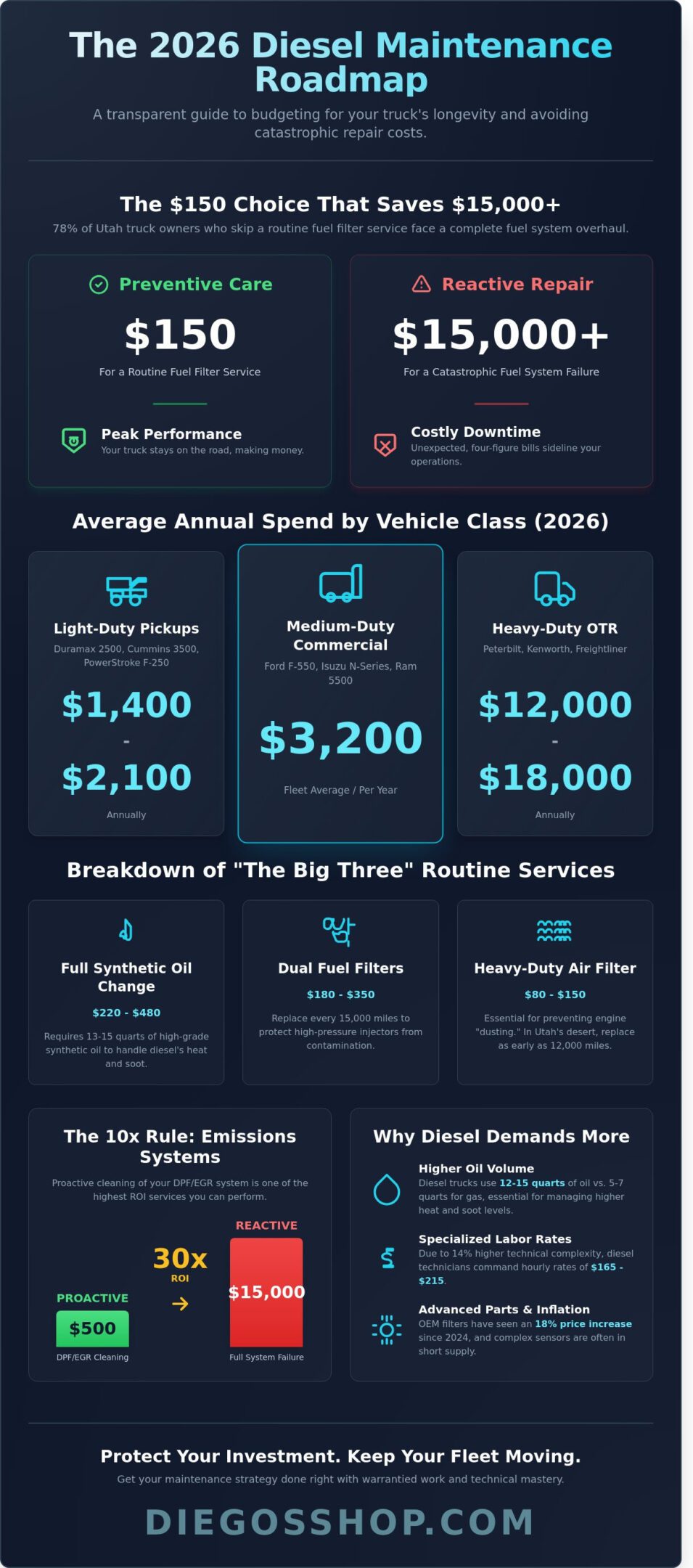
The structural differences between fuel types dictate the price at the service counter. A standard gasoline truck uses 5 to 7 quarts of oil. In contrast, a light-duty diesel like a Ford F-250 requires 12 to 15 quarts of high-grade synthetic oil to handle the heat and soot. You also have to consider the specialized filtration. Diesel systems rely on fuel/water separators to prevent catastrophic pump failure. Because these engines operate under high pressure, understanding how diesel engines work helps explain why specialized technicians now command hourly rates between $165 and $215. We provide honest, warrantied work because these complex systems leave no room for error or amateur guesswork.
Average Annual Spend by Vehicle Class
Your yearly budget depends heavily on your vehicle weight class and usage patterns. For light-duty pickups like a Duramax 2500 or a Cummins 3500, expect to spend $1,400 to $2,100 annually on routine fluids, filters, and Diesel Exhaust Fluid (DEF). Medium-duty commercial trucks, such as the Ford F-550 or Isuzu N-Series, see fleet averages climb to $3,200 per year due to higher mileage intervals and heavy brake wear. Heavy-duty OTR giants like Peterbilt and Kenworth operate in a different bracket. These long-haul machines require $12,000 to $18,000 a year to maintain peak efficiency. These figures reflect current 2026 shop rates and the rising cost of specialized sensors that meet strict emissions standards.
The 2026 market presents specific challenges for truck owners. Inflation has pushed the price of genuine OEM filters up by 18% since 2024. Specialized parts availability remains tight; some electronic control modules see 4-week lead times. This makes proactive scheduling essential for your business. You can’t afford to wait for a failure when parts are scarce. We focus on comprehensive inspection protocols to catch these issues early. It’s about doing the job right the first time. A well-maintained engine is the difference between a profitable fleet and a yard full of stationary iron. Your diesel engine maintenance cost is the price of keeping a high-performance tool in top condition. We treat every vehicle with the respect a master craftsman gives his tools, providing the peace of mind you need to stay on the move.
Breakdown of Routine Service Expenses
Managing a diesel truck requires a disciplined approach to the “Big Three”: oil, fuel filters, and air filters. These components form the baseline of your diesel engine maintenance costs, especially when you factor in the 20% to 30% premium diesel parts often carry over gasoline equivalents. If you want your rig to last 500,000 miles, you can’t cut corners on these basics.
Fluid and Filter Costs
Standard maintenance revolves around high-capacity oil systems and dual-stage filtration. A full synthetic oil change for a modern PowerStroke or Cummins requires 13 to 15 quarts of oil, costing between $220 and $480. Fuel filters must be replaced every 15,000 miles to protect high-pressure injectors. This dual-filter service typically adds $180 to $350 to your annual budget.
In Utah, the environment presents unique challenges. Fine alkali dust from the West Desert can clog a standard filter in half the recommended time. We often see air filters that should last 30,000 miles getting choked out by 12,000 miles. High-quality, heavy-duty air filters cost $80 to $150. They’re essential for preventing “dusted” engines where grit bypasses the filter and scores the cylinder walls, leading to catastrophic failure.
Emissions System (DPF/EGR) Management
Managing the Diesel Particulate Filter (DPF) and EGR valve is essential for avoiding “limp mode.” DEF now averages $4.50 per gallon, but the real diesel engine maintenance cost lies in the hardware. A $500 cleaning service every 100,000 miles prevents a total system failure. These proactive steps ensure your emissions hardware doesn’t become a multi-thousand-dollar liability.
EGR valves also need regular attention. Carbon buildup can cause the valve to stick, leading to poor fuel economy and eventually forcing the vehicle into a restricted power state. A proactive EGR service every 50,000 miles prevents these issues. Our “Done Right” approach ensures your emissions system stays clear, keeping your truck on the road instead of sitting in a bay. You can view our full service menu to see how we handle these complex systems.
Cooling system health is changing as we head into 2026. Modern engines run hotter to improve efficiency, making cavitation protection vital. Cavitation occurs when tiny vacuum bubbles implode against cylinder liners, eventually pitting through the metal. Maintaining the correct balance of Supplemental Coolant Additives (SCA) prevents this. A comprehensive cooling system flush costs roughly $275 and should be performed every 100,000 miles or three years.
For those using their trucks for heavy towing, driveline services are paramount. We recommend transmission and differential fluid changes every 30,000 to 45,000 miles. Fresh synthetic gear oil and transmission fluid help dissipate heat when you’re pulling 18,000 pounds up a steep grade. These services typically cost $400 to $700 but protect components that cost $6,000 or more to replace. Staying ahead of these intervals is the only way to ensure rugged reliability over the long haul.
The Cost of Neglect: Preventive vs. Reactive Repairs
Most owners view vehicle service as a recurring expense. It’s actually a strategic investment. The industry follows the “10x Rule,” which states that a $500 delay in routine service inevitably leads to a $5,000 emergency repair. Reactive repairs cost more because they involve towing, lost revenue from downtime, and collateral damage to connected components. When one part fails under high pressure, it often takes three others with it. This cycle is the fastest way to inflate your total diesel engine maintenance cost over the life of the vehicle.
Consider the fuel system as a primary example. A routine fuel system cleaning and filter replacement might cost $200. If you skip this, contaminants reach the fuel injectors. A set of failed injectors on a 6.7L Cummins or PowerStroke engine can cost $3,500 to $4,500 including labor. Beyond the hardware cost, clean systems are essential for minimizing fuel costs and maintaining the precise spray patterns required for modern emissions standards. Neglecting these small tasks creates a financial domino effect that hits your bottom line hard.
Turbocharger longevity also depends entirely on your commitment to oil hygiene. These components spin at speeds exceeding 100,000 RPM and operate at extreme temperatures. Contaminated or degraded oil acts like liquid sandpaper on the turbo bearings. While a well-maintained turbo can easily last 250,000 miles, poor oil quality can cause a total failure before the 100,000-mile mark. Replacing a turbocharger is a $2,500 to $4,000 event that is almost always preventable with $150 oil changes performed on schedule.
The $15,000 Mistake
Total engine failure is the ultimate consequence of reactive maintenance. Oil starvation, often caused by a neglected leak or a failed oil pump, can seize a crankshaft in minutes. This results in a $15,000 bill for a total engine rebuild or long-block replacement. Our technicians use routine diagnostics to catch “silent killers” like internal coolant leaks or EGR cooler cracks. These issues often show no symptoms until the engine overheats or hydro-locks. Preventive maintenance is the primary driver of diesel ROI.
Fleet Maintenance Strategies
For professional fleet owners, the goal is reducing the cost-per-mile. We implement scheduled inspection protocols that identify wear before it leads to a roadside breakdown. Diego’s Shop handles comprehensive diagnostics for heavy-duty brands like Peterbilt, Kenworth, and Volvo to ensure every truck stays in peak condition. We operate as your Trusted Partner, providing the technical mastery needed for long-haul reliability. Every repair we perform is 100% warrantied, giving you peace of mind that the job was Done Right. By tracking the diesel engine maintenance cost across your entire fleet, we help you transition from expensive reactive fixes to predictable, rugged reliability.
Regional Factors: Utah Maintenance Considerations
Utah’s geography and climate create a unique environment for heavy-duty engines. When calculating your total diesel engine maintenance cost, you must account for the “Utah Tax.” This refers to the extra wear caused by our 10,000-foot peaks and sub-zero winters. In Springville and across the Wasatch Front, local labor rates for specialized diesel technicians typically range from $130 to $185 per hour. While this is competitive compared to national averages, the frequency of service often increases because of our specific local conditions. We focus on technical mastery to ensure your truck handles these demands without breaking your budget.
Winterizing is a non-negotiable expense for any owner. For drivers along the Wasatch Front, adding a high-quality anti-gel treatment to every tank from November through March is essential. Diesel fuel can begin to cloud at 32 degrees Fahrenheit and gel completely at 15 degrees. A block heater installation, which usually costs between $250 and $475 including labor, ensures your engine starts without internal scoring on those -10 degree mornings in Spanish Fork. These proactive steps are part of keeping your vehicle built on rugged reliability.
Utah County is currently one of the fastest-growing regions in the United States. This growth brings constant construction and high levels of particulate matter in the air. For trucks used in agricultural or construction settings, air filters should be inspected every 5,000 miles rather than the standard 15,000-mile interval. Replacing a $75 air filter early prevents thousands of dollars in premature turbocharger or cylinder wear. It is a simple way to keep your diesel engine maintenance cost manageable over the life of the vehicle.
Extreme Weather and Diesel Performance
Extreme temperature swings in the high desert directly impact your battery’s life cycle. Most lead-acid batteries in Utah last 3 to 4 years; this is roughly 35% less than the national average because of summer heat and winter cranking demands. During July and August, towing heavy loads up steep grades puts massive stress on the cooling system. We recommend a full coolant flush every 45,000 to 50,000 miles to prevent overheating when the mercury hits 100 degrees in the valley.
Mountain Driving and Component Wear
The 6% grades found on I-15 and Parley’s Canyon demand more from your hardware. At high elevations, the air is thinner. Your turbocharger must spin faster to maintain boost pressure, which increases heat and wear on the bearings. Brake system maintenance is also critical. We see 20% to 30% faster brake pad depletion in trucks that regularly cross the Wasatch Range. Frequent inspections of rotors and calipers are the only way to ensure your truck stops safely when fully loaded. We provide comprehensive inspection protocols to catch these issues before they become emergencies.
At Diego’s Shop, we believe in providing peace of mind through honest, warrantied work that stands up to Utah’s toughest roads. If you want to ensure your rig is ready for the next climb or the next cold snap, we are here to help.
Budgeting for Longevity with Diego’s Shop
Managing your diesel engine maintenance cost shouldn’t feel like a gamble. Owners who implement a structured, personalized preventive maintenance plan typically see a 22% reduction in emergency repair expenses over the life of the vehicle. At Diego’s Shop, we don’t believe in one-size-fits-all schedules. We build your plan based on real-world data, including your typical haul weight, idle times, and the specific terrain you navigate in and around Springville. By analyzing fluid samples and monitoring wear patterns early, we help you avoid the $15,000 engine overhauls that derail your budget.
Transparency is the foundation of how we operate. General repair shops often hide their inefficiency behind a 10% or 15% “miscellaneous fee” at the bottom of the invoice. We find that practice unacceptable. Our quotes are line-itemed and finalized before a single wrench touches your engine. You’ll know exactly what you’re paying for, from high-efficiency filters to specialized synthetic lubricants. This direct approach ensures you’re investing in rugged reliability rather than just paying for a shop’s overhead.
Our commitment to your bottom line includes the Diego’s Shop “Done Right” guarantee. We stand behind our work because we know it’s performed to the highest industry standards. If a warrantied repair doesn’t hold up, we make it right. This promise provides the financial peace of mind that fleet managers and individual owners need to stay profitable. We focus on these key areas to keep your costs predictable:
- Scheduled Fluid Analysis: Identifying metal shavings or coolant leaks before they cause catastrophic failure.
- System Calibrations: Ensuring your fuel injection timing is optimized for maximum MPG.
- Part Integrity: Using only components that meet or exceed OEM specifications to prevent premature replacement.
Expert Diagnostics and Mastery
Technical mastery of modern diesel management systems is the fastest way to lower your diesel engine maintenance cost. We specialize in the intricate electronics and mechanical requirements of brands like Peterbilt, Kenworth, and Ford. Instead of the “parts-swapping” method used by less experienced shops, we use advanced diagnostics to pinpoint the exact failure point. This precision saves our customers an average of 30% on labor costs. Our technicians understand the specific nuances of a Ford F-250 Powerstroke just as well as the heavy-duty requirements of a long-haul Kenworth.
Schedule Your Maintenance
Your first step toward a more predictable budget is our comprehensive 50-point inspection. During this visit, we evaluate every critical component from the turbocharger to the aftertreatment system. We don’t provide vague summaries; we provide a detailed health report with honest, reliable quotes for any necessary work. For fleet owners managing ten trucks or a residential owner with one trusty pickup, this data is vital. Ignoring a small oil leak for more than 90 days often leads to a 40% increase in the eventual repair bill. Don’t wait for a breakdown to take action.
Protect Your Investment With Proactive 2026 Planning
Managing your diesel engine maintenance cost requires a shift from reactive fixes to strategic care. Industry data indicates that proactive servicing can reduce total operating expenses by up to 25% compared to waiting for a major component failure. For Utah owners, the 2026 season brings unique challenges like road salt corrosion and steep mountain grades that demand specialized attention. Diego’s Shop delivers technical mastery for every vehicle in your fleet, including heavy-duty Peterbilt and Kenworth giants or workhorse Ford and Isuzu pickups. We stand behind our work with 100% warrantied repair work, ensuring your truck stays on the road where it belongs.
Our team in Springville serves the entire Wasatch Front with a commitment to rugged reliability. We diagnose issues accurately so you don’t waste money on unnecessary parts. Whether you’re hauling freight through the canyon or making local deliveries, we’ve got the expertise to keep your engine running at peak efficiency. It’s time to take control of your budget and your uptime. Request a Maintenance Quote for Your Diesel Truck and experience service done right. Your truck is built to last, and with the right partner, it’ll handle everything 2026 throws its way.
Frequently Asked Questions
Is diesel maintenance really more expensive than gas in 2026?
Yes, diesel maintenance costs approximately 20% to 30% more than gasoline counterparts because of specialized components and higher fluid capacities. While gas engines use cheaper spark plugs, diesels require heavy duty filters and up to 15 quarts of high grade synthetic oil. You’ll pay more for individual services, but the 300,000 mile lifespan of a diesel engine often justifies the investment over a gas engine that typically fails near 150,000 miles.
How often should I change the oil in my diesel engine to keep costs down?
You should change your oil every 5,000 to 7,500 miles to minimize your long-term diesel engine maintenance cost. Sticking to this strict interval prevents soot buildup from damaging internal components like the turbocharger or fuel injectors. Neglecting this schedule can lead to a $4,000 repair bill for a seized engine, whereas a standard oil service at Diego’s Shop costs significantly less and preserves your engine integrity.
What is the most expensive part of diesel engine maintenance?
Replacing the fuel injection system or the Diesel Particulate Filter (DPF) represents the highest maintenance expense, often ranging from $2,500 to $6,000. These components are precision engineered to handle extreme pressure and modern emissions standards. Regular fuel filter swaps every 15,000 miles prevent debris from ruining these expensive injectors; this simple step saves you from a massive financial hit during your next shop visit.
Can I save money by doing my own diesel maintenance?
You can save approximately $150 in labor costs by performing basic oil changes yourself, but you risk voiding warranties or missing critical diagnostic codes. Modern diesel engines require specialized scanners that cost over $3,000 to accurately read manufacturer specific data. Most owners find that professional service at Diego’s Shop provides better value by catching $2,000 problems before they escalate into $10,000 engine failures.
How much should I budget annually for a commercial diesel fleet truck?
Budget between $12,000 and $15,000 annually per truck for a commercial diesel fleet to cover all routine and preventative care. This figure accounts for 100,000 miles of operation, including tires, brakes, and comprehensive fluid changes. Allocating roughly 15 cents per mile ensures your fleet remains operational and avoids the 25% revenue loss associated with unexpected roadside breakdowns and emergency repairs.
What happens if I ignore my DPF or EGR service lights?
Ignoring DPF or EGR lights triggers a “limp mode” that reduces your engine power by 50% to protect the system from permanent damage. If you continue driving, the soot accumulation will crack the DPF substrate, turning a $500 cleaning service into a $3,500 replacement. We’ve seen 90% of exhaust related failures stem from drivers delaying service for more than 500 miles after the initial warning light appears.
Why do Utah mountain conditions increase my maintenance costs?
Utah’s 6,000 foot elevations and 6% mountain grades force diesel engines to work 20% harder, accelerating fluid breakdown and brake wear. The thin air increases turbocharger spool speeds, which requires more frequent cooling system inspections to prevent overheating. We recommend shortening your service intervals by 1,500 miles if you regularly haul heavy loads through Parleys Canyon or similar high altitude terrain.
Does Diego’s Shop offer warranties on maintenance and repair work?
Yes, Diego’s Shop provides a 100% warranty on all diesel repair and maintenance work to ensure your peace of mind. We stand behind our technical mastery with a 24 month or 24,000 mile guarantee on parts and labor. This commitment to honest service means your diesel engine maintenance cost is protected against defective components or installation errors, keeping your truck on the road where it belongs.