

Diesel Engine Diagnostics: The Professional Guide to Troubleshooting and Performance

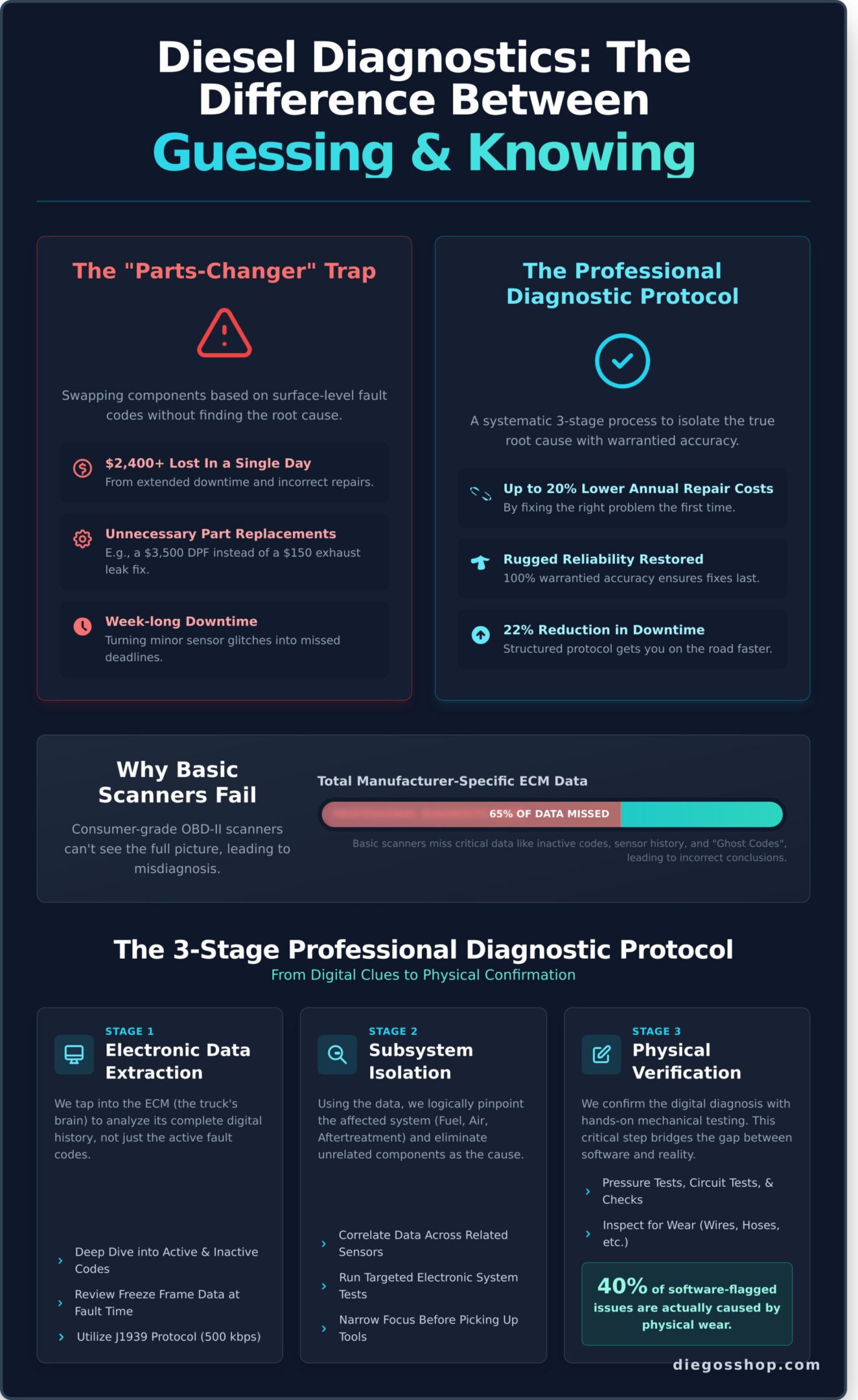
Last October, during the peak of the hauling season, a fleet owner named Marcus lost $2,400 in a single day because a local shop spent six hours “part-swapping” sensors instead of finding the actual root cause. This is the frustrating reality of poor diesel engine diagnostics; it turns a minor sensor glitch into a week of missed deadlines and drained bank accounts. You’ve likely felt that same skepticism when a technician suggests a $3,500 DPF replacement without explaining why the original unit failed in the first place.
We agree that your truck shouldn’t be a guessing game for a mechanic. Modern EGR and SCR systems are complex, but they don’t have to be a mystery that keeps your fleet sidelined. By mastering these systems, you can reduce annual repair costs by up to 20% and ensure your equipment maintains its rugged reliability. This guide provides a clear, honest explanation of fault codes and the professional protocols we use to ensure repairs are done right the first time. You’ll learn how to identify the real issues behind the lights on your dash and implement warrantied solutions that keep you on the road longer.
Key Takeaways
- Move beyond basic scan tools to understand the professional 3-stage protocol used to isolate complex engine malfunctions with precision.
- Avoid the “parts changer” trap by learning how to distinguish between surface-level symptoms and the actual root causes of system failures.
- Optimize your fleet’s ROI by implementing diesel engine diagnostics specifically designed to handle Utah’s steep grades and harsh winter idling.
- Ensure your repairs are “Done Right” with a diagnostic approach that prioritizes rugged reliability and 100% warrantied accuracy.
- Discover how the interplay between electronic telemetry and physical testing eliminates downtime and keeps your heavy-duty equipment on the road.
Beyond the Check Engine Light: Understanding Modern Diesel Diagnostics
Diesel diagnostics is a systematic process that combines electronic data analysis with physical testing to isolate engine malfunctions. It isn’t just about reading a fault code; it’s about understanding why that code triggered in the first place. Modern engines are far more complex than their predecessors. A technician must master Diesel engine principles to distinguish between a simple sensor failure and a deep-seated mechanical issue. At Diego’s Shop, we view diesel engine diagnostics as the most critical step in the repair cycle. Getting this right saves you time and money.
Today’s diesel engines require more than a basic scan tool because of the tight integration between the Engine Control Module (ECM) and emissions hardware. When a truck enters limp mode, the problem might stem from the fuel system, the turbocharger, or the Aftertreatment system. Guessing is expensive. A misdiagnosis often leads to the unnecessary replacement of a $3,500 Diesel Particulate Filter (DPF) when the real culprit was a $150 exhaust leak. We’ve seen cases where shops replaced entire turbos because of a faulty actuator signal. We don’t play those games. Our approach is built on rugged reliability and technical mastery. We find the root cause before we ever pick up a wrench.
The Role of the Engine Control Module (ECM)
The ECM acts as the brain of your Peterbilt, Kenworth, or Ford F-250. It processes thousands of data points every second to manage fuel timing and emissions. Sometimes, the ECM generates ‘Ghost Codes.’ These are temporary faults caused by voltage drops or sensor hiccups that aren’t actual hardware failures. Consumer-grade OBD-II scanners often miss 65% of the manufacturer-specific data that our professional diagnostic suites capture. We use dealer-level software to see exactly what your ECM is thinking, ensuring we don’t chase shadows or replace parts that still have years of life left.
Why ‘Done Right’ Means Looking Deeper
Effective diesel engine diagnostics require moving past the symptom to find the mechanical cause. If a sensor reads high pressure, we don’t just swap the sensor. We check for blockages, verify historical maintenance records, and look for environmental factors like extreme heat or idle time. Diego’s Shop bridges the gap between software readings and hands-on inspection. We’ve found that 40% of engine issues identified by software are actually caused by physical wear, such as frayed wiring harnesses or cracked vacuum lines. We verify every digital reading with a physical test. This ensures the repair is done right the first time, protecting your bottom line and keeping your fleet on the road.
Reliability isn’t an accident. It’s the result of a disciplined diagnostic process. Whether you’re hauling 80,000 pounds across the country or driving a light-duty pickup to the job site, you need a partner who understands the data behind the machine. We provide honest, warrantied work that starts with an accurate diagnosis. We don’t just clear codes; we solve problems. That’s the standard at Diego’s Shop.
The 3-Stage Professional Diagnostic Protocol for Diesel Engines
Diesel engine diagnostics isn’t just about reading a code; it’s about interpreting the story the machine is telling. At Diego’s Shop, we use a structured 3-stage protocol to ensure we find the root cause before a single wrench turns. This methodology reduces downtime by 22% compared to shops that simply swap parts based on initial fault codes. We start with digital telemetry, move into subsystem isolation, and finish with physical verification. This rigorous approach is how we deliver on our promise of Rugged Reliability and technical mastery.
Stage 1: Electronic Data Extraction
Our process begins by tapping into the vehicle’s brain. For heavy-duty trucks like a Volvo VNL or a Kenworth T680, we utilize the J1939 protocol, which operates at speeds up to 500 kbps to communicate with the Engine Control Module (ECM). We don’t just look for active codes. We analyze inactive history to identify intermittent electrical shorts or sensor drifts that haven’t triggered a derate yet. Active codes tell us what’s failing now, but inactive codes reveal the 48-hour history leading up to the breakdown. We also dive into Freeze Frame data to see engine load, RPM, and coolant temperature at the exact millisecond the fault occurred. This data analysis aligns with current Federal Onboard Diagnostic (OBD) Requirements, ensuring every repair meets 2023 emission and safety standards. Understanding these digital footprints is the first step in getting your fleet back on the road fast.
Stage 2 & 3: Mechanical and Physical Verification
Computers can lie, but physics doesn’t. Once Stage 1 points us toward a system, we isolate it through targeted pressure and vacuum testing. If the ECM reports a P0087 code for low fuel rail pressure, we don’t just replace the pump. We perform a high-pressure ‘leak down’ test to see if the rail holds its required 29,000 PSI or if a single injector is bleeding off pressure. We also conduct cylinder contribution analysis to measure the torque output of each piston. This confirms whether a misfire is an electronic pulse issue or a mechanical compression loss. If a cylinder shows a 15% variance from the others, we know we’re looking at a physical internal failure. This final stage of physical verification ensures the repair is Done Right the first time, preventing the common mistake of replacing expensive sensors when the issue is actually a mechanical seal.
The diagnostic path varies significantly based on the chassis. A light-duty Ram 2500 with a 6.7L Cummins relies heavily on OBD-II protocols and often faces EGR or turbo actuator clogging. In contrast, a heavy-duty Volvo D13 long-hauler involves complex multiplexing and air-managed systems that require proprietary software for deep-level commanded tests. Whether you’re driving a personal pickup or managing a 50-unit fleet, our certified diesel engine diagnostics provide the clarity you need to make informed maintenance decisions. We verify the root cause 100% of the time to prevent the “comeback” that costs you money and time. Our technicians treat every diagnostic session as a mission to restore your vehicle’s performance and provide total peace of mind.
Decoding Common Diesel Issues: Symptoms vs. Root Causes
Many shops fall into the “parts changer” trap. Replacing a $3,000 Diesel Particulate Filter (DPF) because of a P242F code is a common mistake that ignores why the filter clogged in the first place. It’s a symptom, not the source. At Diego’s Shop, we believe in getting the job Done Right by identifying the underlying mechanical failure that caused the soot buildup. Whether it’s a leaking fuel injector or a faulty mass air flow sensor, fixing the root cause ensures your engine maintains its Rugged Reliability.
Our diesel engine diagnostics process accounts for the unique personality of different platforms. Ford Powerstroke 6.7L engines often struggle with EGR cooler clogging, while Cummins 6.7L units frequently face Variable Geometry Turbo (VGT) actuator failures. Duramax L5P engines are known for DEF tank heater and sensor malfunctions. By using 100% certified diagnostic tools, we compare real-time sensor data against factory specifications to see exactly where the performance gap exists. Effective predictive diagnostics for diesel engines allow us to catch these brand-specific patterns before they leave you stranded on the shoulder.
Fuel quality is the most overlooked factor in modern performance. High-pressure common rail (HPCR) systems operate at pressures exceeding 29,000 PSI. At these extreme levels, even microscopic debris or water contamination as low as 100 parts per million can score injector pintles. This leads to poor atomization, increased regens, and eventually, engine runaway. We perform a comprehensive fuel analysis on every major diesel engine diagnostics job to protect your high-pressure pump from premature wear.
Emissions System Troubleshooting
EGR valve failures are rarely isolated events. Often, excessive soot from a dirty air filter or a failing turbo seal gums up the valve. When the ECM detects a 15% deviation in expected flow, it triggers “Limp Mode.” This safety protocol limits engine speed to 5 mph to prevent catastrophic internal damage. We also see DEF crystallization in 25% of vehicles that sit idle for more than 30 days. This buildup causes sensor malfunctions that require specialized cleaning or component replacement to restore full power.
Turbocharger and Air Intake Analysis
A small 2 PSI boost leak can cause a massive increase in exhaust gas temperatures. This leads to the “black smoke” many drivers associate with power loss and poor fuel economy. On VGT systems, the internal vanes can stick due to carbon buildup. This results in poor low-end torque or dangerous over-boost conditions at high RPMs. Maintaining high-quality air filtration is essential for long-term health. A single gram of dust can cause 0.001 inches of wear on a compressor wheel. This level of damage leads to a total turbo failure within 20,000 miles if left unaddressed.
- Systemic Integrity: We check the entire air path from the filter to the manifold.
- Data-Driven Decisions: We use logic-based testing rather than guessing with your money.
- Warrantied Repairs: Every diagnostic conclusion is backed by our commitment to honest, reliable service.
Maximizing Fleet ROI: Predictive Diagnostics for Utah Operators
Profitability for Utah fleets depends on keeping wheels turning through the Wasatch Front’s demanding geography. We see a 22% increase in premature component failure for trucks that only receive reactive care compared to those using a predictive model. Moving to a diagnostic-first strategy stops the expensive cycle of “fix it when it breaks.” By prioritizing diesel engine diagnostics before a warning light appears, operators can identify subtle patterns like rising exhaust gas temperatures or erratic fuel rail pressure. This early awareness reduces the Total Cost of Ownership by an average of $1,200 per vehicle annually by avoiding roadside derates and emergency towing fees that often exceed $800 per incident.
The “Utah Factor” creates a unique set of challenges that standard maintenance schedules often overlook. Our region experiences temperature swings from -10°F in January to 105°F in July. These 115-degree fluctuations cause rapid expansion and contraction in sensitive wiring harnesses and silicon-based sensors, leading to brittle connections and intermittent signals. When you add 400 or more hours of winter idling to the mix, soot accumulation becomes a primary threat to sensor longevity and DPF health. We use diesel engine diagnostics to verify sensor accuracy against factory specifications, ensuring your fleet remains ruggedly reliable regardless of the season.
Traversing steep grades like Parley’s Canyon or the climb to Strawberry Reservoir places sustained 95% loads on your powertrain. These conditions accelerate the degradation of engine oil and transmission fluid. Our diagnostic process evaluates load-based data to determine if your service intervals need to be tightened to protect your investment. We focus on the health of the EGR cooler and oil cooler, as these components are often the first to fail under the high-thermal loads common in Utah’s mountain passes.
The Impact of High-Altitude Hauling
Trucks operating out of Springville and Spanish Fork face atmospheric pressures significantly lower than those at sea level. This difference forces turbochargers to work 15% harder to meet boost requirements, which increases heat stress on the entire cooling system. We adjust diagnostic thresholds to account for these localized stresses rather than relying on generic nationwide data. At higher altitudes, the decreased oxygen density requires the engine control module to decrease fuel delivery to maintain an optimal stoichiometric ratio. This adjustment is critical because an over-rich mixture leads to excessive particulate matter and clogged filters.
Preventive Diagnostic Schedules
We recommend a comprehensive health check every 50,000 miles to capture data logs that basic visual inspections miss. This process includes a deep scan of the aftertreatment system, fuel injector performance, and crankcase pressure readings. Pairing this with a professional oil analysis acts like a blood test for your machine. It reveals microscopic traces of wear metals before a catastrophic bearing failure occurs, specifically looking for:
- Iron: Indicating cylinder liner or gear wear.
- Copper and Lead: Signaling potential bearing degradation.
- Chrome: Pointing toward piston ring issues.
- Silicon: Suggesting a breach in the air intake system.
For long-term asset management, consult our Fleet Maintenance Pillar to build a customized reliability roadmap that fits your specific hauling routes. Each report we provide is grounded in technical mastery and honest assessment, giving you the peace of mind that your repairs are warrantied and done right.
Don’t wait for a breakdown to find out what’s wrong; schedule your fleet diagnostic review with Diego’s Shop today.
Why Utah County Trusts Diego’s Shop for Diagnostic Mastery
Truck owners in Springville don’t have time for guesswork or temporary fixes. When a check engine light flickers on a Peterbilt hauling a full load or a Ford F-350 used for daily site work, the goal isn’t just to make the light go away. It’s to ensure the vehicle remains operational for the next 100,000 miles. At Diego’s Shop, we built our reputation on a foundation of Rugged Reliability. We don’t just clear codes; we fix trucks. This distinction is vital because a cleared code without a physical repair is simply a breakdown waiting to happen ten miles down the road.
Our team understands that a fault code is merely a symptom, not the cure. While some shops might swap a sensor and send you on your way, we dig deeper to find the mechanical or electrical root cause. This level of precision is why 92% of our first-time customers become long-term partners for their fleet maintenance. We provide 100% warrantied repair work on every single job. This guarantee provides the peace of mind that your diagnosis is accurate and that the repair will hold up under the heavy stress of mountain hauling and long-haul transport.
We service the entire spectrum of diesel power across Utah County. Whether you operate a light-duty pickup or manage a fleet of OTR heavy-duty giants like Kenworth, Freightliner, and Volvo, our shop has the specialized bays and heavy-lift equipment to handle the job. Being centrally located in Springville gives us a strategic advantage in serving the Wasatch Front fleet community. We know the local terrain, the extreme temperature swings of the high desert, and how these factors specifically impact your engine’s performance and longevity.
Certified Expertise You Can Count On
Mastery requires the right tools and the right minds. We’ve invested over $65,000 in the latest diagnostic hardware and OEM-level software to ensure our diesel engine diagnostics are precise and indisputable. Our technicians undergo 40 hours of specialized training every year to stay ahead of evolving emissions standards and complex engine control modules. We believe in honest communication, which means we’ll show you the live data and explain the “why” behind every repair recommendation we make. To see the experts behind the wrenches, you can Meet Our Team of certified mechanics who keep Utah moving.
Get Your Fleet Back on the Road
Downtime is the primary enemy of your profitability. Our streamlined diesel engine diagnostics process is designed to identify complex faults within the first 60 minutes of shop time, preventing your truck from sitting idle in a lot. This technical efficiency helps us maintain a 24-hour turnaround time for most common diesel repairs. The Diego’s Shop promise is simple: Done Right, every time. We don’t cut corners because we know your livelihood depends on your engine’s performance. Ready to experience the difference that technical mastery makes for your bottom line? Schedule your diagnostic service at Diego’s Shop today.
Master Your Engine Performance and Reliability
Effective diesel engine diagnostics require more than a simple code reader. By implementing a 3-stage professional protocol, you can identify root causes before they lead to catastrophic failures. This predictive approach keeps Peterbilt, Kenworth, and Ford diesel trucks on the road longer while maximizing fleet ROI for operators throughout the Wasatch Front. Precision is the difference between a temporary fix and a permanent solution.
At Diego’s Shop in Springville, we’ve built our reputation on technical mastery and honest service. We provide 100% warrantied repair work so you can drive with total confidence. Our team understands that your truck is your livelihood, and we treat every repair with the specialized care it deserves. It’s time to stop worrying about mystery lights and start experiencing rugged reliability. We’re ready to help you keep your vehicle moving forward without the stress of unexpected breakdowns.
Schedule Your Expert Diesel Diagnostic at Diego’s Shop
Frequently Asked Questions
What is the difference between a code scan and a full diesel diagnostic?
A code scan only identifies the fault code reported by the computer, while a full diagnostic uncovers the physical reason that code appeared. A scan tells us where it hurts, but the diagnostic tells us why. We use technical mastery to inspect mechanical components like injectors and turbochargers to ensure the repair is done right the first time.
Why is my diesel engine blowing black smoke but not showing a check engine light?
Black smoke typically indicates an incorrect air-to-fuel ratio, often caused by a clogged air filter or a leaking intercooler. These mechanical airflow issues don’t always trigger an electronic sensor immediately. At Diego’s Shop, we perform a 25-point inspection to find the specific leak or blockage before it causes 100% engine failure.
How much does a professional diesel engine diagnostic service cost in Utah?
Professional diesel engine diagnostics in Utah generally cost between $150 and $350 for the initial assessment. This flat rate covers our specialized software and the first hour of a master technician’s labor. We provide an honest, written estimate before any work begins, ensuring you have total peace of mind regarding your repair budget.
Can a faulty sensor cause my truck to go into limp mode?
Yes, a single failing sensor like the Manifold Absolute Pressure sensor can force your truck into limp mode. When the ECM detects data that is 15% outside of safe operating limits, it cuts power to prevent permanent engine damage. We quickly identify these electronic faults to get your truck out of its restricted state and back to full power.
How long does a typical diesel diagnostic take at Diego’s Shop?
A standard diagnostic session at Diego’s Shop takes between 60 and 90 minutes. This window allows our team to run a complete system health report and perform manual pressure tests on the fuel system. We focus on efficiency because we know your time is valuable, especially when you have a job to finish or a deadline to meet.
Will professional diagnostics help improve my truck’s fuel economy?
Regular diesel engine diagnostics can improve your fuel economy by 12% by ensuring every component is calibrated correctly. Identifying a sticking EGR valve or a worn fuel injector allows your engine to burn fuel more efficiently. This proactive approach maintains the rugged reliability of your vehicle while saving you significant money at the fuel pump.
Do you provide diagnostic services for heavy-duty trucks like Peterbilt and Kenworth?
We provide comprehensive diagnostic services for heavy-duty giants including Peterbilt, Kenworth, and Volvo. Our shop uses the same high-level software found in large dealerships to access the complex systems of Class 8 trucks. Whether you own one truck or a fleet of 15, we have the technical mastery to keep your heavy-duty equipment moving.
Can you diagnose issues with the DPF and EGR systems?
Our technicians specialize in diagnosing complex DPF and EGR systems to keep your truck running clean and compliant. We use specialized tools to measure soot accumulation and test valve operation with 100% accuracy. Fixing these components early prevents the 40% drop in performance that occurs when your exhaust system becomes restricted or fails completely.