

Diagnosing a Knocking Sound in a Diesel Engine: A 2026 Guide for Fleet Owners

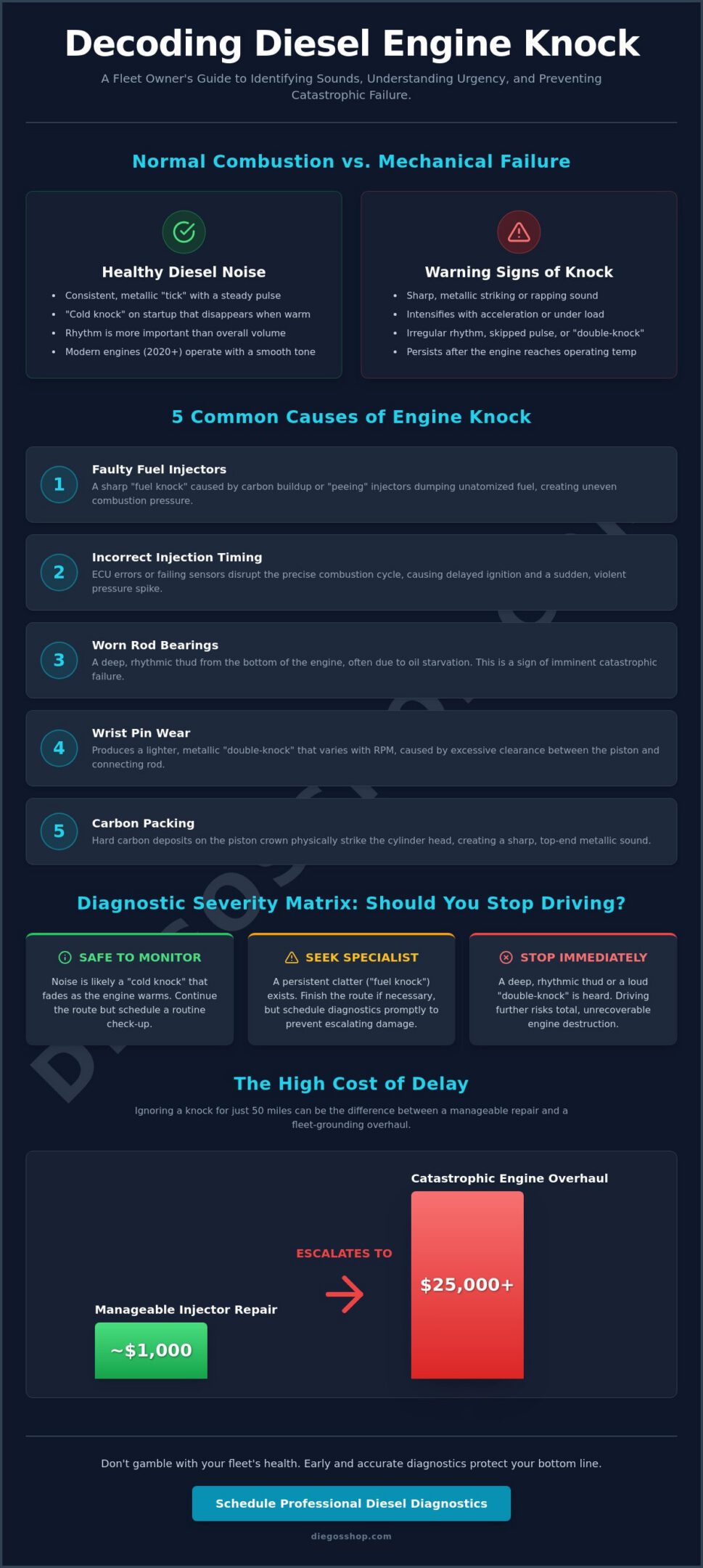
The difference between a manageable injector repair and a $25,000 engine overhaul is often just fifty miles of driving. You know that your fleet is the backbone of your revenue, and hearing an unfamiliar knocking sound in a diesel engine is enough to cause any owner immediate stress. It’s a sound that signals uncertainty, especially when you’re worried about vehicle downtime and the risk of a general mechanic misdiagnosing a complex technical issue.
This guide provides the technical clarity you need to regain control and protect your bottom line. You’ll learn how to distinguish between minor timing issues and the mechanical warnings of catastrophic failure before your truck ends up on a hook. We’ll outline how to accurately identify the sound source and provide a clear urgency matrix so you know when to seek a specialist in the Wasatch Front to maintain your fleet’s integrity.
Key Takeaways
- Learn to distinguish between the standard rhythm of compression ignition and the irregular mechanical interference that signals internal damage.
- Identify the five most common triggers for a knocking sound in a diesel engine, ranging from carbon-clogged injectors to critical timing errors.
- Use the diagnostic severity matrix to determine if a vehicle is safe to continue its route or if an immediate shutdown is required.
- Understand how early intervention prevents minor issues from escalating into a catastrophic hole in the piston or a broken crankshaft.
- Discover why specialized diagnostic tools are essential for maintaining the performance and emissions compliance of modern heavy-duty fleets.
Understanding Diesel Knock: Normal Combustion vs. Mechanical Failure
Distinguishing between a healthy engine and a failing one starts with understanding exactly what you’re hearing. Every diesel engine has a characteristic rattle, but a true engine knocking sound in a diesel engine signals a deviation from the controlled combustion process. While older workhorses were known for their deafening clatter, modern engines manufactured from 2020 onwards should operate with a much smoother, muted tone. If your late-model fleet vehicle suddenly sounds like a gravel mixer, you’re likely dealing with mechanical interference or a severe timing malfunction.
Diesel knock is the result of a delayed ignition causing a sudden pressure spike.
To perform a basic diagnostic “ear test,” listen to the engine at a warm idle and then again under load. A healthy engine maintains a steady, rhythmic pulse. If the sound turns into a sharp, metallic strike that intensifies as the driver accelerates or climbs a grade, the issue has moved beyond simple combustion noise and into the territory of potential internal damage. You should pay close attention to whether the sound disappears when the engine is warm or if it persists through the entire shift.
The Science of Compression Ignition
The “clatter” you hear is actually the sound of rapid pressure changes within the cylinder. In a perfect cycle, the air-fuel mixture ignites precisely at the top of the compression stroke. Modern common-rail systems use pilot injection, which is a small pre-shot of fuel that stabilizes the combustion temperature before the main injection occurs. This technology significantly reduces noise levels. However, in high-elevation areas like the Wasatch Front, thinner air can alter these combustion pressures. Without proper sensor calibration, this environmental factor can cause even a healthy engine to sound slightly more aggressive than it would at sea level.
Identifying ‘Healthy’ Diesel Noise
A well-maintained Cummins or PowerStroke engine should have a consistent, metallic “tick” that stays uniform. During cold-weather mornings in Springville, it’s normal for these engines to sound louder for several minutes. The oil is thicker, and the cylinders are cold, which delays the ignition process. This is often called “cold knock” and should disappear as the block reaches operating temperature. You should focus more on the rhythm than the volume. A change in the beat, such as a skipped pulse or a double-knock, is a much higher priority than a general increase in idle noise. Consistent rhythm indicates integrity; irregular sounds indicate a looming repair.
5 Common Causes of a Knocking Sound in a Diesel Engine
Identifying the source of a knocking sound in a diesel engine requires a systematic approach. Most issues stem from either the fuel delivery system or internal mechanical wear. Understanding these five common causes helps you communicate clearly with your technician and decide when to pull a truck off the road to prevent a total loss.
- Faulty Fuel Injectors: Carbon buildup or “peeing” injectors create a “fuel knock” by dumping unatomized fuel into the combustion chamber. This leads to uneven pressure and a sharp clatter that often mimics mechanical failure.
- Incorrect Injection Timing: ECU errors or failing sensors disrupt the combustion cycle. This creates a knocking sound in a diesel engine that sounds like the components are fighting against each other.
- Worn Rod Bearings: A deep, rhythmic thud from the bottom of the engine indicates that the bearings are failing. This is usually caused by oil starvation or extreme high mileage and is a sign of imminent catastrophic failure.
- Wrist Pin Wear: This produces a lighter “double-knock” that varies with engine RPM. It occurs when the clearance between the piston and the connecting rod becomes excessive, causing the pin to strike the piston twice during each revolution.
- Carbon Packing: Hard deposits on the piston crown can eventually strike the cylinder head. This creates a sharp, top-end metallic sound that fleet owners often mistake for a valve issue.
The ‘Injector Knock’ vs. Mechanical Knock
Isolating a fuel-related knock is a critical first step. You can use a mechanic’s stethoscope or even a long screwdriver pressed against the injector body to listen for irregularities. If you have the diagnostic tools to cut fuel to a specific cylinder and the noise vanishes, you’ve identified a fuel knock. This is often a simpler fix than internal mechanical work. However, ignoring a leaking injector is a gamble you shouldn’t take. A “peeing” injector can quickly lead to melted pistons. If you suspect your fuel system is failing, professional diesel engine repair is the only way to safeguard your equipment.
External Factors: Bad Fuel and Cold Starts
Environmental conditions in the Wasatch Front play a major role in how your engine sounds. Low cetane fuel increases ignition delay, which results in a louder, more aggressive rattle during the combustion stroke. Utah’s harsh winter temperatures also contribute to significant startup noise. When the thermometer drops, oil takes longer to circulate. While some initial rattle is expected in sub-zero weather, a persistent knock means the oil isn’t reaching critical components fast enough. Consistent fleet maintenance and using high-quality winter fuel blends are your best defenses against these timing-related issues.
Diagnostic Severity Matrix: Should You Stop Driving?
When a driver reports a knocking sound in a diesel engine, the dispatcher’s first priority is determining the risk of catastrophic failure. You can’t rely on vague descriptions like “it sounds weird.” Your fleet needs a standardized reporting framework to distinguish between a nuisance and a total loss. This matrix allows you to make an informed decision based on the sound’s characteristics, the engine’s physical symptoms, and the current operating conditions in the Wasatch Front.
The “Load Test” is your most effective field diagnostic. Instruct the driver to monitor the sound while accelerating or climbing a grade. If the knock intensifies under load, you’re likely dealing with a mechanical issue like a rod bearing or wrist pin. If the sound remains constant or diminishes as RPMs increase, the issue might be fuel-related. You should also check the exhaust smoke. White smoke often points to unburnt fuel from a faulty injector or timing error. Black smoke suggests a rich fuel mixture, while blue smoke indicates the engine is burning oil, which often accompanies internal wear and knocking.
Monitoring the oil pressure gauge provides the final piece of the puzzle. If a deep, rhythmic knock is paired with a drop in oil pressure, the rod bearings have likely failed. In this scenario, the engine is no longer safely operational. Continuing to drive will result in a thrown rod, which can destroy the engine block and turn a repairable issue into a $25,000 replacement. Professional fleet maintenance protocols require an immediate shutdown when these symptoms align.
Sound vs. Likely Cause vs. Urgency
- High-pitched ticking: This often indicates a valve train issue or a minor injector “tick.” It’s generally safe to finish the shift, but you should schedule service within the week.
- Fast rattling or metallic clatter: This usually points to a loose heat shield or a fuel timing error. You should have a technician inspect the vehicle within 24 hours to prevent secondary damage.
- Deep, heavy thumping: This is the signature of a failing rod bearing. You must stop driving immediately and call for a tow to avoid total engine destruction.
Performance Symptoms to Watch For
Mechanical failure rarely happens in a vacuum. A rhythmic knock combined with a noticeable loss of power suggests the engine is struggling to maintain compression. You should also feel for excessive vibration through the steering wheel or floorboards, as this indicates a balance issue within the rotating assembly. Finally, check for “blow-by” by carefully removing the oil fill cap while the engine idles. If smoke or pressure pulses heavily out of the filler neck, the piston rings or cylinder walls are likely compromised. These symptoms combined with a knocking sound in a diesel engine mean the vehicle is a liability on the road.
The High Cost of Delay: From Minor Repair to Engine Replacement
Ignoring a knocking sound in a diesel engine is a gamble with your fleet’s profitability. A small vibration or a faint metallic tick can quickly escalate into a catastrophic engine failure that sidelines a vehicle for weeks. Many fleet owners make the mistake of waiting for a fault code to appear on the dashboard. However, mechanical knocks, such as those caused by a failing rod bearing or a wrist pin, often don’t trigger a Check Engine Light until the damage is irreversible. Catching these issues early is critical. Diesel engine repair caught early is 70% cheaper than a full rebuild.
When a rod bearing fails, it creates what technicians call the “shrapnel effect.” The bearing material disintegrates, sending metallic debris through the oiling system and scoring the crankshaft. If the rod eventually snaps, it can punch a hole through the engine block, turning a repairable bottom-end job into a total engine replacement. Similarly, a faulty injector that “pees” fuel instead of misting it will eventually burn a hole through the piston crown. This leads to a total loss of compression and requires an expensive out-of-frame overhaul that could have been avoided with a simple injector swap.
Piston and Cylinder Wall Integrity
Pre-ignition knocking creates extreme thermal stress that the engine wasn’t designed to handle. This heat causes the piston to expand beyond its tolerances, leading to “scuffing” against the cylinder walls. Once the cross-hatching on the walls is destroyed, the engine loses its ability to hold oil and maintain compression. Utilizing specialized diesel diagnostics services allows you to identify these thermal imbalances before they result in permanent metallurgical damage. Protecting the integrity of the cylinder walls is the difference between a mid-life service and a premature engine death.
The ROI of Preventive Maintenance
Proactive management is the only way to avoid the $25,000 to $40,000 price tag of a modern engine rebuild. Implementing structured fleet maintenance programs can reduce emergency repair costs by 40% by catching wear before it becomes audible. Oil analysis is a powerful tool in this process. It detects trace amounts of bearing copper or lead long before you hear a knocking sound in a diesel engine. Relying on warrantied repair work ensures that your investment is protected and your trucks stay on the road where they belong.
If your engine has started talking to you, it’s time to listen. Contact Diego’s Shop today to schedule a professional diagnostic before a minor knock becomes a major loss.
Professional Diesel Diagnostics in Springville, Utah
Reliability is the only currency that matters in fleet management. When your equipment develops a knocking sound in a diesel engine, you need more than a guess; you need a definitive diagnosis backed by technical mastery. Diego’s Shop has earned its reputation as the preferred partner for fleet managers across Utah County by combining decades of hands-on experience with the most advanced diagnostic technology available in 2026. We don’t just fix trucks; we restore the dependability of your entire operation.
Our technicians maintain total control over complex engine failures across a wide range of manufacturers. Whether you operate a fleet of heavy-duty Peterbilt and Kenworth trucks or rely on the versatility of Isuzu and Ford powerplants, we speak your equipment’s language. We understand that a truck sitting in a bay is a truck losing revenue. That’s why our service protocols focus on accuracy and durability, ensuring that every repair is a long-term solution rather than a temporary patch. Our commitment to the Wasatch Front is built on a foundation of integrity and technical excellence.
Advanced Diagnostic Technology
Pinpointing the exact origin of a knocking sound in a diesel engine requires tools that go far beyond the traditional mechanic’s stethoscope. We utilize OEM-level diagnostic software to monitor real-time data on timing, fuel delivery, and cylinder pressure. This level of precision allows us to identify whether a knock is a software-driven timing error or a physical mechanical interference. General repair shops often lack this specialized focus, which leads to misdiagnosis and unnecessary parts replacement. By concentrating exclusively on light, medium, and heavy-duty diesel engines, we catch the subtle signs of early-stage failure that others simply miss. This specialized approach protects your bottom line from the high cost of trial-and-error repairs.
Fleet-Specific Support and Reliability
A one-size-fits-all approach doesn’t work for high-mileage commercial operations. We develop customized maintenance protocols that align with your specific route demands and load requirements. Our location in Springville provides convenient, centralized access for fleets operating throughout the Wasatch Front. We stand behind our work with comprehensive performance guarantees, providing you with the peace of mind that comes from knowing your repairs are warrantied and your drivers are safe. Don’t let a minor vibration turn into a catastrophic engine loss. You can schedule your diesel diagnostic at Diego’s Shop today to keep your fleet moving with confidence.
Protect Your Fleet and Your Bottom Line
A knocking sound in a diesel engine is a clear signal that your equipment requires professional attention. By applying the severity matrix and prioritizing early detection, you prevent minor injector issues from escalating into catastrophic engine failures. Protecting your revenue depends on making the right call before a vehicle is forced off the road by a broken rod or a melted piston. Accurate diagnostics and consistent maintenance are your best defenses against the high costs of unplanned downtime.
At Diego’s Shop, we provide the technical expertise and peace of mind you need to keep your operation moving. We specialize in warrantied repair work for heavy-duty and light-duty brands, including Peterbilt, Kenworth, and Ford PowerStroke. Our team serves fleet owners throughout Utah County and the Wasatch Front with a commitment to integrity and durable results. Don’t leave your engine’s health to chance when specialized help is just a call away.
Book Your Diesel Diagnostic at Diego’s Shop in Springville and secure the long-term reliability of your fleet today.
Frequently Asked Questions
Is a ticking sound always a sign of a bad diesel engine?
No, a light ticking sound is often just the normal operation of high-pressure fuel injectors or the fuel pump. Modern diesel engines have a natural rhythmic click that shouldn’t cause alarm. However, if the tick develops into a heavy rhythmic tap that gets louder as the engine speeds up, it could indicate excessive valve lash or a failing injector. You should monitor any change in the sound’s volume or beat.
Can bad fuel cause my diesel engine to knock?
Yes, low cetane fuel or water contamination can lead to a knocking sound in a diesel engine. Poor fuel quality causes an increased ignition delay, which creates a sharp pressure spike when the fuel finally ignites. This is often called a “fuel knock.” It sounds very similar to mechanical failure but can usually be resolved by draining the fuel system and using high-quality, treated diesel.
How much does it cost to fix a knocking diesel engine?
Repair costs vary depending on whether the issue is a fuel system component or an internal mechanical failure. A single injector replacement is a fraction of the price of an engine rebuild. Industry data for 2026 indicates that an in-frame overhaul can cost between $15,000 and $25,000. Early diagnosis is the most effective way to keep your repair expenses at the lower end of the spectrum.
Can I drive my truck with a fuel injector knock?
You shouldn’t drive a truck with a known injector knock for more than a few miles to reach a shop. A “peeing” injector that drips fuel instead of misting it can burn a hole through a piston in a matter of hours. This turns a relatively simple fuel system repair into a catastrophic engine failure that requires a complete and expensive out-of-frame rebuild.
What is the difference between ‘cold knock’ and a permanent engine knock?
A cold knock occurs only during initial startup in low temperatures and disappears as the block reaches operating temperature. This happens because cold cylinders delay the combustion process. A permanent engine knock persists regardless of the engine’s temperature. If the sound doesn’t go away after ten minutes of driving, it usually signals a mechanical problem like a worn rod bearing or a damaged wrist pin.
Why does my diesel engine knock louder when I accelerate?
Acceleration puts the engine under higher thermal and physical stress. If a mechanical component like a rod bearing is worn, the increased force makes the knocking sound in a diesel engine much more audible. This is also when timing errors become most apparent. If the sound sharpens or intensifies as you press the pedal, the engine is struggling to manage the increased combustion pressures and requires immediate inspection.
What should I do if my oil pressure drops while hearing a knocking sound?
You must shut the engine down immediately and call for a tow. A drop in oil pressure combined with a deep, heavy knock is the classic signature of a failed rod bearing. If you continue to run the engine, the lack of lubrication will cause the rod to snap or seize. This will likely destroy the crankshaft and the engine block, making the engine impossible to rebuild.
Does Utah’s high altitude make diesel engines louder?
The thinner air at high altitudes in the Wasatch Front can affect combustion pressure and timing. While modern engines use sensors to compensate for elevation, the change in air density can sometimes lead to a more pronounced “diesel rattle” during heavy loads. However, a sharp or irregular knock is never normal. It shouldn’t be dismissed as an altitude effect without a professional diagnostic check.