

Developing a Fleet Preventive Maintenance Plan for Diesel Reliability in 2026

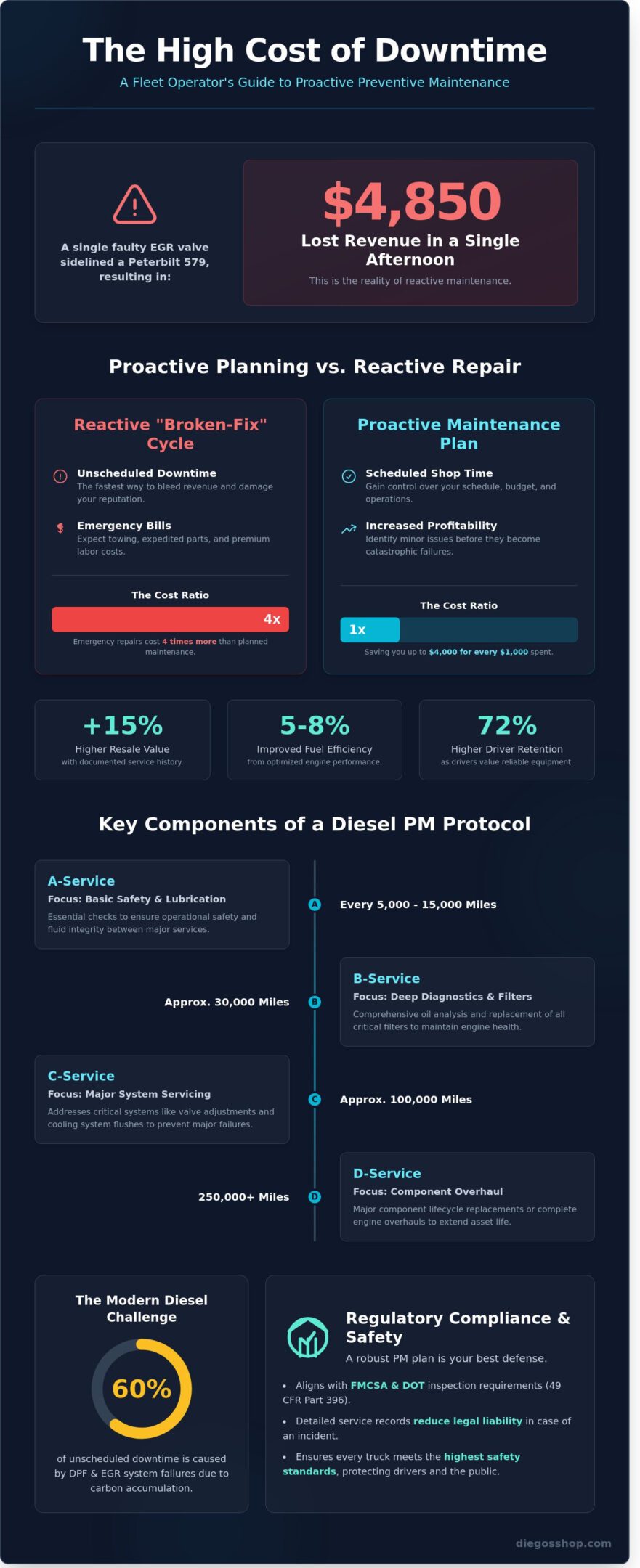
Last Tuesday, a fleet operator watched $4,850 vanish in a single afternoon because a faulty EGR valve sidelined a Peterbilt 579 during a time-sensitive delivery. It’s a scenario we see too often. You understand that unexpected downtime is the fastest way to bleed revenue, especially with the rising complexity of modern diesel emission systems. Implementing a structured fleet preventive maintenance plan is the only way to stop these $1,200 emergency roadside bills and the constant stress of looming DOT inspections.
At Diego’s Shop, we believe in doing things right the first time. This guide will show you how to build a technical maintenance protocol that eliminates unexpected failures and extends the life of your commercial diesel assets well into 2026. We’ll preview the exact inspection cycles and diagnostic mastery required to lower your total cost of ownership and keep your budget predictable. It’s time to stop guessing and start operating with the confidence that your fleet is built on rugged reliability.
Key Takeaways
- Identify minor issues early to stop catastrophic failures before they start, ensuring your commercial assets stay on the road.
- Discover the essential elements of a technical fleet preventive maintenance plan that prioritizes complex diesel diagnostics over simple oil changes.
- Master data-driven scheduling to minimize operational downtime and ensure your vehicles are only in the shop when necessary.
- Prepare your fleet for the Wasatch Front’s unique challenges by addressing the impact of high elevation and steep grades on cooling systems.
- Learn why partnering with a specialized diesel shop provides the technical mastery needed to guarantee your fleet’s rugged reliability.
What is a Fleet Preventive Maintenance Plan?
A fleet preventive maintenance plan is a proactive strategy for scheduled vehicle inspections and services. It focuses on technical mastery rather than reacting to failures. Instead of waiting for a warning light to flash, this approach identifies and rectifies minor issues before they escalate into catastrophic mechanical failures. It’s the definitive line between profitable scheduled shop time and expensive emergency roadside downtime. Every diesel engine, from a light-duty pickup to a heavy-duty hauler, requires a disciplined schedule to stay on the road. The core objective is maximizing the Rugged Reliability of every asset in the fleet, ensuring your equipment works as hard as you do.
Effective Preventive maintenance involves more than just oil changes. It’s a comprehensive diagnostic process that monitors the health of critical systems like turbochargers, fuel injectors, and aftertreatment components. When you implement a structured fleet preventive maintenance plan, you move away from the chaos of “broken-fix” cycles. You gain control over your schedule, your budget, and your reputation. In the diesel service industry, we know that a well-maintained truck is a badge of honor for any fleet owner. It shows a commitment to quality and a respect for the machinery that drives the business forward.
The Financial Impact of Proactive vs. Reactive Maintenance
The numbers don’t lie when it comes to the bottom line. Industry data consistently shows a 4:1 cost ratio between emergency repairs and planned maintenance. This means for every $1,000 you spend on a proactive service, you’re likely saving $4,000 in emergency towing, expedited parts shipping, and lost revenue. For owners of premium diesel assets like Peterbilt or Kenworth trucks, the stakes are even higher. A documented history of comprehensive service increases the resale value of these heavy-duty giants by as much as 15% compared to units with inconsistent records. Beyond resale, PM plays a vital role in reducing fuel consumption. By optimizing engine performance through regular sensor calibrations and filter replacements, fleets often see a 5% to 8% improvement in fuel efficiency. For a truck traveling 100,000 miles a year, that translates to thousands of dollars in direct savings.
Regulatory Compliance and Safety Standards
Safety isn’t just a goal; it’s a legal requirement. Your maintenance strategy must align with FMCSA and DOT inspection requirements, specifically those outlined in 49 CFR Part 396. Failing to keep detailed records can lead to heavy fines and increased scrutiny during audits. By maintaining comprehensive service records for every vehicle, you significantly reduce legal liability. If an incident occurs, having a paper trail that proves the vehicle was “Done Right” is your best defense. This level of accountability also impacts your workforce. Recent surveys indicate that 72% of professional drivers consider vehicle reliability a top factor when choosing a carrier. When drivers know their equipment is safe and well-maintained, retention rates climb. A solid plan ensures that every truck leaving the yard meets the highest safety standards, protecting both your drivers and the public.
Key Components of a Comprehensive Diesel PM Protocol
Diesel engines are the backbone of any heavy duty operation. They require technical mastery, not just a quick look under the hood. A robust fleet preventive maintenance plan must account for the high torque and extreme heat these powerplants generate. We organize these tasks into specific tiers to ensure no component is overlooked. A-service typically occurs every 5,000 to 15,000 miles depending on duty cycle, focusing on basic safety and lubrication. B-service, usually performed at 30,000 miles, includes deep oil analysis and comprehensive filter changes. C-service happens at 100,000 miles to address valve adjustments and cooling system flushes. D-service involves major component life cycle replacements or overhauls at 250,000 miles or more. Following a structured Federal Energy Management Program (FEMP) fleet management framework ensures your operation remains efficient while reducing total petroleum consumption. Modern diesel fleets see 60% of their unscheduled downtime caused by DPF and EGR systems because these components struggle with carbon accumulation during low-speed operation or excessive idling. For those managing high-mileage assets, getting your diesel service done right is the only way to protect your bottom line and keep your trucks on the road. We use advanced diagnostic software to pull deep-system data that basic handheld scanners often miss.
Fluid Analysis and Engine Health Monitoring
Oil analysis is a crystal ball for your engine. It detects chrome or copper levels that signal bearing wear before a $25,000 blowout happens. Cooling systems need specific additives to prevent cavitation. It’s a silent killer where vapor bubbles implode against cylinder liners, pitting the metal until it fails. High-pressure injectors operate at 30,000 PSI; even a microscopic speck of water will ruin them instantly.
Chassis, Brakes, and Suspension Integrity
Heavy loads punish leaf springs and air bags every mile. Federal inspectors find that nearly 20% of trucks have brake-related issues during roadside checks. We measure brake stroke and lining thickness to ensure you stay compliant with 2024 DOT regulations. Proper alignment saves up to 10% in fuel costs and extends tire life by 30,000 miles by preventing irregular wear patterns and reducing rolling resistance.
Modern Emission System Maintenance
The Diesel Particulate Filter (DPF) traps soot and needs professional cleaning every 150,000 miles. If it plugs, the engine chokes and enters a costly “regeneration” failure. We also monitor Selective Catalytic Reduction (SCR) and DEF quality to avoid “limp mode,” which limits speeds to 5 mph. EGR valves need regular inspection to prevent the carbon buildup that kills power and destroys fuel efficiency.
Strategic Scheduling to Minimize Operational Downtime
The biggest hurdle to implementing a fleet preventive maintenance plan is the fear of losing a truck for 24 hours. Fleet owners often view a vehicle in the shop as a lost day of revenue. This perspective is understandable, but it’s also expensive. A 2023 report from the American Transportation Research Institute found that unplanned roadside repairs cost an average of $450 more per incident than scheduled shop visits. You don’t want to wait for a breakdown to tell you a truck is tired. We use hard data to predict exactly when a vehicle needs to be off the road, ensuring your fleet stays productive.
Effective scheduling integrates shop visits with your existing driver routes to protect your delivery windows. If a truck finishes its route at 4:00 PM on a Tuesday, that’s when the maintenance window should begin. We balance three primary triggers to keep your assets moving:
- Mileage-based: This is the standard for long-haul assets like a Kenworth T680 that covers 3,000 miles every week.
- Hour-based: This is critical for local delivery trucks or vocational assets that spend 35% of their duty cycle idling in traffic.
- Time-based: This ensures backup vehicles or seasonal assets don’t suffer from dry-rotted seals or fluid degradation while sitting.
By aligning these triggers with your operational flow, we turn “downtime” into “planned uptime.” It’s about mastery over the schedule rather than being a slave to the breakdown.
Determining the Right Service Intervals
Setting intervals requires an honest look at your duty cycle. While a manufacturer might suggest an oil change every 15,000 miles, 70% of commercial fleets actually operate under “Severe Service” conditions. If your Ford F-250 spends 5 hours a day idling at a construction site, the odometer is lying to you. Engine hours provide the truth about wear. For older Kenworths with over 450,000 miles, we often shorten intervals by 12% to catch component fatigue before it causes a shutdown.
Leveraging Maintenance Records for Predictive Insights
Your maintenance history is a roadmap for future reliability. We track the Mean Time Between Failures (MTBF) to identify the “problem children” in your fleet. If data shows your 2020 Freightliners consistently require coolant sensor replacements at 140,000 miles, we’ll schedule that fix at 130,000 miles for the rest of your units. This digital paper trail is essential for warrantied repair work. Precise records help our clients recover an average of $1,500 per major component claim by proving the fleet preventive maintenance plan was followed to the letter.
Trusting the data allows you to stop guessing and start knowing. We provide the technical mastery to ensure your trucks are serviced correctly without disrupting your bottom line. Our goal is to provide peace of mind through rugged reliability. When the maintenance is done right, the downtime becomes a non-issue.
Adapting Your Plan for Utah’s Rugged Operating Conditions
Generic maintenance schedules don’t account for the 4,000-foot elevation shifts along the Wasatch Front. A standard fleet preventive maintenance plan might keep a truck running in the Midwest, but Utah’s geography demands a specialized approach. We see heavy-duty engines struggling with 6% grades on Parley’s Summit daily. These steep climbs push diesel cooling systems to their thermal limits; meanwhile, the subsequent descents heat braking components to over 600 degrees Fahrenheit. Constant stop-and-go traffic on I-15 combined with heavy loads through mountain passes accelerates wear on medium-duty truck transmissions, often shortening fluid life by 25% compared to flat-land highway cruising. If you aren’t adjusting your service intervals for these local realities, you’re asking for a roadside breakdown.
Operating in the “Salt Lake” climate requires more than just a wash and a wax. The combination of high-desert heat and valley inversions creates a unique chemical environment that attacks your fleet. We’ve observed that vehicles operating primarily within 50 miles of the Great Salt Lake experience accelerated oxidation on exposed metal surfaces. This isn’t just a cosmetic issue. It affects the structural integrity of your chassis and the reliability of your air brake lines. Your fleet preventive maintenance plan must prioritize aggressive corrosion prevention to avoid costly DOT violations and safety failures.
Combating Corrosion and Cold Starts
Utah’s winters are brutal on diesel electrical systems. When temperatures drop below 20 degrees in Springville, weak batteries fail without warning. We recommend load testing every battery that is more than 24 months old before November 1st. Glow plug resistance should be verified to ensure reliable ignition in sub-zero conditions. Road salt and liquid de-icers like magnesium chloride eat through electrical connectors and chassis components; this causes 30% more wiring faults in local fleets compared to national averages. Use winter-grade diesel additives to prevent fuel gelling when the mercury hits 10 degrees or lower.
- Electrical Protection: Apply dielectric grease to all exterior lighting connectors to block salt intrusion.
- Chassis Care: Schedule high-pressure undercarriage rinses every 14 days during the winter months.
- Cold Start Reliability: Inspect block heater cords for fraying or corrosion before the first frost.
High-Elevation Engine Performance
Thin air at high altitudes changes how your diesel engine breathes. Turbochargers must spin faster to maintain boost pressure, which increases heat soak and stresses internal bearings. We’ve found that cooling systems in Utah require pressure testing at 15-18 PSI every six months to identify micro-leaks that lead to overheating on steep grades. Arid, dusty environments near the West Desert mean air filters reach capacity 15% faster than manufacturer recommendations. Replacing filters every 10,000 miles instead of the standard 15,000 keeps your turbo efficient and prevents “dusted” engines that require total overhauls.
Don’t let Utah’s terrain dictate your downtime. You can schedule a comprehensive fleet inspection to ensure your trucks are ready for the mountain passes.
Effective maintenance in this region is about proactive adjustments. We’ve seen that fleets utilizing a 5,000-mile oil sample analysis program identify 40% more wear-metal issues before they turn into engine failures. This data-driven approach allows you to catch failing injectors or leaking EGR coolers long before they leave a driver stranded on the shoulder of I-80. Reliability in Utah isn’t an accident; it’s the result of a plan built for the mountains.
Implementing Your Plan with Diego’s Shop in Springville
A fleet preventive maintenance plan is only as effective as the technicians who execute it. You can have the most detailed checklist in the industry, but if the person under the hood lacks specialized diesel knowledge, critical issues will slip through the cracks. At Diego’s Shop, we understand that a missed detail isn’t just a minor inconvenience; it’s a potential $5,000 roadside repair or a week of lost productivity. We don’t just “check boxes.” We apply technical mastery to every inspection to ensure your assets remain on the road.
Choosing a specialized diesel shop over a generalist mechanic is a strategic business decision. Generalist shops often lack the heavy-duty diagnostic software and high-torque tools required for 18-wheelers or medium-duty box trucks. Statistics show that specialized diesel facilities reduce “comeback” rates by 22% compared to general repair shops. Our technicians live and breathe diesel engines. We understand the specific thermal cycles and vibration patterns of these powerplants, allowing us to identify a failing water pump or a hairline fracture in a manifold long before it causes a catastrophic engine failure.
Our “Done Right” philosophy is built on the foundation of rugged reliability. We integrate directly with your business operations to minimize downtime. We don’t want you to worry about when a truck is due for service; we track that for you. Every repair we perform comes with the peace of mind of 100% warrantied work. In a high-stakes fleet environment, this warranty is your financial safety net. It eliminates the risk of paying for the same repair twice and holds us personally accountable for the quality of our craftsmanship. When we say a truck is ready for the Wasatch Front winters, we mean it.
Our Comprehensive Inspection Protocols
We utilize the latest diesel engine management technology to perform deep-dive diagnostics on your vehicle’s ECM. This isn’t a simple code scan. We analyze fuel trim data, exhaust backpressure, and cooling efficiency to get a full picture of engine health. Our detailed reporting provides fleet managers with a clear “Pass, Monitor, or Repair” status for every critical system. Whether you operate a line of Kenworth long-haulers, Isuzu delivery trucks, or a fleet of Ford F-350s, we have the brand-specific expertise to maintain factory tolerances. This data-driven approach has helped our clients reduce emergency maintenance costs by 35% within the first year of implementation.
Partnering for Long-Term Fleet Success
We don’t believe in one-size-fits-all solutions. We customize every fleet preventive maintenance plan to account for your specific vehicle mix, heavy-load requirements, and annual mileage. Our Springville location is strategically positioned to serve all of Utah County and the broader Wasatch Front, providing a centralized hub for your maintenance needs. We treat your fleet with the same pride we take in our own shop’s reputation. Our goal is to build a partnership based on honesty and technical excellence. Schedule your fleet consultation with Diego’s Shop today and let us handle the heavy lifting of keeping your business moving forward.
Secure Your Fleet’s Future on the Wasatch Front
Operating a diesel fleet in 2026 demands more than just reacting to sudden breakdowns. A robust fleet preventive maintenance plan keeps your trucks moving across Utah’s demanding grades and extreme temperature swings without unexpected interruptions. By prioritizing strategic scheduling and modern diagnostic protocols, you eliminate the 30% increase in emergency repair costs often seen with neglected heavy-duty fleets. We provide the technical mastery required for today’s complex diesel engines, ensuring every component from the fuel system to the aftertreatment sensors performs at peak efficiency.
Diego’s Shop delivers the peace of mind you need through 100% warrantied repair work. Our team in Springville specializes in the latest diesel technology, providing the rugged reliability your business depends on to stay profitable throughout the year. We’ve built our reputation on honest service and diesel repair done right for every client. Don’t leave your uptime to chance when you can partner with local experts who understand exactly what your vehicles face on the road. It’s time to protect your investment with a strategy that’s built to last.
Request a Custom Fleet Maintenance Plan from Diego’s Shop today and keep your operation running smoothly. We’re ready to get to work for you.
Frequently Asked Questions
How often should a diesel fleet vehicle undergo preventive maintenance?
Most diesel fleet vehicles require a comprehensive service every 10,000 to 15,000 miles or at least every 6 months to ensure rugged reliability. Heavy-duty long-haul giants like a Kenworth or Peterbilt might extend oil intervals to 25,000 miles with synthetic blends, but safety inspections must remain more frequent. Regular intervals prevent 80% of common roadside breakdowns and keep your trucks moving without unexpected interruptions.
What is the difference between preventive and predictive maintenance for trucks?
Preventive maintenance follows a fixed schedule based on time or mileage, while predictive maintenance uses real-time data from telematics to forecast specific component failures. You perform preventive tasks like oil changes every 12,000 miles regardless of condition. Predictive methods use sensors to tell you a specific alternator on a Volvo truck is likely to fail within 48 hours based on voltage fluctuations.
Can a small fleet benefit from a structured maintenance plan?
A small fleet of 3 to 5 trucks sees the most immediate impact from a structured fleet preventive maintenance plan because it protects limited capital. By catching small leaks or worn brake pads early, you avoid the $3,000 emergency tow and repair bills that cripple small business cash flow. It ensures your Ford F-250s and RAM 3500s stay on the job where they belong.
How does a PM plan help with DOT truck inspections near me?
A PM plan ensures your vehicle consistently passes the 40 plus safety points required for a Level I North American Standard Inspection. We check critical items like tire tread depth, which must be at least 4/32 inch on steer tires, and air brake stroke measurements. This preparation helps you avoid “out of service” orders that cost carriers an average of $861 per day in lost revenue.
What are the most common diesel engine failure points to watch for?
The most frequent failure points include EGR cooler leaks, fuel injector clogs, and turbocharger carbon buildup. Cooling system issues cause 40% of all diesel engine failures, often leading to cracked heads or blown gaskets in engines like the Duramax 6.6L. Monitoring these systems through regular pressure tests and fluid analysis is the only way to ensure your engine reaches its 500,000 mile potential.
How much can a fleet save by implementing a preventive maintenance plan?
Implementing a fleet preventive maintenance plan saves a company approximately $0.15 per mile in total operating costs. For a single truck covering 100,000 miles annually, that’s a $15,000 saving compared to a reactive repair strategy. These savings come from a 20% increase in fuel efficiency and the elimination of expensive secondary damage caused by part failures during transit.
Is it better to use a diesel specialist or a general repair shop for fleet service?
A diesel specialist is always the better choice because they possess the technical mastery and diagnostic software required for complex aftertreatment systems. General shops often don’t have the heavy-duty lifts or the specific experience needed to calibrate a Cummins or International engine correctly. Choosing a specialist means the job is done right the first time, which reduces your shop floor days significantly.
What should be included in a daily driver pre-trip inspection?
A daily pre-trip inspection must include a check of all fluid levels, tire pressures, lighting systems, and air brake functionality. Drivers should look for fresh puddles under the chassis and verify that safety equipment, like the fire extinguisher and three reflective triangles, is present. Taking 15 minutes every morning to verify these basics prevents 60% of common DOT violations and keeps your drivers safe.