
Commercial Truck Inspection Utah: The Comprehensive Pre-DOT Checklist

During the 2023 International Roadcheck, inspectors placed 20.9% of all inspected commercial vehicles out-of-service for safety violations. For a Utah fleet owner, that isn’t just a statistic; it’s a potential $1,200 loss per day in idle equipment and missed hauls. You know that keeping your trucks moving is the only way to stay profitable, but the confusion between annual federal requirements and specific Utah state safety standards can make compliance feel like a gamble. A single overlooked component during a commercial truck inspection utah can lead to costly downtime that your schedule simply cannot afford.
We believe in diesel service and repair done right. That’s why we’ve developed this expert-verified guide to help you navigate the complexities of UDOT and FMCSA regulations with confidence. You’ll learn exactly what inspectors look for so you can achieve a “pass” on your first attempt, maintain rugged reliability, and keep your maintenance costs predictable. This checklist covers everything from brake systems to securement, giving you the peace of mind that your fleet is truly road-ready.
Key Takeaways
- Learn the critical distinctions between federal FMCSA standards and UDOT enforcement to ensure your fleet remains fully compliant on Utah roads.
- Follow a systematic, expert-verified checklist to identify and fix “Safety-First” items that commonly trigger costly Out-of-Service orders.
- Discover how to protect your fleet from Utah’s unique environmental challenges, including mountainous terrain and salt-related corrosion, during your next commercial truck inspection utah.
- Master the final preparation steps, from tactical cleaning to the 10-minute walk-around, that signal professional maintenance to DOT inspectors.
- Gain peace of mind by understanding how comprehensive diagnostic protocols and technical mastery keep your heavy-duty trucks ruggedly reliable and road-legal.
Understanding Utah Commercial Truck Inspection Requirements
Staying compliant requires more than a quick glance at your tires. In Utah, the Department of Transportation (UDOT) works with the Utah Highway Patrol to enforce Federal Motor Carrier Safety Administration (FMCSA) standards. If your vehicle operates for hire or has a Gross Vehicle Weight Rating (GVWR) over 10,001 pounds for interstate travel, you need a valid commercial truck inspection utah. For those staying within state lines, the threshold is typically 26,001 pounds.
Failing to keep a current sticker leads to more than just a fine. According to 2023 data from the American Transportation Research Institute, an Out-of-Service order costs an average of $861 per day in lost revenue. This doesn’t include the actual repair costs, towing fees, or the long-term damage to your CSA score. Our shop focuses on rugged reliability to ensure your fleet avoids these costly setbacks. We believe in getting the job done right the first time so you can stay on the road safely.
Legal consequences for operating without a valid inspection can include civil penalties that scale based on the severity of the violation. A single missing inspection sticker can trigger a full audit of your maintenance records. This puts your entire operation under a microscope, which is why we emphasize comprehensive maintenance mastery for every vehicle we service.
Federal vs. Utah State Inspection Standards
Owners in Utah County or Salt Lake County face an extra layer of complexity. You have to balance federal safety rules with local emissions requirements. The Utah Highway Patrol conducts roadside audits to ensure every rig meets these dual standards. While 49 CFR 396.17 mandates an inspection every 12 months, high-mileage fleets often require quarterly checks to maintain peak performance. We’ve seen 15% of roadside failures stem from simple maintenance gaps that a professional shop would have caught during a routine service.
The Levels of DOT Inspections Explained
Understanding the specific levels helps you prepare for the Utah Highway Patrol. Each level has a different focus and requires different documentation.
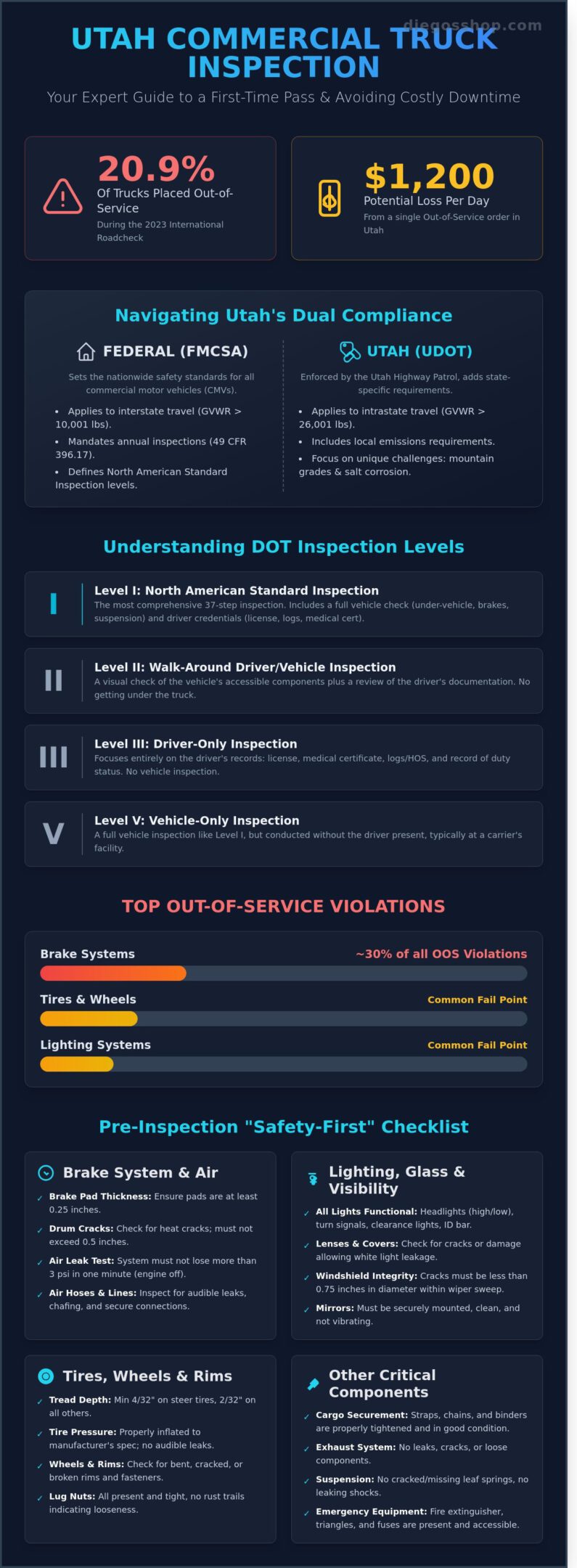
- Level I: This is a 37-step North American Standard Inspection. It’s the most thorough, including an intense under-vehicle check of the braking system and suspension components.
- Level II and III: Level II is a walk-around that covers everything visible without getting under the chassis. Level III focuses strictly on the driver’s credentials, logbooks, and Medical Examiner’s Certificate.
- Level V: This is a vehicle-only inspection. It’s usually conducted at a shop location without the driver present to ensure the equipment meets all safety criteria before deployment.
The Comprehensive Pre-Inspection Checklist for Utah Drivers
Consistency is the foundation of a safe fleet. To ensure your vehicle is road-ready, you must follow a systematic approach that starts at the front of the cab and moves clockwise to the rear of the trailer. This routine prevents simple oversights that lead to expensive delays. A failed commercial truck inspection utah often stems from visible defects that a driver could have spotted in five minutes. Beyond passing the test, documenting these checks daily creates a paper trail for your fleet maintenance records. This data proves your commitment to technical mastery and provides peace of mind if an auditor ever visits your shop.
Visual checks are a start, but functional tests are what keep you out of the “Out-of-Service” (OOS) category. You can see a cracked lens, but you must pump the brakes to hear an air leak. Catching these issues early is how you keep your operations moving without interruption.
Lighting, Glass, and Visibility Systems
Check every bulb on the rig. This includes high and low beam headlights, turn signals, clearance lights, and the five-light ID bar. Utah inspectors look for cracked lenses that allow white light to leak through amber or red covers. Windshields must be clear; cracks cannot exceed 0.75 inches in diameter if they’re within the area swept by the wiper blades. Your mirrors provide the rugged reliability you need for lane changes, so ensure they’re mounted securely and aren’t vibrating loose.
Brake System and Air Components
Brakes account for nearly 30% of all OOS orders. Measure your brake pads to ensure they meet the 0.25-inch thickness minimum. Look for heat cracks in drums that extend more than 0.5 inches. You must perform a static and applied air leak test. If your system loses more than 3 psi in one minute on a single unit with the engine off, it’s an immediate failure. Check that slack adjusters are within legal limits; for a standard Type 30 chamber, that means less than 2 inches of travel.
Tires, Wheels, and Suspension
Tread depth is non-negotiable for a commercial truck inspection utah. Steer tires must have at least 4/32 of an inch of tread, while drive and trailer tires need 2/32 of an inch. Never run re-grooved tires on a steer axle; it’s a major safety violation. Inspect wheels for “bleeding” rust, which indicates a loose lug nut. Finally, examine the suspension for cracked leaf springs or leaking air bags. If you notice uneven tire wear or sagging, scheduling a professional diagnostic can prevent a roadside breakdown and keep your truck “Done Right.”
Common Fail Points and Utah-Specific Challenges
Utah presents unique environmental hurdles that demand more from your equipment than flatter, coastal regions. A commercial truck inspection utah often reveals specific mechanical stresses caused by our high-altitude environment and extreme seasonal shifts. Drivers operating along the Wasatch Front frequently encounter 6% to 7% grades that punish braking systems and cooling components. If your maintenance routine doesn’t account for these local factors, you’re likely to face unexpected downtime.
Emissions compliance is another critical area, especially within Utah County. Local inspectors look closely at Exhaust Gas Recirculation (EGR) and Diesel Particulate Filter (DPF) systems to meet regional air quality standards. A single active fault code or a visible leak in your exhaust manifold can result in an immediate failure during a roadside check in the Provo or Springville areas. In Springville specifically, 2023 data suggests “The Big Three” reasons for inspection failure remain lighting malfunctions, brake out-of-adjustment issues, and tire tread depth below 4/32 of an inch on steer tires.
Mountain Grade Brake and Steering Wear
Descending 3,000 feet over a 10-mile stretch creates internal drum temperatures that can exceed 600 degrees Fahrenheit. You should check your brake drums for heat-checking cracks; any crack reaching over 0.5 inches in length or 1.5 inches in width is a violation. The constant torque required to navigate winding mountain passes also accelerates wear on steering linkages and kingpins. We recommend checking for kingpin play exceeding 1/8 inch, as this is a common reason trucks are pulled off the road during a commercial truck inspection utah. Don’t ignore small power steering fluid spots. A leak that’s “moist” is a warning, but a steady drip will end your shift early.
Corrosion and Electrical Integrity
UDOT applies thousands of tons of salt brine and magnesium chloride to the roads every winter. This liquid chemical is a silent killer for trailer wiring and 7-way plugs. It wicks into harness jackets and corrodes copper from the inside out. You’ll want to inspect light housings for any “green crust” buildup that indicates moisture intrusion. Frame integrity is also a priority for inspectors. While surface oxidation is expected on a working truck, structural rust that results in a 15% reduction in cross-sectional thickness will fail. Clean your battery terminals regularly and ensure they’re secured tightly. Road vibrations on I-15 can loosen mounts, leading to cracked battery cases and electrical shorts that are difficult to diagnose in the field.
Preparing Your Fleet for the Inspection Day
Preparation is the bridge between a passing grade and a costly out-of-service order. When you head into a commercial truck inspection utah, the inspector’s first impression often dictates the depth of their scrutiny. A clean truck signals a well-maintained fleet. If your engine block and chassis are covered in 20 pounds of road grime, inspectors will likely look harder for hidden fluid leaks or stress cracks. Clean equipment allows inspectors to see the “Rugged Reliability” of your vehicle rather than digging for faults hidden under dirt.
Perform a 10-minute “last look” before you arrive at the station. This isn’t a full pre-trip, but a targeted check of high-visibility items that often lead to easy citations. Focus on these specific areas:
- Test every exterior light, including the license plate lamp and high beams.
- Secure all loose items like heavy tools, bottles, or tablets that could become projectiles in the cab.
- Clear the dashboard of any clutter that might obstruct your mirror views or VIN plate.
- Check that your windshield wipers aren’t streaking and the fluid is topped off.
When you interact with UDOT officials, stay professional and calm. Answer questions directly and keep your responses concise. Treat the inspector as a specialist doing their job; professional communication often results in a smoother, faster process. If you’re organized and respectful, it shows you’ve got everything under control.
Documentation and Driver Credentials
Keep your paperwork in a dedicated, easy-to-reach binder. Your Medical Examiner’s Certificate and CDL must be current and valid. Federal law requires you to carry an ELD “Instruction Sheet” and a manual for your logging device at all times. You’ll need to provide the last 14 days of logs and your previous inspection report immediately upon request. Having these documents ready prevents the inspector from digging deeper into your history due to a lack of preparation.
The “Done Right” Maintenance File
An organized maintenance file proves your commitment to safety and quality. Whether it’s a digital folder or a physical binder, having records of your last 3 major repairs shows you don’t ignore mechanical issues. Verify your fire extinguisher is ready by ensuring the pressure gauge needle rests in the green zone and the maintenance tag confirms a professional inspection within the last 12 months. Finally, wipe down your GVWR and VIN plates. If these plates aren’t legible or don’t match your registration, it’s an automatic red flag during a commercial truck inspection utah.
Why Diego’s Shop is Utah County’s Partner for DOT Readiness
Diego’s Shop delivers the technical mastery required to clear state requirements without the typical stress of a roadside audit. Our team utilizes a rigorous 52-point inspection protocol that goes far beyond the bare minimums set by federal guidelines. Based in Springville, we provide a central hub for operators across the Wasatch Front who need expert diesel diagnostics and honest service. We’ve built our reputation on rugged reliability and a commitment to getting every job “Done Right.”
When you bring your rig to us, you’re getting more than a simple checklist. You’re getting a partner who understands that a commercial truck inspection utah is a high-stakes event for your business. We identify and resolve potential fail points before an inspector even sees your vehicle. Our fleet-specific maintenance programs are designed to eliminate inspection anxiety by keeping your equipment in peak condition through every season.
- Precision Diagnostics: We identify hidden faults in steering, braking, and suspension components that others miss.
- Rugged Reliability: Every repair is performed by specialists who know Kenworth, Peterbilt, and Volvo systems inside out.
- Honest Communication: You receive a clear report of what’s vital for safety and what can wait for the next service interval.
Expert Diagnostics and Warrantied Repairs
Our shop uses advanced diagnostic scanners to ensure your EGR and DPF systems are fully compliant with 2024 emission standards. We know that every hour your truck sits in a bay is an hour of lost revenue, often costing an owner-operator upwards of $175 per hour in potential freight billing. To combat this, we maintain a 24-hour turnaround goal for most standard repair work. Every job is backed by our warrantied work promise, providing the peace of mind you need when hauling heavy loads through the local canyon passes.
Schedule Your Pre-DOT Inspection Today
Moving your operations from reactive repairs to a proactive compliance model can reduce your annual maintenance spend by 18% or more. Our Springville technicians build custom plans that factor in your specific mileage, engine hours, and cargo types. Whether you manage two trucks or a fleet of twenty, we provide the same level of seasoned craftsmanship. Get Your Fleet Inspection-Ready with Diego’s Shop and ensure your next commercial truck inspection utah is a success. Book your comprehensive fleet review today to keep your business moving forward without interruptions.
Keep Your Fleet Compliant and Road-Ready
Staying ahead of DOT requirements involves more than a quick walk-around. You need to focus on the 13 critical inspection areas, specifically targeting common failure points like brake stroke measurements and tire tread depth. When you address these technical details before the official audit, you eliminate the risk of costly out-of-service orders that can sideline your operations for 24 hours or more. Successfully navigating a commercial truck inspection utah requires technical mastery and a proactive approach to fleet maintenance. It’s about protecting your bottom line and ensuring every driver returns home safely.
Diego’s Shop provides that mastery from our Springville facility. We serve the entire Wasatch Front, offering specialized expertise for heavy-duty brands like Peterbilt, Kenworth, and Volvo. Every repair we perform comes with 100% warrantied repair work, ensuring your truck leaves our bays built on rugged reliability. Our team understands that your time is money; we focus on precision and honesty in every diagnostic. Don’t leave your compliance to chance. Get your service done right and keep your business moving forward with total confidence.
Schedule Your Commercial Truck Inspection at Diego’s Shop
Frequently Asked Questions
How often do I need a commercial truck inspection in Utah?
You must schedule a commercial truck inspection utah at least once every 12 months to comply with Federal Motor Carrier Safety Regulation 396.17. This annual requirement ensures your vehicle remains safe for operation on public highways. We recommend scheduling your review 30 days before your current sticker expires to avoid fines or downtime. Staying compliant is the only way to keep your business running without legal interruptions.
What are the most common reasons for failing a DOT inspection in Utah?
Brake systems and lighting failures are the primary causes for failing a roadside check. Brake-related issues accounted for 25% of all out-of-service violations in recent CVSA Roadcheck data. Lighting failures, including non-functional turn signals or brake lights, represent another 12% of common citations. Tires with tread depth below 4/32 of an inch on steer axles also trigger immediate failures. These preventable issues often stem from skipped pre-trip inspections.
Can I perform my own annual DOT inspection?
You can perform your own inspection only if you meet specific qualification standards set by the FMCSA. Federal law requires the inspector to understand inspection criteria and have at least 1 year of training or experience in a truck maintenance program. You must also have the proper tools and a designated facility to perform the check accurately. Most owner-operators prefer professional shops because a certified technician provides an unbiased report that holds up during audits.
What happens if my truck is placed “Out-of-Service” during an inspection?
You cannot move the vehicle until you repair all identified safety violations on the spot. Being placed out-of-service means the inspector found a Category 1 violation that poses an immediate danger. In 2023, approximately 20% of vehicles inspected during the CVSA International Roadcheck were sidelined for these critical issues. You’ll face towing fees and repair costs on-site, which are often 3 times more expensive than standard shop rates.
Do I need a separate inspection for my trailer in Utah?
Yes, every trailer with a Gross Vehicle Weight Rating over 10,000 pounds requires its own annual inspection. The trailer is treated as a separate unit with its own documentation and inspection sticker. Inspectors look at the kingpin, sliding tandems, and air brake lines specifically during this process. Neglecting the trailer is a mistake that leads to 15% of total fleet violations during roadside stops in the Intermountain West.
How much does a professional pre-DOT inspection cost at Diego’s Shop?
A comprehensive pre-DOT inspection at Diego’s Shop starts at $150 for a standard power unit. This fee covers a 50-point safety check to identify potential failures before you hit the scales. We provide a detailed report on brakes, suspension, and engine components to ensure your commercial truck inspection utah goes smoothly. Investing in this proactive service prevents the $500 to $2,000 fines often associated with roadside violations.
Does Utah require an emissions test for commercial diesel trucks?
Requirements vary by county, but Salt Lake, Davis, and Weber counties require opacity testing for diesel vehicles. Heavy-duty trucks with a GVWR over 14,000 pounds must pass an annual smoke opacity test to renew their registration. Vehicles must stay below a 20% opacity limit for 1991 and newer models. Our team uses calibrated meters to ensure your exhaust meets these environmental standards during your regular maintenance visit.
What documents must a driver have ready for a Level I inspection?
You need your commercial driver’s license, medical examiner’s certificate, and Record of Duty Status ready for the officer. The inspector will also ask for the vehicle registration and proof of insurance for the current period. Having these 5 documents organized in a binder saves time and shows the officer you’re a professional. Roughly 10% of driver-related violations occur simply because paperwork is missing, messy, or expired.