

Commercial Truck Diagnostics in Springville: Precision Diesel Service for 2026

Your truck’s warning lights aren’t a suggestion. When a derate hits on a loaded haul or a fault code locks your rig at half power, every hour off the road is money you won’t get back. For fleet operators and owner-operators across the Wasatch Front, commercial truck diagnostics in Springville has become less of a routine service and more of a critical business decision.
You already know the frustration. A shop hooks up a generic scanner, reads a code, swaps a part, and two weeks later the same light is back on. That’s not diagnostics. That’s guesswork with your invoice attached. Modern diesel engines, particularly those built to 2026 emission standards, run on layered electronic systems where a single fault can mask a deeper failure. Getting it wrong the first time costs far more than the repair itself.
This article breaks down exactly how precision diesel diagnostics work, why emission-related derate modes are becoming more frequent, and what a proper diagnostic process at a specialized shop actually looks like. If you want a clear answer on what’s wrong, a warrantied repair plan, and your truck back on the road fast, you’re in the right place.
Key Takeaways
- Modern 2026 diesel engines run on layered electronic systems that a basic OBD-II scanner cannot fully evaluate — understanding what a real diagnostic process involves will help you avoid costly repeat repairs.
- Professional commercial truck diagnostics in Springville goes beyond reading fault codes, using OEM-level software to stream live ECM data and systematically test both the hot and cold sides of your engine.
- Regular diagnostic check-ups catch silent killers like fuel dilution and coolant electrolysis before they escalate into major failures — a proactive strategy that directly lowers your total fleet maintenance costs.
- Working with a specialized local shop means personal accountability and a consistent relationship with a master craftsman, not a rotating roster of technicians at a corporate dealer.
- Every repair recommendation from a proper diagnostic process is backed by warrantied work — so you know exactly what was found, why it matters, and that the fix will hold.
What Defines Modern Commercial Truck Diagnostics?
Commercial truck diagnostics isn’t a single test. It’s a comprehensive evaluation of your truck’s Electronic Control Module and every mechanical system tied to it. On a 2026-spec diesel, those systems are deeply interconnected. A problem in one area can trigger faults across three others, and a basic OBD-II scanner will only show you the surface.
Modern diesel engines rely on a dense network of sensors monitoring fuel trim, boost pressure, exhaust gas temperature, NOx output, and DEF quality in real time. When something drifts out of spec, the ECM logs it, adjusts operating parameters, and sometimes initiates a derate to protect the engine. A scanner reads what the ECM reported. A diagnostic tells you why the ECM reported it.
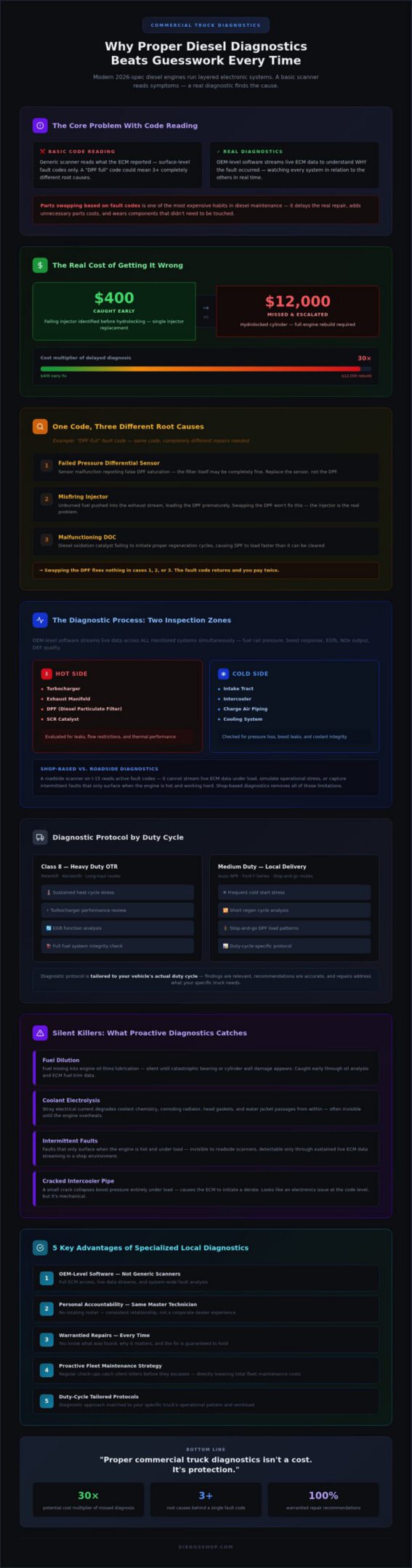
That distinction matters more than most operators realize. Catching a failing injector before it causes a hydrolocked cylinder, or identifying a cracked intercooler pipe before it collapses boost pressure entirely, can be the difference between a $400 repair and a $12,000 rebuild. Proper commercial truck diagnostics in Springville isn’t a cost. It’s protection.
The Difference Between Codes and Causes
A fault code is a symptom report, not a diagnosis. A “DPF full” code is a perfect example. On the surface, it points to the diesel particulate filter. But the actual cause could be a failed pressure differential sensor, a misfiring injector pushing unburned fuel into the exhaust, or a malfunctioning DOC that can’t initiate proper regeneration. Swapping the DPF fixes nothing. The code returns, and you’re out the cost of the part plus the labor.
Think of the ECM as the brain of your truck. It stores data, manages inputs, and communicates faults in its own language. That language requires expert translation, not just reading. At Diego’s Shop, the diagnostic process starts with streaming live ECM data to understand what the engine was actually doing when the fault occurred, not just what code it threw afterward.
Parts swapping based on surface-level fault codes is one of the most expensive habits in diesel maintenance. It delays the real repair, adds unnecessary parts costs, and puts wear on components that didn’t need to be touched.
Heavy-Duty vs. Medium-Duty Diagnostic Protocols
The diagnostic approach for a Class 8 Peterbilt or Kenworth running OTR routes is fundamentally different from what a local Isuzu NPR or Ford F-Series diesel needs. Long-haulers accumulate heat cycles, sustained load stress, and emission system wear that require a deeper review of turbocharger performance, EGR function, and fuel system integrity. Local delivery units face different pressures: frequent cold starts, short regeneration cycles, and stop-and-go load patterns that stress the DPF differently.
Diego’s Shop tailors the diagnostic protocol to the vehicle’s actual duty cycle. That means the findings are relevant, the repair recommendations are accurate, and the work done addresses what your specific truck actually needs.
The Technical Process: How Diego’s Shop Analyzes Your Rig
Roadside diagnostics have a hard ceiling. A portable scanner connected to a truck on the shoulder of I-15 can read active fault codes, but it can’t stream live ECM data under load, simulate operational stress, or log the intermittent faults that only surface when the engine is hot and working hard. Shop-based commercial truck diagnostics in Springville removes those limitations entirely.
At Diego’s Shop, the process starts with a full hook-up to OEM-level diagnostic software, not a generic aftermarket reader. That connection opens real-time data streams across every monitored system: fuel rail pressure, boost response curves, exhaust gas temperatures, NOx sensor output, and DEF quality readings. The technician isn’t just reading what the ECM flagged. He’s watching how every system behaves in relation to the others.
From there, the inspection moves through two distinct zones.
- Hot Side: The turbocharger, exhaust manifold, DPF, and SCR catalyst are evaluated for leaks, flow restrictions, and thermal performance. A cracked exhaust manifold or a partially plugged DPF can look identical at the code level but require completely different repairs.
- Cold Side: The intake tract, intercooler, charge air piping, and cooling system are checked for pressure loss, boost leaks, and coolant integrity. A collapsed intercooler hose or a marginal coolant electrolysis reading won’t always throw a code, but both will degrade performance and eventually cause serious damage.
Load testing and operational simulations come next. Ghost codes, faults that appear only under sustained highway load or during a regeneration cycle, won’t show up during a cold idle. Replicating real operating conditions in the shop is the only reliable way to surface them before they strand a driver.
ECM Deep-Dives and Data Logging
Historical ECM data tells a story that a single snapshot misses. Recurring intermittent faults, freeze frame data from previous fault events, and logged parameter deviations can reveal a pattern that points directly to a root cause. Where telematics data is available, that information is integrated into the analysis to identify stress points before they escalate into failures. Firmware updates are also reviewed as part of this process, since outdated engine management software can cause false faults or prevent proper system calibration on 2026-spec engines.
Emission System Troubleshooting (DPF/EGR)
Emission system faults are the leading trigger for derate modes across Utah’s commercial fleet. EGR cooler leaks, face-plugged DPF substrates, and failing NOx sensors each produce overlapping fault patterns that require methodical testing to separate. At Diego’s Shop, each component is tested in sequence: differential pressure across the DPF, EGR flow rates against spec, and SCR conversion efficiency under load. The goal isn’t just clearing the code. It’s confirming that the truck meets 2026 environmental standards before it rolls back onto the road.
If you want a full picture of what your truck’s emission systems are actually doing, schedule a diagnostic evaluation at Diego’s Shop before a derate turns into a shutdown.
Diagnostics as the Foundation of Fleet Maintenance
Reactive maintenance is the most expensive strategy in trucking. You wait for a failure, absorb the emergency costs, and lose revenue while the truck sits. Scheduled commercial truck diagnostics in Springville flips that equation. Regular check-ups create a documented baseline for every monitored system, so deviations get caught early, repairs get scheduled during planned downtime, and the catastrophic failures that drain fleet budgets become rare instead of routine.
The real value shows up in what diagnostics finds before it becomes a problem. Two of the most damaging conditions in a diesel engine produce almost no obvious symptoms until the damage is done:
- Fuel dilution: Raw diesel entering the crankcase thins the oil, strips lubrication from bearings and cylinder walls, and accelerates wear across the entire bottom end. It won’t always trigger a fault code. Sensor data and oil analysis will catch it.
- Coolant electrolysis: Stray electrical current in the cooling system corrodes water pump impellers, degrades hose fittings, and pits cylinder liners from the inside. By the time a driver notices anything, the damage is already significant.
Identifying these conditions through sensor data and systematic inspection is exactly what separates a real diagnostic process from a code-read-and-clear service. For OTR fleets, there’s a direct line between this kind of precision and fuel economy. An engine running with degraded injector spray patterns, marginal boost pressure, or a partially restricted DPF burns more fuel to produce the same output. Catching those issues early keeps fuel consumption where it belongs.
Proactive diagnostics also directly supports DOT truck inspections. A truck with documented maintenance history, confirmed emission system function, and no deferred fault codes walks into an inspection in a fundamentally different position than one that’s been running on deferred issues. Failing an inspection costs far more than the inspection itself once you factor in downtime, citations, and out-of-service orders.
Preventing Roadside Derate Emergencies
A tow from I-15 to a shop, a missed delivery window, and an expedited repair on someone else’s schedule adds up fast. A one-hour diagnostic during planned downtime costs a fraction of that, and it gives you the information to schedule any needed repairs on your terms. At Diego’s Shop, the preventive protocol for high-mileage commercial engines includes a full ECM data review, emission system evaluation, and a systematic check of the systems most likely to trigger derate modes before they actually do.
Extending Engine Longevity in the Wasatch Front
Utah’s elevation and temperature swings create conditions that generic maintenance schedules don’t account for. Turbochargers work harder at altitude, thermal cycling accelerates seal wear, and cold-start stress on high-mileage engines compounds quickly in winter months. Boost-response diagnostics at Diego’s Shop track turbocharger performance against spec under actual operating conditions, catching early-stage bearing wear or compressor inefficiency before it becomes a failure. That’s where diesel engine repair starts: not with a parts list, but with accurate data about what’s actually happening inside the engine. A repair built on that foundation holds. One built on assumptions doesn’t.
For fleet operators managing multiple units across the Wasatch Front, consistent diagnostic check-ups through Diego’s Shop also mean a single point of accountability and a repair history that travels with each truck, making every future service decision faster and more accurate.
Why Springville Fleet Managers Choose Specialized Local Diagnostics
Location isn’t just a convenience factor in commercial trucking. It’s an operational variable. When a rig comes off I-15 with an active derate, every mile between the fault and a qualified shop is a liability. Diego’s Shop sits off North Parkway Court in Springville, putting it directly in the path of Utah County’s heaviest commercial corridors. That positioning isn’t incidental. It’s built for the operators who can’t afford a long detour when something goes wrong.
What a map pin doesn’t tell you is whether the shop actually understands the routes those trucks run. There’s a difference between a shop that services commercial diesels and one that knows the specific demands of hauling aggregate out of Spanish Fork Canyon, running loaded flatbeds through the elevation changes on the Wasatch Front, or managing DPF regeneration cycles on units that rarely get sustained highway time. That regional context shapes how a diagnostic gets interpreted and what a repair recommendation actually addresses.
Proximity Matters for Commercial Downtime
Diego’s Shop serves Springville, Spanish Fork, and the broader Wasatch Front with diagnostic bays configured for commercial schedules, not passenger car throughput. Utah’s heavy-haul regulations add another layer of complexity that a generalist shop won’t prioritize. A unit flagged during a roadside inspection needs more than a cleared code; it needs documented confirmation of compliance. Getting that done close to your operating area, without a cross-county haul to a dealer, keeps downtime measurable and manageable.
Personalized Service vs. Corporate Dealers
At a high-volume dealership, your truck moves through a queue. The technician who did your last service probably won’t be the one handling this visit. That rotation breaks continuity, and continuity matters when you’re tracking intermittent faults across multiple service events.
Commercial truck diagnostics in Springville at Diego’s Shop works differently. You’re dealing directly with the technician performing the work. Questions get real answers, not filtered summaries. For fleet managers who need to justify repair costs internally, that direct communication translates into clear, specific reporting: what was found, what it means, and why the recommended repair is the right call.
That’s the practical value of working with a named shop built around personal accountability. Diego’s isn’t a franchise location staffed by rotating technicians. It’s a specialist operation where the same hands that run the diagnostic write the repair plan and stand behind the warrantied work. Grounded, honest, and technically superior diesel repair in Utah isn’t a tagline. It’s the operating standard.
If your fleet is running routes through Utah County and you want a consistent diagnostic partner who knows this region’s demands, contact Diego’s Shop to schedule your next evaluation.
Get Your Commercial Truck Back on the Road with Diego’s Shop
Everything covered in this article points to one conclusion: guesswork is expensive, and precision pays. Commercial truck diagnostics in Springville done right means the repair recommendation that follows is built on verified data, not assumptions. That foundation is exactly what makes warrantied repair work possible.
A warranty on a repair is only as strong as the diagnostic that preceded it. If the root cause wasn’t correctly identified, the fix won’t hold, and no warranty language changes that reality. At Diego’s Shop, the diagnostic process exists specifically to eliminate that uncertainty. When the root cause is confirmed through OEM-level data analysis and systematic testing, the repair plan is accurate. That’s what gets backed with warrantied work.
Warrantied Repairs You Can Trust
The warranty on every diagnostic-led repair at Diego’s Shop isn’t a marketing add-on. It’s the natural result of doing the diagnostic correctly in the first place. When you know exactly what failed, why it failed, and what the correct fix requires, you can stand behind the outcome. That confidence runs in both directions: it means Diego’s is accountable for the work, and it means you’re not rolling back onto the highway wondering whether the problem is actually solved.
For fleet managers who answer to dispatch schedules and delivery commitments, that peace of mind has a direct operational value. A truck that leaves Diego’s Shop with a documented diagnostic finding and a warrantied repair isn’t a question mark. It’s a confirmed asset back in rotation.
Schedule Your Diagnostic Today
Don’t wait for a derate to force the decision. Scheduling commercial truck diagnostics in Springville during planned downtime puts you in control of the timeline, the cost, and the outcome. Reactive repairs always cost more.
Diego’s Shop is located off North Parkway Court in Springville, positioned directly along Utah County’s primary commercial corridors. Whether you’re managing a multi-unit fleet or running as an owner-operator, the scheduling process is straightforward and built around minimizing your time off the road.
- Fleet operators: Contact Diego’s Shop to coordinate staggered diagnostic appointments that keep your units moving while each truck gets a full evaluation.
- Owner-operators: Reach out directly to discuss your truck’s current fault history and schedule a comprehensive diagnostic before your next run.
Accurate data. Warrantied repairs. Personal accountability from the same hands that run the diagnostic and write the repair plan. That’s the standard at Diego’s Shop. Schedule your diagnostic evaluation today and get your truck back on the road with confidence.
Precision Diagnostics, Warrantied Results, Your Truck Back Where It Belongs
Commercial truck diagnostics in Springville isn’t a line item to minimize. It’s the decision that determines whether your next repair holds or becomes a recurring problem. The difference between guesswork and verified data shows up in your downtime numbers, your fuel costs, and your ability to pass a DOT inspection without surprises.
Diego’s Shop brings that precision to every Peterbilt, Kenworth, and Ford diesel that rolls through the bay. OEM-level analysis, systematic testing, and warrantied repair work backed by the same hands that ran the diagnostic. One point of accountability, every time.
Don’t let a deferred fault code turn into a roadside shutdown. Schedule your evaluation during planned downtime and stay in control of your timeline. Book your diagnostic at Diego’s Shop today and put your truck back on the Wasatch Front with confidence.
Frequently Asked Questions About Commercial Truck Diagnostics in Springville
How long does a commercial truck diagnostic service typically take?
A thorough commercial truck diagnostic typically runs between one and three hours, depending on the complexity of the fault history and how many systems need evaluation. Simple fault code reviews take less time. Cases involving intermittent faults, emission system issues, or multiple overlapping codes require load testing and extended data logging to surface the actual root cause, which takes longer but produces a repair plan that holds.
Can I drive my truck if the check engine light is on but it feels fine?
Don’t assume a light with no obvious symptoms means a minor issue. Some of the most damaging conditions, like early-stage fuel dilution or a drifting NOx sensor, produce no noticeable change in drivability until the damage is already done. A check engine light on a 2026-spec diesel can also be one fault event away from triggering a derate. Getting it evaluated during planned downtime costs far less than a roadside shutdown.
What is the difference between a ‘soft code’ and a ‘hard code’ in diesel engines?
A hard code is an active fault the ECM is currently detecting, meaning the triggering condition is present right now. A soft code, sometimes called an inactive or stored code, is a fault the ECM logged previously but isn’t detecting at the moment. Soft codes matter because they reveal patterns. A soft code that keeps returning points to an intermittent problem that will eventually become a hard fault, and catching it early is exactly where a real diagnostic process adds value.
Do I need to go to a dealer like Rush Truck Center for OEM-specific diagnostics?
No. OEM-level diagnostic capability isn’t exclusive to dealerships. Diego’s Shop uses professional-grade diagnostic software that accesses the same ECM data streams, freeze frame records, and parameter monitoring that dealer tools provide. The practical difference is accountability: at a high-volume dealer, your truck moves through a queue with rotating technicians. At Diego’s Shop, the same specialist who runs the diagnostic writes the repair plan and stands behind the warrantied work.
Will professional diagnostics help my truck pass a DOT inspection?
Commercial truck diagnostics in Springville directly supports DOT inspection readiness. A documented diagnostic evaluation confirms emission system function, identifies any deferred fault codes, and creates a maintenance record that demonstrates the truck has been properly serviced. Inspectors look for more than a cleared code; they want evidence of compliance. A truck with a clean diagnostic history and confirmed emission system performance walks into that inspection in a fundamentally stronger position.
What are the most common diagnostic codes for trucks in Utah’s climate?
Utah’s elevation and temperature swings create specific stress patterns. DPF-related faults are frequent on units running stop-and-go routes that don’t allow full regeneration cycles. EGR cooler faults appear more often on trucks handling sustained grades through elevation changes. Turbocharger performance codes show up on high-mileage OTR units where altitude compounds normal wear. Cold-start conditions in winter also accelerate certain sensor faults, particularly around the DEF system, which is sensitive to temperature extremes.
How much does a commercial truck diagnostic test cost in Springville?
Diagnostic pricing varies based on the scope of the evaluation, the vehicle’s fault history, and how much data logging and load testing the situation requires. Providing a single flat figure here wouldn’t be accurate or fair to you. Contact Diego’s Shop directly to discuss your truck’s current symptoms and fault history; that conversation will give you a clear picture of what the diagnostic process involves and what to expect before any work begins.
Does Diego’s Shop provide a written report of the diagnostic findings?
Yes. Every diagnostic evaluation at Diego’s Shop produces documented findings that clearly identify what was found, what it means for the truck’s performance and compliance, and what the recommended repair addresses. That documentation isn’t just a courtesy; it’s the foundation for the warrantied repair work that follows. For fleet managers who need to justify repair decisions internally, having specific, written findings from the diagnostic makes that conversation straightforward.