
How to Diagnose Diesel Engine Coolant Contamination and Check for Causes

White smoke isn’t the only clue to a diesel cooling-system problem. A sound diesel engine coolant contamination diagnosis assesses coolant condition, additive levels, and possible internal leaks instead of relying on one symptom alone.
It’s understandable to suspect a head gasket when coolant looks oily or exhaust smoke changes. But a failed head gasket is only one possible cause. A cracked cylinder head or failing oil cooler can also contaminate coolant. A technician assesses the symptoms and uses tests to narrow down the source.
This guide explains how a diesel technician evaluates coolant condition and additives, considers head gasket symptoms, and investigates maintenance and engine factors. You’ll also learn why identifying the underlying cause matters before flushing the cooling system, and how preventive maintenance can help fleets catch developing problems.
Key Takeaways
- Don’t use white smoke alone to rule a head gasket problem in or out; a technician weighs several symptoms and possible internal leak sources.
- Coolant and additive testing can reveal condition issues that appearance alone may miss, helping guide the next diagnostic step.
- Use the coolant type and maintenance schedule specified for the engine, and avoid mixing chemistries unless compatibility is confirmed.
- Fleet preventive maintenance can help identify changing coolant condition early and support more informed repair decisions.
Does a blown head gasket always cause white smoke?
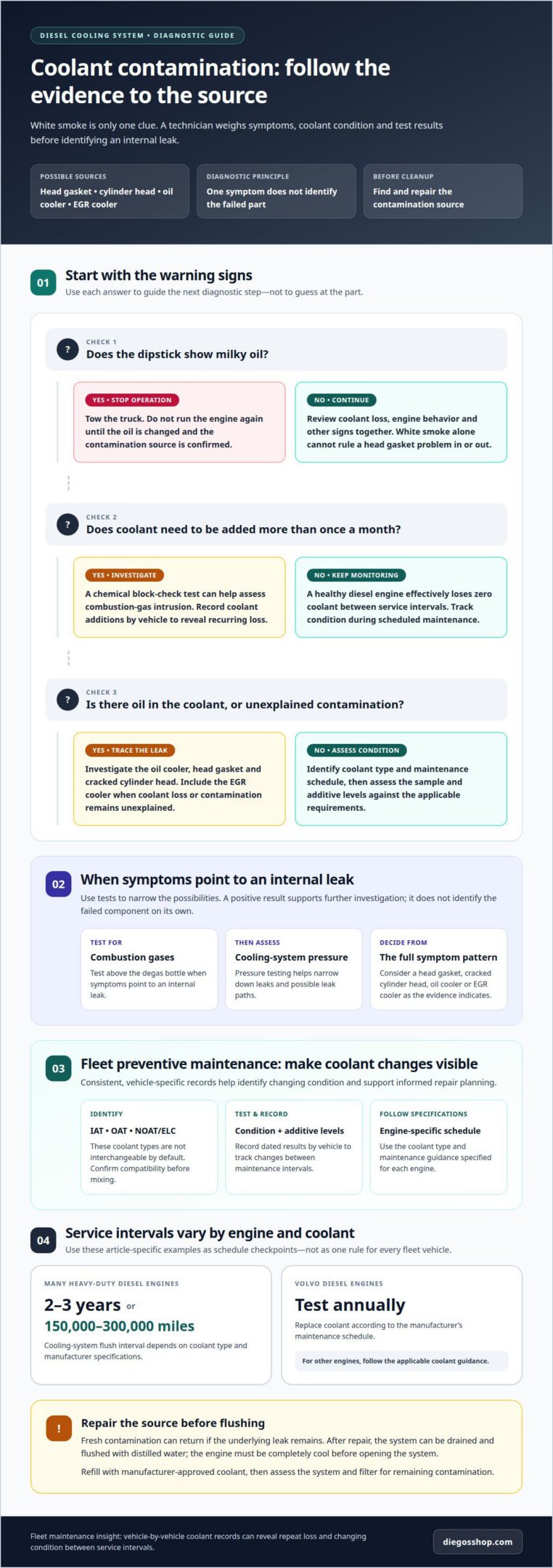
- Don’t use white smoke as the sole test for a head gasket. A failed gasket can let combustion gases enter the cooling system without obvious exhaust smoke. A technician considers coolant loss, engine behavior, and other signs together, rather than letting one visible symptom determine the diagnosis.
- When symptoms point to an internal leak, test for combustion gases above the degas bottle. A positive chemical test supports further investigation, but it doesn’t identify the failed component on its own. The technician may pressure-test the cooling system and assess whether the evidence points to a head gasket, cracked cylinder head, or another leak path.
- Investigate oil-cooler cross-contamination when oil appears in the coolant. A failing oil cooler can allow oil and coolant to cross between their separate passages. A head gasket or cracked cylinder head can also cause oil contamination. Identify and repair the source before flushing, or fresh contamination may return.
- Include the EGR cooler in the investigation when coolant loss or contamination remains unexplained. A leak in the cooler can create an internal coolant-loss path, so the technician evaluates it alongside the head gasket and oil cooler. Pressure testing helps narrow down leaks, while the complete pattern of symptoms guides the next test.
- Stop operating the engine if the dipstick shows milky oil. Don’t run it again until the oil is changed and the contamination source is confirmed. This finding calls for prompt diagnosis, not just a flush. A careful diesel engine coolant contamination diagnosis identifies the cause before cleanup.
Coolant condition and additive testing
- Start by identifying the coolant type and the engine’s maintenance schedule. Heavy-duty diesel coolant testing depends on both. IAT, OAT, and NOAT/ELC are common coolant types, but the right chemistry depends on engine make and model. A technician uses that information to interpret test results against the applicable maintenance requirements.
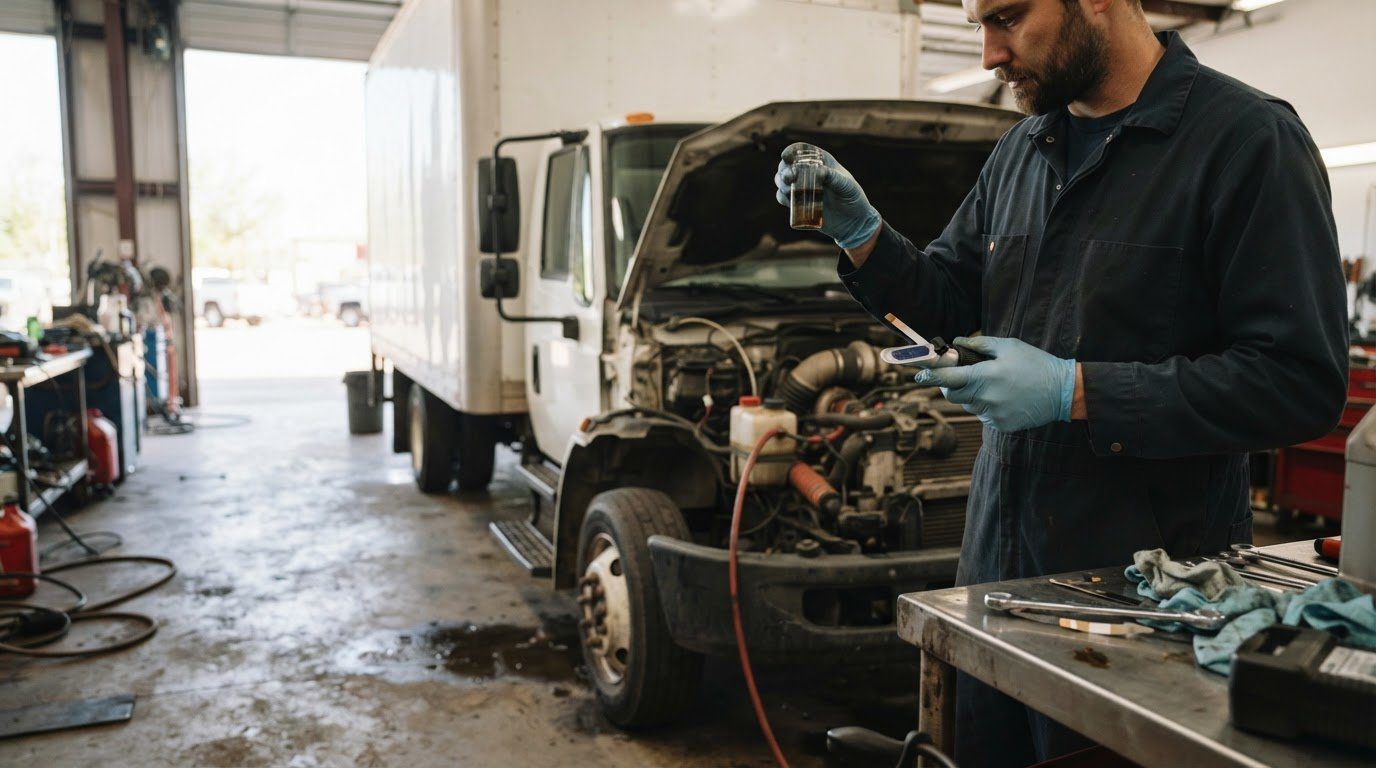
- Assess the sample’s condition, not just its color. A technician looks for visible changes and contamination, then arranges laboratory testing when coolant quality needs closer evaluation. Lab analysis can assess coolant condition and contamination levels, helping distinguish a sample that needs routine service from one that may indicate a developing problem.
- Test additive levels against the coolant type and manufacturer’s schedule. Additives protect cooling-system components, but their condition can change with use. Test results give the technician a basis for deciding whether the coolant remains serviceable or needs attention. For a fleet, recording results by vehicle helps track changes between maintenance intervals.
- Keep coolant chemistries separate unless the manufacturer confirms they’re compatible. IAT, OAT, and NOAT/ELC are not interchangeable by default. Mixing incompatible types can complicate test interpretation and maintenance decisions. The technician identifies the coolant already in the system before recommending an approach, rather than assuming every diesel engine has the same requirements.
- Apply the vehicle-specific interval consistently. Volvo diesel engine coolant should be tested annually and replaced according to the manufacturer’s maintenance schedule. For other engines, the technician follows the applicable coolant guidance. In fleet preventive maintenance, dated test records make it easier to spot changes in condition and plan follow-up before service is disrupted.
Coolant maintenance and engine factors
- Base service intervals on the engine and coolant specifications. Many heavy-duty diesel engines require a cooling-system flush every 2 to 3 years or every 150,000-300,000 miles, depending on coolant type and manufacturer specifications. A technician uses the applicable schedule rather than applying one interval across a fleet.
- Track coolant loss between services. A healthy diesel engine effectively loses zero coolant between service intervals. If coolant needs to be added more than once a month, a chemical block-check test can help assess combustion-gas intrusion. Record additions by vehicle so recurring loss stands out in fleet maintenance records.
- Tow the truck if it is overheating or the dipstick shows milky oil. Don’t continue driving until the oil is changed and the contamination source is confirmed. Contaminated coolant can contribute to engine damage, and continued operation can worsen overheating or allow coolant to affect engine oil. Damage can progress while the engine runs, so don’t assume there is a safe driving interval.
- Have a technician repair the contamination source before flushing. The system can then be drained and flushed with distilled water, avoiding tap-water minerals that can contribute to scaling and corrosion. The engine must be completely cool before the system is opened because hot, pressurized coolant can cause serious burns.
- Refill with the manufacturer-approved coolant for that engine, then assess the system and filter for remaining contamination. If the source was unclear, flushing and monitoring the filter can help track whether contamination returns. For recurring fleet coolant concerns, schedule diesel engine repair with Diego’s Shop.
Diego’s Shop: Diesel Engine Repair
Diego’s Shop provides Diesel Engine Repair for owners and fleet managers dealing with coolant contamination, unexplained coolant loss, or signs of an internal leak. Turn to the shop when test results point to a problem that needs diagnosis and repair, rather than another flush that leaves the underlying cause unresolved.
For commercial operators, Fleet Maintenance and Preventive Maintenance support a consistent approach to vehicle condition and service needs. Including coolant concerns in the fleet’s maintenance plan can help identify repeat issues and inform repair planning across vehicles. Diego’s Shop also performs Warrantied Repair Work.
Share the symptoms, recent coolant or repair history, and any test findings when arranging service. This information helps frame the diagnostic process and connect the reported condition to the next repair step. Contact Diego’s Shop to discuss diesel engine repair or fleet maintenance.
Turn coolant findings into a maintenance plan
A sound diesel engine coolant contamination diagnosis can turn a confusing symptom into a clear repair decision. For fleet managers, the next step is connecting that decision to ongoing maintenance planning. A record of the affected vehicle, its symptoms, and the work completed gives the maintenance team a useful starting point for future service discussions.
Diego’s Shop works with diesel owners and fleets through Diesel Engine Repair, Fleet Maintenance, and Preventive Maintenance. Bring the vehicle’s service history and any test results to help frame the discussion. The focus is practical: understand what the engine needs and plan the next step with care.
Contact Diego’s Shop to discuss your diesel engine or fleet maintenance needs. A clear next step starts with a straightforward conversation.
Frequently Asked Questions
How do professionals diagnose a diesel engine coolant leak?
A technician checks for visible leaks, reviews coolant-loss history, and pressure-tests the cooling system to help locate the leak. If an external leak isn’t evident, further testing can investigate internal paths, including a head gasket, oil cooler, or EGR cooler. For most Class 8 diesel engines, a pressure test can identify external leaks in about 20 minutes.
What Is Coolant Contamination?
Coolant contamination occurs when unwanted substances enter the cooling system or the coolant’s condition changes. Examples include oil or fuel in the coolant, combustion gases entering through an internal leak, or incompatible coolant chemistries being mixed. A technician assesses the sample and system together because coolant’s appearance alone cannot establish what entered it or identify the source.
What’s involved in professional coolant contamination diagnosis, and how long can it take?
Diagnosis can include reviewing symptoms and service history, inspecting coolant and engine oil, testing coolant condition, and pressure-testing for leaks. A chemical test can check for combustion gases above the degas bottle. An external-leak pressure test takes about 20 minutes on most Class 8 diesel engines; tracing internal contamination can take longer because it may require additional tests to isolate its source.
What are the symptoms of coolant contamination in a diesel engine?
Possible signs include an oily film or unusual residue in the coolant, milky engine oil, unexplained coolant loss, overheating, or changes in exhaust smoke. A single sign doesn’t identify the cause. White smoke, for example, doesn’t prove a head gasket has failed, and oil in coolant can come from an oil cooler or another internal failure. The full pattern of symptoms matters.
How do technicians identify oil, fuel, or exhaust gases in diesel engine coolant?
Technicians inspect coolant samples and use tests suited to the suspected contaminant. Laboratory analysis can assess coolant quality and contamination levels. A chemical test above the degas bottle can detect combustion gases, while pressure testing helps investigate leak paths. Oil in coolant points to possible oil-cooler or engine failures; identifying the source requires interpreting test results alongside the vehicle’s symptoms.