
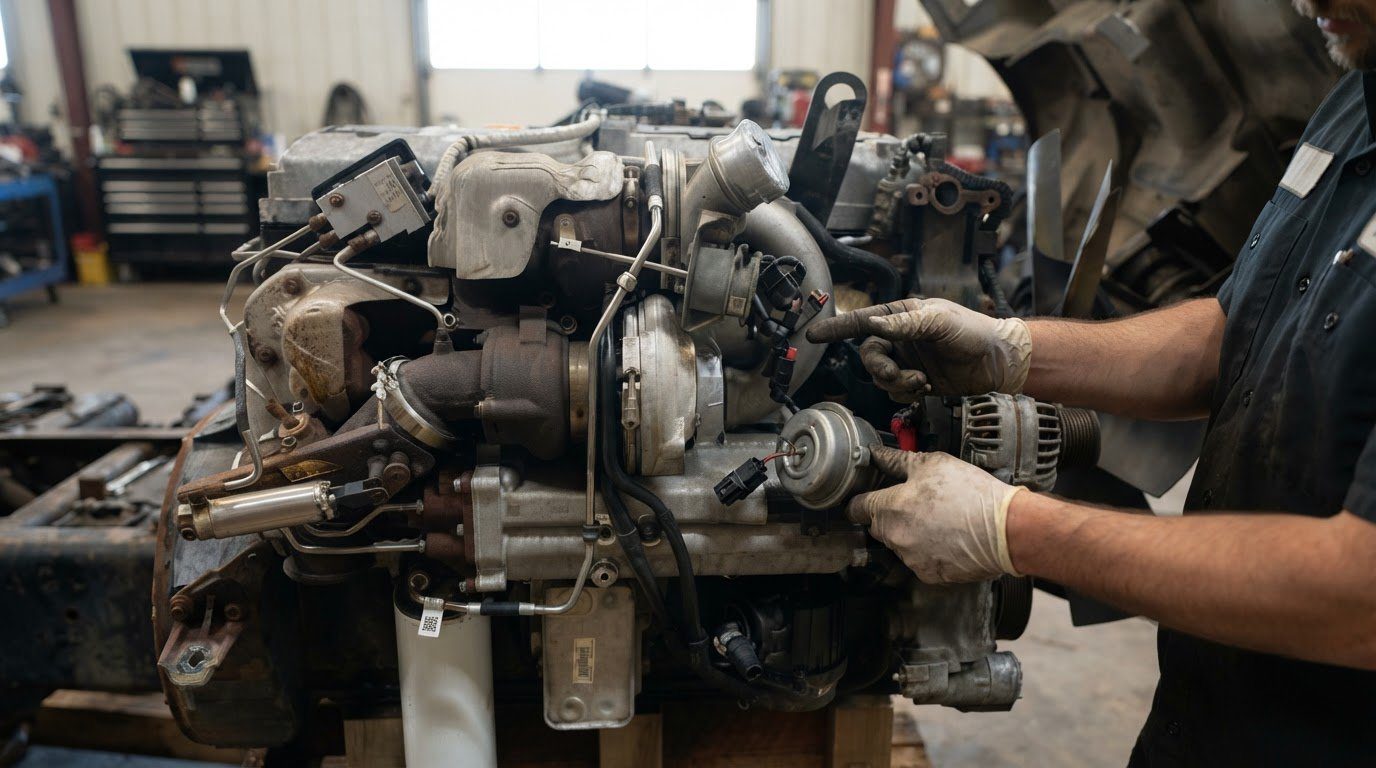
Variable geometry turbo actuator problems: when to replace both

For fleet maintenance teams, diagnosing a failed VGT actuator helps guide repair planning and preventive maintenance. Variable geometry turbo (VGT) actuator problems can stem from the actuator or its electrical circuit. But if the turbo vanes stick or the mechanism is damaged, replacing the actuator alone won’t address the underlying fault. The right repair depends on the diagnosis.
Knowing when the turbo and actuator should be replaced together, how a replacement actuator is matched and calibrated, and which fault codes and electrical checks can help pinpoint the cause can support fleet maintenance planning. A code alone isn’t enough to condemn the actuator. A thorough diagnosis should establish what failed before parts are replaced.
Key Takeaways
- Replace the turbo and actuator together when diagnosis finds a stuck or damaged VGT mechanism, not simply because an actuator code appears.
- Actuator replacement calls for a part matched to the turbo and calibration using the procedure for that engine.
- Use fault codes as diagnostic clues, then assess the power supply, ground, wiring, communication circuits, and turbo movement.
- Fleet preventive maintenance can help identify developing diesel engine concerns before they disrupt vehicle availability.
Do I have to replace the turbo and actuator together?
No. Replace both only when diagnosis shows the turbo’s vane mechanism is stuck or mechanically damaged, not simply because the actuator failed. A technician checks the mechanism’s movement with the actuator removed before deciding which parts need replacement.
How VGT and MaxxForce DT systems work
A variable geometry turbo adjusts its vanes: narrowing them helps the turbine spool sooner at low engine speeds, while opening them supports airflow and power at higher speeds. On a MaxxForce DT, the engine is a 7.6-liter inline-six. The 2007 to 2009 models used one BorgWarner B2UV VGT, while models starting in 2010 used two turbochargers in series. Carbon buildup can stick the vanes, so a new actuator alone won’t correct that mechanical fault. A VGT turbo with more than 100,000 miles is at risk of vane seizure, but mileage alone doesn’t establish failure.
Risks of Continued Operation
A VGT mechanism stuck toward the closed position can restrict exhaust flow, raising exhaust backpressure and exhaust gas temperatures. These conditions can create damaging operating conditions for the turbo, even when the actuator is the first suspected fault. If a truck may have seized vanes, abnormal temperatures, or signs of mechanical turbo failure, avoid driving it until it has been diagnosed. Prompt assessment helps identify whether the fault is mechanical, electrical, or actuator-related.
Actuator Replacement Costs
VGT actuator replacement cost depends on the diagnosis, the replacement part required, and the labor involved. There is no single fixed cost for parts and labor; the price depends on the repair and is provided after a quote request. If carbon has stuck the vanes or the turbo has mechanical damage, replacing only the actuator may leave the underlying problem unresolved and require further repairs.
How professionals replace and calibrate a failed actuator
Professional replacement starts with matching the actuator to the turbo and engine application. Installation alone isn’t enough: electronically controlled VGT actuators generally need calibration after removal or replacement.
For a MaxxForce DT, the replacement actuator must match the turbo part number and be calibrated to that turbo. The technician follows the procedure specified for the engine and actuator, then confirms that the controls respond correctly. With accurate diagnosis and part matching, a MaxxForce DT actuator replacement can be a half-day repair.
Repair or Replacement Decisions
Repair or replacement depends on whether the fault is in the actuator, its calibration, or the turbo itself. This distinction matters because an actuator cannot correct a mechanically stuck vane mechanism. A technician assesses the turbo and actuator together to determine whether the actuator can be repaired or needs replacement. Calibration follows installation so the actuator positions the vanes as the engine controls require.
OEM and Aftermarket Replacements
An OEM actuator replacement and an aftermarket turbo replacement are different repair options, so the part must suit the work being done. For a MaxxForce DT actuator, matching the turbo part number is essential, whatever the replacement route. If the turbo assembly is replaced, the new actuator still needs the correct engine-specific installation and calibration procedure. Proper matching helps prevent fitting a component that cannot operate correctly with the turbo.
For a diesel engine with a failed actuator, professional diesel engine repair can include diagnosis, replacement, and calibration. Correct parts and procedure matter.
Diagnostic fault codes and electrical checks
Technicians combine scan data, circuit tests, and mechanical inspection to diagnose variable geometry turbo (VGT) actuator problems. For fleet preventive maintenance, they test electrical power and communication, then assess commanded actuator operation and vane movement to identify developing faults and help manage fleet repair needs.
Diagnostic Fault Codes
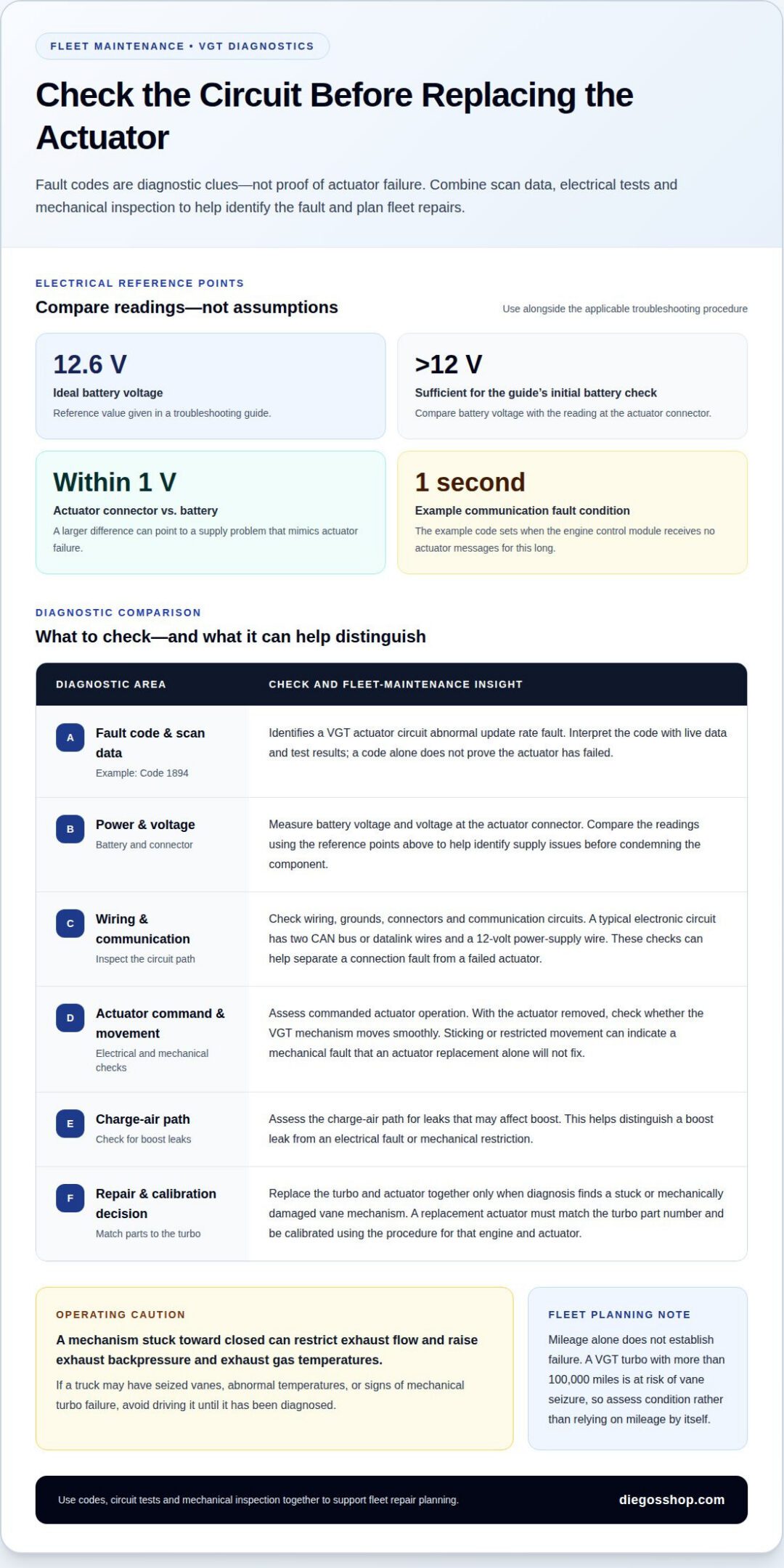
A diagnostic code points to a detected condition, but it doesn’t prove the actuator itself has failed. Code 1894 identifies a VGT actuator circuit abnormal update rate fault; an example code sets when the engine control module receives no actuator messages for 1 second. Technicians interpret codes alongside live data and test results to support fleet maintenance planning, not in isolation.
Battery and Actuator Voltage Checks
Technicians measure battery voltage and compare it with voltage at the actuator connector as part of fleet preventive maintenance. A troubleshooting guide gives 12.6 volts as ideal and considers a battery reading above 12 volts sufficient for its initial check. Actuator voltage should be within 1 volt of battery voltage. These comparisons help identify supply problems that can mimic actuator failure and inform fleet repair planning.
Wiring and Connector Checks
For variable geometry turbo (VGT) actuator problems, technicians inspect wiring, grounds, connectors, and communication circuits during fleet maintenance. A typical electronic circuit has two CAN bus or datalink wires and a 12-volt power-supply wire. If an actuator test fails, they check applicable power, ground, wiring, and communication circuits before condemning the component. That helps fleet accounts distinguish a connection fault from a failed actuator and manage repair needs.
Boost-Leak and Actuator Tests
Technicians also assess the charge-air path for leaks that may affect boost, then test actuator commands and mechanical movement. With the actuator removed, they check whether the VGT mechanism moves smoothly. These tests help fleet maintenance teams separate a boost leak, electrical fault, and mechanical restriction. For recurring variable geometry turbo (VGT) actuator problems, diesel engine diagnosis can help identify the cause.
Diego’s Shop
Diego’s Shop helps commercial fleets address diesel engine concerns with repair, fleet maintenance, and preventive maintenance. For fleet decision-makers, considering a vehicle’s repair needs alongside ongoing maintenance priorities can support clearer planning across the fleet.
Whether you manage a single diesel vehicle or coordinate fleet maintenance, Diego’s Shop can help with engine service needs and preventive maintenance. Discussing repair concerns alongside the wider needs of your diesel vehicles gives fleet managers a practical starting point.
Contact Diego’s Shop to discuss fleet maintenance or preventive maintenance for your diesel vehicles.
Put the Next Repair Decision on Solid Ground
Unresolved variable geometry turbo (VGT) actuator problems can complicate repair planning, especially when a diesel vehicle is essential to daily fleet operations. Use the diagnosis to plan the next step for the affected vehicle, and consider how recurring maintenance needs fit into your fleet’s preventive maintenance schedule and fleet account.
Diego’s Shop provides Diesel Engine Repair, Fleet Maintenance, and Preventive Maintenance for diesel vehicles at its Springville location. Clear communication about symptoms and diagnostic findings gives the repair process a practical starting point.
Contact Diego’s Shop for help with your diesel repair, fleet maintenance, or fleet account needs. A sound plan starts with understanding the vehicle’s needs and choosing the right next step.
Frequently Asked Questions
How Does a Cummins ISX VGT Turbo Work?
For fleet maintenance, understanding how a Cummins ISX VGT turbo works can help identify performance changes. The turbo adjusts exhaust flow through its turbine as engine demand changes. At lower engine speeds, vane position helps the turbo respond; as speed and load rise, the vanes shift to support engine breathing and power. A control fault can disrupt that operation, making it worth checking during preventive maintenance.
Should You Upgrade to a Non-VGT Turbo?
A non-VGT turbo may suit some fleet applications, but converting involves tradeoffs. Non-VGT turbos can offer more efficient exhaust flow and greater reliability, while reducing low-end response. The right choice depends on the engine setup and how the vehicle is used. Consider the effect on low-speed response before choosing a conversion over repairing the existing system, and factor the decision into fleet maintenance planning.
What Causes Failure?
Failure can begin in the actuator’s electronics, wiring, power or ground circuits, or the turbo’s vane mechanism. Carbon buildup can restrict vane movement, while turbo bearing failure can lead to turbo failure. MAF performance, EGR activity, and exhaust-backpressure sensing can also affect actuator performance. Checking these components during preventive maintenance can help fleet technicians identify whether a control input, rather than the actuator itself, is involved.
What Is the Ram VGT Turbo and Why Does It Fail?
Ram VGT concerns are commonly reported on Ram 2500 and 3500 trucks with 6.7L Cummins engines from 2007.5 to 2022 model years. The actuator operates in an environment exceeding 1000 degrees Fahrenheit, and carbon buildup can make the turbo vanes stick. For fleet maintenance, diagnosis needs to distinguish actuator trouble from restricted vane movement or another turbo fault.
What are the symptoms of a bad VGT actuator on a MaxxForce DT?
A MaxxForce DT actuator fault may appear as an actuator-related code or as a failure to control vane position as commanded. If the vanes stick toward closed, exhaust restriction, high backpressure, and elevated exhaust temperatures may follow. These signs can point to a turbo mechanism problem as well as actuator trouble, so fleet technicians assess engine behavior alongside fault information when maintaining vehicles.