
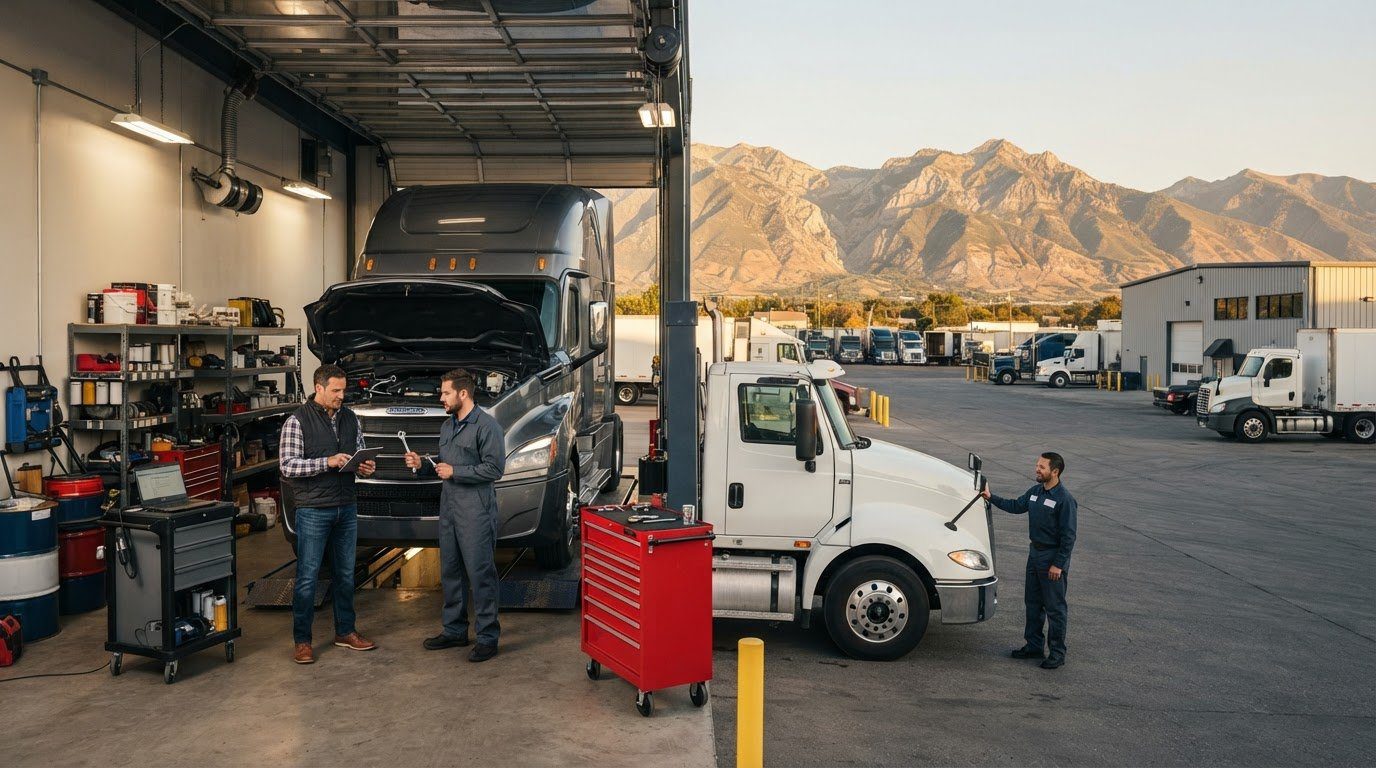
Evaluating the Cost of an In-House Mechanic vs. Outsourcing Diesel Fleet Maintenance

The mechanic on your payroll isn’t always the lower-cost choice. Evaluating the cost of an in-house mechanic vs outsourcing means looking beyond hourly labor. Benefits, diagnostic equipment, training, workload, and time a truck spends out of service all affect the total. Repair invoices may vary, but your fleet’s own records can show what each model actually costs.
Fleet managers often weigh two concerns: outsourcing can feel like a loss of control, while an in-house technician may not have the capacity or tools for every diesel repair. Start with your maintenance history, vehicle mix, and the work your fleet needs to decide what belongs in-house and where outside support fits.
This article compares the full cost and capacity picture, then explains how fleet preventive maintenance and a diesel repair partner can support dependable operations. Use your records to choose a practical model for your fleet, not an assumption.
Key Takeaways
- When evaluating the cost of an in-house mechanic vs outsourcing, include compensation, training, tools, facility needs, management time, and repair expenses.
- Use a consistent review period and your fleet’s own payroll, equipment, invoice, administration, and downtime records to make a fair comparison.
- A combined approach can retain internal capacity for routine needs while outsourcing specialist diesel diagnostics and repairs.
- Build fleet preventive maintenance into your operating plan to support consistent service for vehicles working across Utah County and the Wasatch Front.
In-House Diesel Mechanic vs. Outsourcing: What Costs Should a Fleet Compare?
An in-house model employs maintenance staff to handle some or all fleet service. The fleet takes on ongoing responsibility for staffing, equipment, and work space, while gaining direct control over scheduling and day-to-day priorities. With outsourcing, a repair shop performs the work the fleet sends out, and the fleet pays through repair invoices. A hybrid model keeps selected maintenance tasks internal and sends work beyond the team’s capacity to a specialist.
Outsourcing is a business practice for assigning work to an external provider. In fleet maintenance, understanding outsourcing helps clarify the distinction: the provider handles the repair, while the fleet still manages scheduling, records, and operating decisions. Compare both the direct bill and the staff time needed to coordinate service.
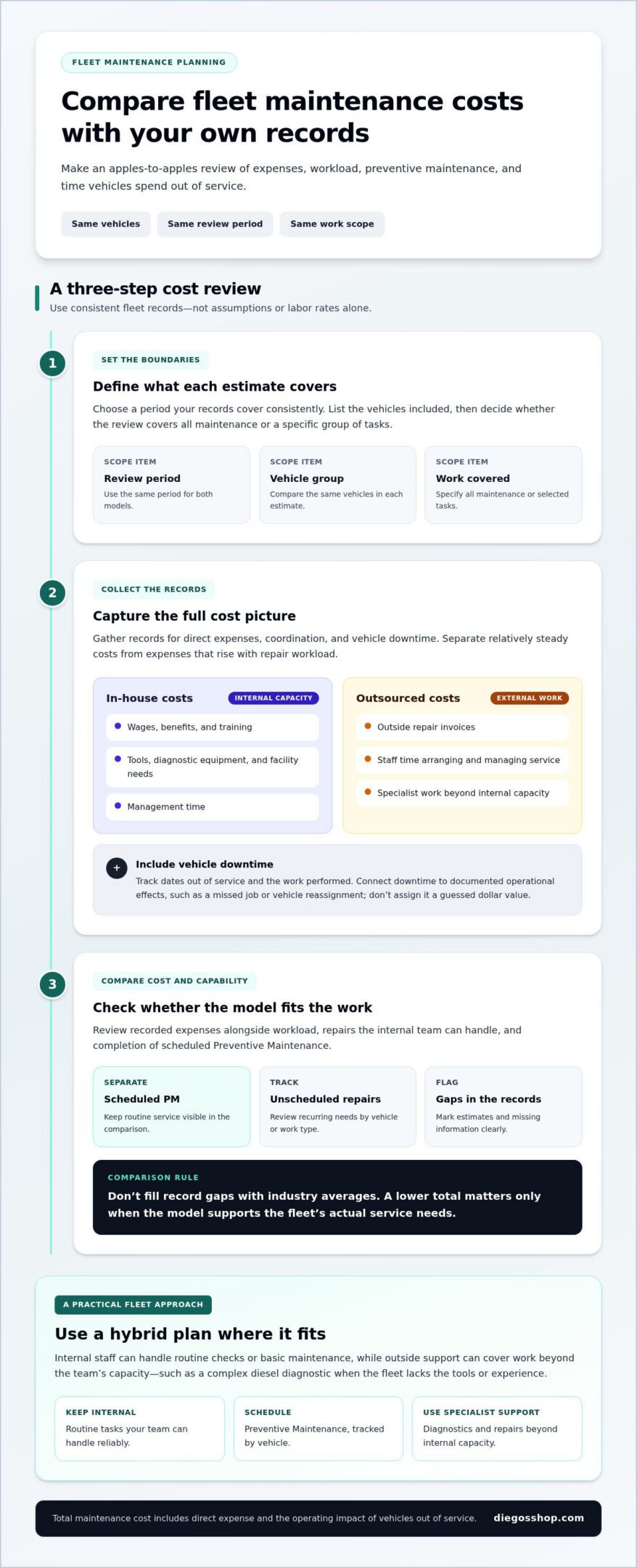
- In-house costs: Wages, benefits, training, tools, diagnostic equipment, facility needs, and management time.
- Outsourced costs: Repair invoices, staff time arranging service, vehicle downtime, and specialist work outside internal capacity.
- Hybrid costs: The fixed expense of retained staff and equipment, plus invoices and coordination for outsourced work.
Which fleet expenses are easy to overlook?
Separate relatively steady costs, such as staffing and equipment, from expenses that rise with repair workload, including parts and outside labor. Use payroll, purchase, invoice, administrative, and vehicle-use records to evaluate actual spending. Track how long each vehicle is unavailable and record the work involved. Rather than assigning downtime a guessed dollar value, connect it to documented operational effects, such as a missed job or a vehicle reassignment. Total maintenance cost is direct expense plus the operating impact of keeping fleet vehicles out of service. This gives the cost comparison a practical basis: your fleet’s records, not assumptions.
How to Compare Fleet Maintenance Costs with Your Own Records
A useful comparison starts with a defined scope. If one estimate covers every vehicle and another includes only the busiest units, the totals won’t show which model fits your fleet. Use the same review period, vehicles, and maintenance work for each scenario.
- Set the boundaries. Choose a period your records cover consistently, then list the vehicles included. Decide whether the comparison covers all maintenance or a specific group of tasks.
- Collect the records. Gather payroll and training costs, equipment purchases, facility expenses, outside repair invoices, and staff time spent managing maintenance. Include available vehicle downtime records, such as dates out of service and the work performed.
- Compare cost and capability. Review recorded expenses alongside workload, the repairs your internal team can handle, and completion of scheduled Preventive Maintenance. A lower total matters only if the model also supports the fleet’s actual service needs.
Build an apples-to-apples cost comparison
Keep the vehicle group, time period, and work scope consistent in both estimates. Separate scheduled Preventive Maintenance from unscheduled repairs so routine work doesn’t disappear inside a combined total. Mark estimates and missing records clearly, and don’t fill gaps with industry averages. For context on maintenance and emissions-related practices, consult CARB’s diesel engine maintenance guidelines, while applying requirements that are relevant to your fleet.
Then compare results by vehicle or work type. Recurring scheduled service may fit a planned maintenance process, while less frequent diagnostic work may require different equipment or expertise. This record-based method makes your cost comparison more useful than comparing labor rates alone.
Fleets in Utah County and the Wasatch Front can also consider how fleet preventive maintenance fits into their service planning.
A Practical Diesel Fleet Plan for Utah County and the Wasatch Front
A hybrid plan can make sense when internal staff can handle routine checks or basic maintenance, but the fleet doesn’t need or can’t support in-house capacity for every repair. Use vehicle mix and maintenance records to identify the gaps. For example, your team may manage scheduled service but lack the tools or experience for a complex diesel diagnostic. Outside shop support can cover that work without requiring the fleet to build the same capability internally.
Keep the plan tied to the work. Set a schedule for Preventive Maintenance, track completed service by vehicle, and review fleet records for recurring repair needs. A consistent service relationship can help organize scheduled maintenance and repair work around the fleet’s operating demands. For planning details, explore this fleet maintenance guide and the Utah diesel repair guide.
Match service support to fleet workload
Based in Springville, Diego’s Shop supports commercial fleets with diesel repair, fleet services, and Preventive Maintenance across Utah County and the Wasatch Front. For fleets operating in Springville, Orem, Provo, Spanish Fork, Payson, Nephi, Lindon, and Pleasant Grove, that support can complement internal capacity when a vehicle needs diesel diagnostics or repairs beyond the team’s scope. Diego’s Shop specializes in diesel service, and all repairs come with a 100% warranty.
As you continue evaluating the cost of an in-house mechanic vs outsourcing, compare service needs as well as expenses: which tasks can your staff handle reliably, and where would specialist support strengthen the plan? Fleets looking to discuss maintenance needs can request an honest quote and plan ongoing fleet service around their operating needs.
Put Your Fleet’s Maintenance Plan Into Motion
Turn your cost comparison into a plan your team can use: decide which work stays in-house, where specialist support fits, and how fleet service will keep scheduled maintenance on track. Revisit the plan as vehicle needs and internal capacity change. Evaluating the cost of an in-house mechanic vs outsourcing is most useful when it leads to a workable maintenance approach, not just a spreadsheet total.
For fleets in Utah County and the Wasatch Front, Diego’s Shop brings diesel-only specialization and certified technicians to fleet maintenance and repair work. Build a service relationship that fits your operation and supports consistent maintenance.
Schedule diesel fleet service with Diego’s Shop. Take the next step with a practical plan for your fleet’s ongoing service.
Frequently Asked Questions
Which types of diesel vehicles can Diego’s Shop service?
Diego’s Shop services light-duty diesel pickups, medium-duty commercial trucks, and heavy-duty semi-trucks. Examples include Ford F-250 and F-350 pickups, Isuzu NPR and NQR trucks, and Peterbilt and Kenworth semis. This range helps commercial fleets with different vehicle classes organize diesel service and maintenance across their operations.
Where does Diego’s Shop serve commercial diesel fleets?
Diego’s Shop serves commercial fleets in Utah County and across the Wasatch Front, operating from Springville. Nearby communities include Orem, Provo, Spanish Fork, Payson, Nephi, Lindon, and Pleasant Grove. Fleets based in these areas can plan diesel repair and maintenance support around local operations, including vehicles that work across several nearby cities.
Does Diego’s Shop work on gasoline vehicles?
No. Diego’s Shop specializes in diesel service and repair, not gasoline vehicle service. For a mixed fleet, identify which units are diesel-powered when organizing maintenance records and service needs. That distinction keeps diesel repair and preventive maintenance planning focused on the vehicles Diego’s Shop services.
Are repairs from Diego’s Shop warrantied?
Yes. Diego’s Shop provides a 100% warranty on all repairs. When evaluating the cost of an in-house mechanic vs outsourcing, repair coverage is one factor to consider alongside the work performed and your fleet’s maintenance requirements. Keep repair documentation with fleet records to make service history easier to review during future maintenance planning.