

Commercial Fleet Preventive Maintenance ROI: How to Build the Business Case

What if the strongest case for preventive maintenance is not a lower repair bill, but less vehicle downtime? Measuring commercial fleet preventive maintenance ROI can be challenging: scheduled service is easy to see in the budget, while failures that never happen are harder to count.
For fleet managers, unplanned repairs can interrupt schedules and reduce vehicle availability. Service records may also fail to connect maintenance history with costs. A defensible business case compares planned maintenance spending with reactive repair costs and the documented operational effects of vehicles being out of service.
This article explains how to estimate and track that value using maintenance costs, repair recurrence, and vehicle availability. You’ll learn how to compare results with your fleet’s baseline, account for vehicle use and duty cycle, and identify where specialist diesel inspections and maintenance fit. Diego’s Shop supports commercial fleets across Utah County and the Wasatch Front with preventive maintenance, diagnostics, and diesel repair for light-, medium-, and heavy-duty vehicles. The goal is a practical business case grounded in your fleet’s records, not an assumed return.
Key Takeaways
- Define ROI over a consistent period by comparing documented program costs with measurable benefits, including repair spending and vehicle downtime.
- Establish a reliable baseline, then track maintenance work, repeat repairs, vehicle availability, and changes in fleet workload.
- Compare planned service and reactive repairs fairly. Scheduled costs are visible, while avoided failures must be estimated from fleet records.
- Build your commercial fleet preventive maintenance ROI case around a specific decision, comparable vehicles, and a transparent calculation.
- Turn the analysis into consistent inspections and service records, supported by specialist diesel maintenance suited to your vehicles and duty cycle.
Why Commercial Fleet Preventive Maintenance ROI Is More Than a Repair-Cost Calculation
A maintenance invoice shows what a fleet spent. It doesn’t show the potential cost of an unexpected failure, including lost vehicle availability, disrupted schedules, or deferred work. Commercial fleet preventive maintenance ROI should account for both financial results and operational effects, rather than comparing planned service with repair bills alone.
Fleet preventive maintenance ROI is the measured value of maintenance-related benefits compared with program costs over a defined period. For a useful comparison, decide what counts as a benefit, set a baseline, and separate observed results from estimates. Preventive maintenance describes the proactive approach; a fleet business case tests how that approach relates to your fleet’s own costs and operations.
Which costs and operational effects belong in the business case?
Track planned service labor, parts, inspections, and the resources used to administer the program. Then measure outcomes that matter to operations, such as unplanned repair spending, repeat repairs, and vehicle availability. Greater availability may support scheduled work, but assign it a financial value only when records show how it affected operations.
Separate realized savings from avoided costs. A reduction in recurring repair expenses is an observed result; the cost of a failure that might have occurred is an estimate. Use past repair and downtime records to support estimates, state assumptions clearly, and avoid attributing every improvement to maintenance alone.
Why is the business case different for every diesel fleet?
Vehicle age, mileage or hours of use, route demands, and maintenance history all shape the comparison. An OTR long-hauler and a dump truck can have different operating patterns, workloads, and service needs. A fleet-wide average may obscure those differences. Compare vehicles with similar roles where possible, and record changes in use or fleet composition.
Inspection needs also depend on the equipment. Modern engine management and emissions-control systems call for relevant diagnostic and inspection expertise. Diego’s Shop provides preventive maintenance, diagnostics, and diesel repair for light-, medium-, and heavy-duty commercial vehicles, with comprehensive inspection protocols that account for these systems. The resulting service records give fleet leaders practical information to compare with their baseline.
Use ROI as a decision aid, not a promise of a fixed return. Results depend on fleet size, vehicle condition, duty cycle, and the quality of available records. An estimate can still support a sound decision when it clearly distinguishes observed results, estimates, and remaining uncertainty.
How to Measure Preventive Maintenance ROI with Reliable Fleet Data
A useful ROI review doesn’t require a complex system. It requires consistent records that connect maintenance activity with vehicle outcomes. Preventive maintenance ROI is only as dependable as the baseline and cost definitions used to calculate it. If the fleet changes how it counts downtime or repair events during the review, the comparison loses value.
Which fleet maintenance metrics help establish a baseline?
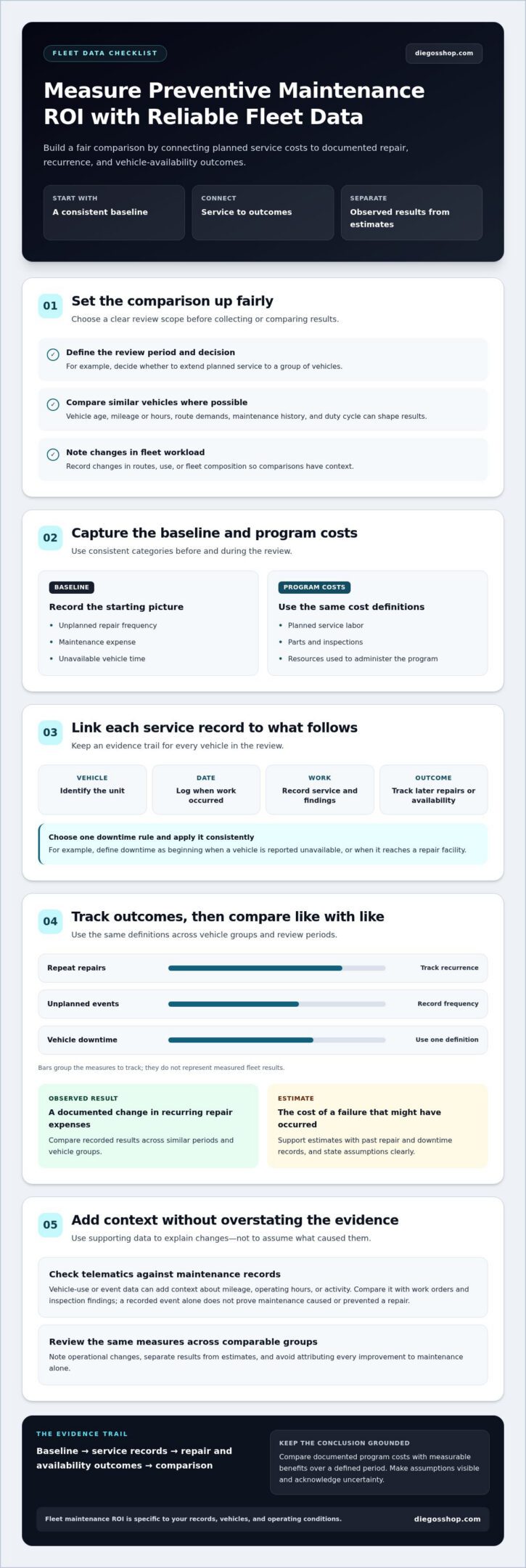
Start by defining the review period and the decision it will inform, such as whether to extend planned service to a group of vehicles. Select comparable vehicles where possible, and record changes in workload, routes, or fleet composition. Then use the same process for each vehicle group:
- Establish the baseline: Record unplanned repair frequency, maintenance expense, and unavailable vehicle time before the program or change.
- Define costs: Use consistent categories for planned service labor, parts, inspections, and program administration.
- Record interventions: Log service dates, work performed, inspection findings, and related labor and parts. Track unscheduled repairs for the same vehicles.
- Measure outcomes: Track repeat repairs, unplanned events, and downtime using the same definitions throughout the review.
- Review results: Compare similar periods and vehicle groups, note operational changes, and distinguish observed results from estimates.
Define terms before collecting data. For instance, decide whether downtime begins when a vehicle is reported unavailable or when it reaches a repair facility, then apply that rule consistently. The NAFA Vehicle Maintenance & Performance Guide offers fleet professionals guidance related to preventive maintenance programs and record-keeping.
How can fleet telematics support the analysis?
Telematics can add context about vehicle use or recorded events, helping explain changes in mileage, operating hours, or activity between review periods. It doesn’t replace service records. Compare telematics data with work orders and inspection findings before drawing conclusions. A recorded event may point to a condition worth investigating, but it doesn’t by itself prove that maintenance caused or prevented a repair.
Keep the evidence trail simple: connect each service record to the vehicle, date, work performed, and later repair or availability outcome. This makes commercial fleet preventive maintenance ROI easier to review and repeat. Specialist diesel inspections and maintenance can contribute useful records. Diego’s Shop supports commercial fleets with diesel fleet maintenance for light-, medium-, and heavy-duty vehicles.
Preventive Maintenance vs. Reactive Repair: Compare the Trade-Offs Fairly
Planned service creates a visible expense on a schedule. Reactive repair creates costs when a problem appears, often with less control over timing and vehicle availability. Neither approach is automatically cheaper for every fleet. A fair comparison uses the fleet’s service history and separates recorded outcomes from estimates about failures that might have been avoided.
When does planned maintenance make a stronger operational case?
Planned maintenance may be a stronger fit when fleet records show recurring repair patterns, service can be scheduled around operating needs, or documented downtime disrupts scheduled work. After changing maintenance practices, look for shifts in those measures while accounting for vehicle use and workload. Base the case on observed patterns, not a generic failure rate or a promise that planned service will always lower costs.
How should fleets treat downtime and avoided repairs?
Record when a vehicle became unavailable, when it returned to service, and the documented reason. If the same disruption appears both as an expense and as an estimate of lost work, explain the distinction so it isn’t counted twice.
For commercial fleet preventive maintenance ROI, label confirmed expenses and outcomes separately from modeled avoided repairs. Then test how the result changes under conservative, central, and higher estimates for uncertain avoided costs or downtime effects. If small changes in assumptions sharply change the conclusion, present the result as uncertain. This shows decision-makers what the records support and what remains an estimate.
Build a Commercial Fleet Preventive Maintenance ROI Case Step by Step
A credible business case answers a specific decision, not just whether maintenance is worthwhile in general. Define what leaders need to decide, such as whether to extend a preventive maintenance approach to a particular vehicle group. State the review period, evidence sources, assumptions, and who will approve or reassess the recommendation.
What belongs in a maintenance ROI worksheet?
Keep the worksheet practical and consistent. Identify the vehicle group and date range, then record planned service, unplanned repairs, downtime, and the source for each figure. Mark every entry as actual, estimated, or assumed so readers can distinguish documented results from modeled possibilities.
- Define the decision: Identify the proposed maintenance change and what a successful result would look like.
- Select vehicles: Choose a comparable group and note differences in age, use, or operating demands.
- Gather baseline data: Collect existing service, repair, and availability records for the same group.
- Estimate costs and benefits: Include program costs and measurable outcomes, clearly labeling projected avoided costs.
- Set a review cadence: Revisit the worksheet at a consistent interval and update assumptions as better fleet evidence becomes available.
Use a transparent formula: ROI = (measured benefits − program costs) ÷ program costs. Define the inputs first. Benefits might include documented changes in repair spending or the operational value of improved availability, but don’t present estimates as confirmed savings. Diego’s Shop’s fleet maintenance guide provides broader context for building a maintenance program, while its diesel maintenance handbook offers related maintenance education.
How can fleet leaders present a credible recommendation?
Keep the recommendation focused: describe the operational problem, proposed maintenance approach, evidence, review period, and uncertainties. Show conservative, expected, and higher-impact scenarios, labeling each as an estimate rather than a guaranteed outcome. Explain which records support each scenario and who will monitor results.
After approval, track the same measures used in the baseline, including service activity, repeat repairs, unplanned events, and unavailable vehicle time. Set a reassessment date and revise the business case when actual results or operating conditions change. Diego’s Shop shares information about diesel fleet preventive maintenance.
Turn the ROI Analysis into a Dependable Diesel Fleet Maintenance Program
An ROI estimate becomes useful when it guides repeatable work. Turn the findings into consistent inspections, clear service records, and regular reviews of what happens after maintenance. This lets fleet leaders compare actual service activity, unscheduled repairs, and vehicle downtime with the original baseline without treating an estimate as a guaranteed result.
What should a fleet review after launching its maintenance plan?
Review the measures used to build the business case. Check whether planned services took place, note unscheduled repairs and recurring issues, and track how long affected vehicles were unavailable. Pair those records with inspection findings and operating context, including changes in routes, workload, or vehicle use. A repeat repair may warrant closer review; a change in operating conditions may explain why results differ from the baseline.
Update the analysis when the fleet or its assumptions materially change. New vehicles, different duty cycles, or a changed workload can affect maintenance needs and the meaning of earlier comparisons. Keep the original baseline for reference, and document why a revised comparison uses a new period or vehicle group.
How can a diesel service partner support the business case?
Consistent inspections and clear repair findings give fleet leaders better information for maintenance decisions. Diego’s Shop provides commercial diesel preventive maintenance, diagnostics, and repair for light-, medium-, and heavy-duty vehicles, including OTR trucks and dump trucks. Its comprehensive inspection protocols account for modern engine management and emissions-control systems, helping fleets connect specialist diesel attention with conditions noted during service.
Service records are operational inputs, not proof of a specific return by themselves. Fleet leaders can compare service findings with subsequent repairs, recurring issues, and vehicle availability to refine the commercial fleet preventive maintenance ROI case over time. For additional context on hands-on service, read about expert diesel engine repair.
Diego’s Shop supports commercial fleets in Utah County and across the Wasatch Front with preventive maintenance and diesel repair. Learn more about diesel maintenance for your fleet.
Put Your Fleet Maintenance Business Case to Work
A defensible commercial fleet preventive maintenance ROI starts with a clear baseline, consistent cost definitions, and records that connect service activity to repairs and vehicle availability. Compare planned maintenance with reactive repair using your fleet’s history, and keep measured results separate from estimated avoided costs. This gives decision-makers a practical basis for reviewing the program and adjusting it as vehicle use or operating conditions change.
Reliable inspections and repair records help turn that analysis into day-to-day maintenance decisions. Diego’s Shop provides comprehensive preventive maintenance inspections and commercial diesel service for light-, medium-, and heavy-duty vehicles. Repair work is warrantied, giving fleet operators service information to include in their ongoing review.
For fleets in Utah County and across the Wasatch Front, discuss preventive maintenance for your diesel fleet with Diego’s Shop. Build your case with care, track what matters, and make the next maintenance decision with greater confidence.
Frequently Asked Questions
How do you calculate preventive maintenance ROI for a commercial fleet?
Compare documented maintenance benefits with program costs over a defined period. A common formula is (measured benefits − program costs) ÷ program costs. Define each input first: include planned service expenses and measure outcomes such as changes in unplanned repair spending or vehicle downtime. Separate actual results from estimated avoided costs, and use a consistent vehicle group and review period. The calculation supports a decision; it doesn’t guarantee future results.
Is preventive maintenance cheaper than reactive fleet repairs?
Not necessarily for every fleet or vehicle group. Planned service has visible costs, while reactive repairs may bring unplanned expenses and downtime. Compare your fleet’s maintenance and repair records over a consistent period, accounting for vehicle age, use, and condition. Don’t assume every avoided breakdown represents a saving. A fair comparison identifies what the records show and labels projected costs or benefits as estimates.
What fleet maintenance costs should a preventive maintenance ROI include?
Include planned service labor, parts, inspections, and the resources needed to administer the program. Track unscheduled repair expenses separately so you can compare them with planned work. If your analysis assigns a value to vehicle availability or avoided failures, document the calculation and label it as an estimate unless supported by recorded outcomes. Use the same cost categories throughout the review to keep comparisons consistent and avoid double-counting.
Can telematics data help measure fleet preventive maintenance ROI?
Yes. Telematics may add context about vehicle use or recorded events, such as changes in activity between review periods. It doesn’t replace service records or prove that maintenance caused a particular result. Compare telematics information with work orders, inspection findings, and repair history before drawing conclusions. Consistent vehicle identifiers and dates help connect the records and make the ROI review easier to repeat.
How do you measure downtime costs for a commercial vehicle fleet?
First, define when downtime begins and ends, then record each vehicle’s unavailable time and the reason. Use dispatch or shop records to understand how the interruption affected scheduled work. If you estimate lost operational value, state the method and assumptions separately from confirmed expenses. Avoid counting the same impact twice, such as recording a lost-work estimate and treating that amount as a separate repair cost.
How often should a fleet review its preventive maintenance ROI?
Set a review cadence that matches the decision and use it consistently. Compare service activity, unplanned repairs, and downtime against the same baseline and date range. Reassess sooner if vehicle groups, routes, workloads, or maintenance practices change enough to affect the comparison. Record the reason for any adjustment. Regular reviews help fleet leaders update assumptions as evidence improves without overstating short-term changes.
Does preventive maintenance reduce diesel truck breakdowns?
Preventive maintenance is intended to identify service needs before they develop into larger problems, but it can’t prevent every breakdown or ensure a specific reduction. Track inspections, service findings, later repairs, and downtime to see how the program relates to your fleet’s experience. Diesel vehicles may require attention to engine management and emissions-control systems. Diego’s Shop provides diesel preventive maintenance and repair for light-, medium-, and heavy-duty vehicles.