

Truck Breakdown SOP: A Fleet Manager’s Guide

A single roadside breakdown can drain your quarterly maintenance budget before the tow truck even arrives. You’ve likely felt the stress of that 2 AM phone call where a driver is stranded, communication is breaking down, and the repair estimates are climbing. It’s a high-stakes moment where driver safety and your bottom line are both at risk. This is why creating a standard operating procedure for truck breakdowns is a strategic necessity rather than just a clerical task.
We understand that unpredictable repair costs and communication gaps between drivers and mechanics are your biggest hurdles. This guide will show you how to master the art of minimizing downtime with a professional-grade SOP that turns roadside emergencies into manageable repairs. We’ll walk through the essential steps to lower your emergency bills, ensure FMCSA compliance with digital records, and establish clear communication lines during a crisis. By the end, you’ll have a roadmap to keep your fleet moving and your costs under total control.
Key Takeaways
- Calculate the total financial impact of downtime, including lost revenue and driver pay, to protect your bottom line.
- Master the process of creating a standard operating procedure for truck breakdowns to eliminate confusion and ensure rapid emergency response.
- Define specific criteria for choosing between on-site mobile repairs and towing a vehicle to a specialized diesel shop for warrantied work.
- Build a reliable network of vetted repair partners across Utah County to secure high quality service when your fleet needs it most.
- Implement a proactive fleet maintenance schedule to minimize the need for emergency roadside stops and keep your trucks moving.
The Real Cost of Roadside Chaos: Why Your Fleet Needs a Breakdown SOP
A truck breakdown isn’t just a mechanical failure; it’s a financial emergency. Without a plan, you’re reacting to chaos rather than managing a professional process. A Standard Operating Procedure (SOP) serves as your fleet’s tactical roadmap for emergency response. By creating a standard operating procedure for truck breakdowns, you move away from frantic phone calls and toward a controlled, professional repair sequence. This document ensures that every driver and dispatcher knows exactly what to do when a warning light flashes or an engine loses power.
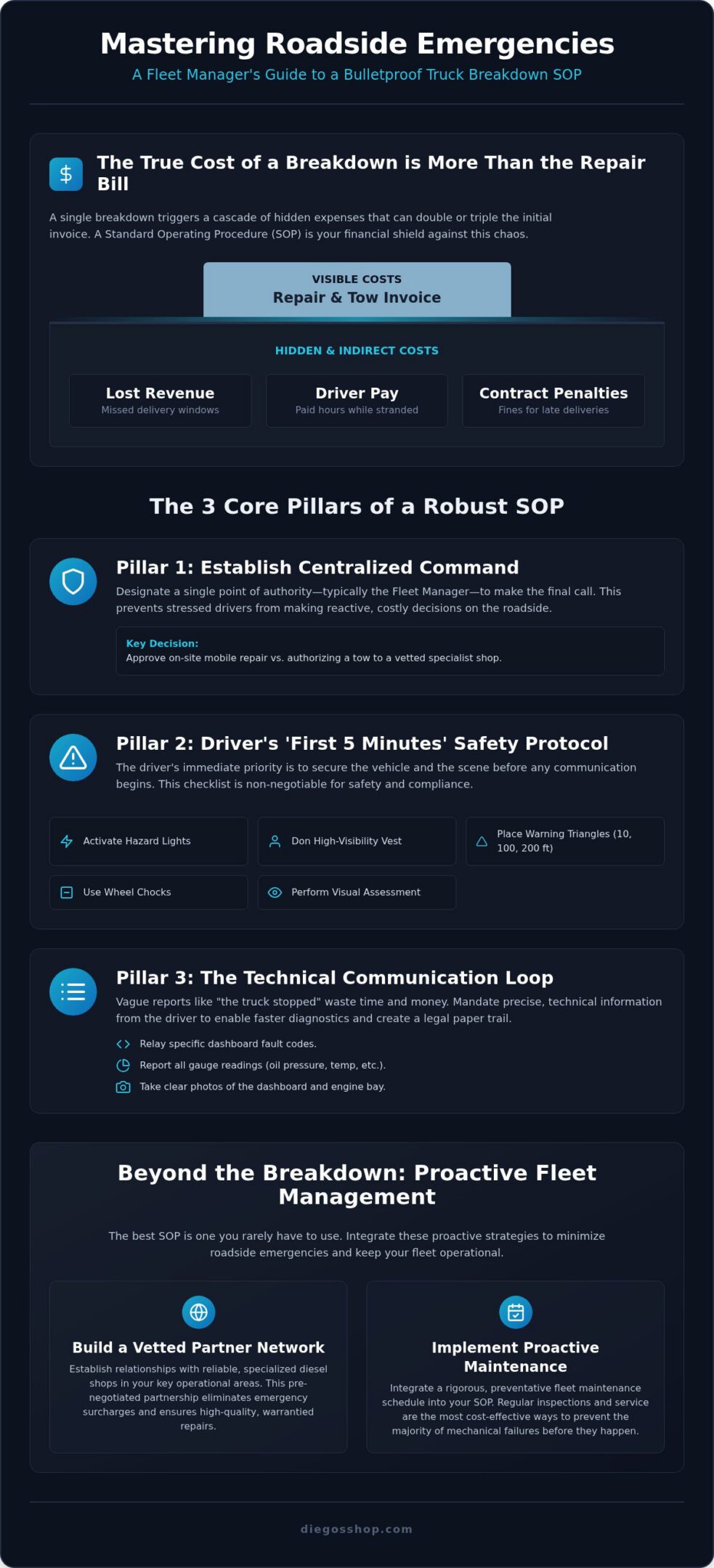
The true cost of downtime extends far beyond the repair invoice. You must account for lost revenue from missed delivery windows, driver hourly pay during the wait, and the high cost of expedited parts. In many cases, these indirect costs can double or triple the actual bill. A structured SOP minimizes these losses by speeding up the decision-making process and getting the vehicle to a qualified diesel engine repair specialist faster. It provides peace of mind when the pressure is highest.
Financial Impact of Unmanaged Failures
Unmanaged failures often lead to “emergency surcharges” at unknown shops that lack the expertise for modern diesel technology. When you don’t have a vetted partner in place, you’re at the mercy of whoever is closest. This often results in quick-fix roadside patches that fail within a week. In contrast, an SOP prioritizes warrantied repair work at a trusted facility. While a heavy-duty tow might seem expensive, it’s often more cost-effective than paying for a sub-par roadside repair that doesn’t hold up. Avoiding missed contract penalties requires a fast, decisive move to a shop that can handle complex fleet maintenance with total competence.
The Safety and Liability Factor
Safety is the highest priority during any roadside event. An SOP provides clear instructions for the driver to secure the vehicle, reducing the risk of secondary accidents during the stop. It also mandates thorough documentation of the incident. This paper trail is vital for maintaining DOT compliance and protecting your company from liability claims. Beyond the legalities, a clear plan shows your drivers that you value their safety. In a competitive market, providing this level of support reduces driver frustration and turnover. They shouldn’t have to guess what to do; they should have a clear protocol that keeps them safe and supported.
The Core Pillars of a Robust Truck Breakdown SOP
A structured breakdown response relies on a firm command hierarchy. When creating a standard operating procedure for truck breakdowns, you must designate a single point of authority. This person, usually the fleet manager, makes the final call on whether to attempt a roadside repair or tow the vehicle to a specialized shop. Centralizing this decision prevents drivers from making reactive, expensive choices while they’re under the stress of being stranded on a busy shoulder.
Step 1: Driver Safety and Scene Management
Safety is the immediate priority. Drivers need a “First 5 Minutes” checklist to secure the scene before they even pick up the phone. This includes activating hazard lights, donning a high-visibility safety vest, and placing warning triangles at 10, 100, and 200 feet to alert oncoming traffic. Wheel chocks must be used to prevent roll-away accidents. Once the vehicle is secure, the driver should perform a quick visual assessment to identify fluid leaks, visible smoke, or any mechanical binding that could complicate a tow.
Step 2: The Technical Communication Loop
Vague descriptions like “the truck just stopped” lead to diagnostic delays and higher labor costs. Your SOP should require drivers to relay specific dashboard fault codes and gauge readings immediately. Utilizing professional diesel diagnostics services allows your repair partner to prepare for the specific failure before the truck even hits the shop floor. Following rigorous documentation standards, similar to the protocols established at Georgia Tech Fleet Management, ensures that every incident is recorded with technical precision.
Comprehensive documentation also includes taking clear photos of the dashboard and the engine bay. These records are essential when creating a standard operating procedure for truck breakdowns that truly protects the company from liability. These files provide a clear history for future warrantied work. If your drivers are consistently reporting the same fault codes, it’s time to look at your fleet maintenance schedule to identify systemic issues. Standardizing these communication codes turns a chaotic failure into a manageable technical event. Consistent reporting creates a reliable bridge between the driver, the dispatcher, and the master mechanic.
Strategic Decision Making: Roadside Repair vs. Towing to a Specialist
When a truck stops on the I-15, the clock starts ticking against your profit margins. The most critical part of creating a standard operating procedure for truck breakdowns is defining the “Roadside Repair Limit.” This is the line where a mobile technician’s capabilities end and a specialized shop’s necessity begins. Making this call requires a grounded understanding of mechanical reality rather than relying on generic software predictions. It’s about deciding whether a quick fix will actually hold or if it will lead to a secondary failure fifty miles down the road.
When to Call for Roadside Assistance
Major failures demand a controlled environment and master-level expertise. If your driver reports steering binding, transmission slipping, or severe engine knocking, towing is the only responsible choice. While heavy-duty towing involves an upfront cost, the long-term value is found in expert diesel engine repair that comes with a formal warranty. Specialized shops in Springville provide a level of technical mastery that generic highway truck stops cannot match. They possess the heavy-duty lifts, overhead cranes, and manufacturer-specific software needed for Peterbilt, Kenworth, Isuzu, and Ford systems.
Positioning a trusted local partner as your default destination for major repairs is a strategic cornerstone of creating a standard operating procedure for truck breakdowns. By directing your fleet to a shop that understands your specific equipment and maintenance history, you ensure the durability of the work performed. This approach eliminates the uncertainty of “emergency surcharges” at unknown shops and guarantees that your trucks return to the Wasatch Front in peak operating condition. Professional repairs are the only way to maintain total control over your fleet’s performance and safety.
How to Build Your Truck Breakdown SOP: A Step-by-Step Implementation Guide
Building a document that simply sits on a shelf is useless. For a fleet operating across the Wasatch Front, your SOP must be a living tool. When creating a standard operating procedure for truck breakdowns, use clear, declarative language that leaves no room for interpretation. This is especially vital during high-stress winter conditions in Utah County, where a single misunderstood instruction can lead to hours of unnecessary roadside exposure for your driver. A professional SOP bridges the gap between a mechanical failure and a successful repair.
Step 1: Create Your Preferred Vendor List
Your SOP is only as strong as your network. Identify your “Tier 1” partner for major engine work. This should be a diesel repair Utah specialist with proven expertise in Peterbilt, Kenworth, and Isuzu systems. Next, select heavy-duty towing partners capable of handling OTR long-haulers. Pre-negotiating labor rates and establishing a priority service agreement ensures your fleet isn’t stuck at the back of the line during peak seasons. Having these names and numbers vetted in advance eliminates the panic of searching for help in the middle of the night.
Step 2: Develop the Reporting Template
A driver on the side of the I-15 needs a simple, one-page “Breakdown Report.” This template should capture mileage, specific fault codes, and precise GPS coordinates or mile markers. This eliminates the guesswork for the dispatch team and provides the mechanic with actionable data. Ensure this report clearly lists the contact information for Diego’s Shop to facilitate an immediate technical consultation. Providing this data upfront allows the shop to prepare for the truck’s arrival, significantly reducing diagnostic time and getting the vehicle back on the road faster.
Step 3: Review and Refine
A professional SOP requires constant maintenance. Conduct a “Post-Mortem” analysis after every major breakdown to identify where the protocol succeeded or failed. Did the driver have the right contact info? Was the towing partner responsive? Update your contact lists and repair protocols every six months to account for shop changes or new equipment in your fleet. Incorporating feedback from the field ensures the document remains practical and supportive for your team. The process of creating a standard operating procedure for truck breakdowns is only complete once every cab is equipped with a physical or digital Breakdown Kit containing these refined instructions.
If you want to ensure your fleet receives warrantied work and expert care during an emergency, partner with a team that knows modern diesel technology inside and out. Contact Diego’s Shop to establish a reliable repair partnership today.
Beyond the Breakdown: Integrating Professional Fleet Maintenance into Your SOP
The most effective version of your breakdown protocol is the one that stays in the glovebox. While creating a standard operating procedure for truck breakdowns is essential for crisis management, the ultimate goal is to eliminate the crisis entirely. Shifting your strategy from reactive repairs to proactive fleet maintenance turns unexpected roadside disasters into scheduled shop visits. This transition requires a commitment to technical mastery and a deep understanding of modern diesel engine longevity.
Regular reliable DOT truck inspections in Utah County act as your first line of defense. These aren’t just regulatory hurdles; they are opportunities to identify worn components before they fail on the I-15. By catching a leaking seal or a frayed belt during a routine check, you avoid the high costs of emergency towing and the 30-40% price increases seen in heavy-duty parts over the last few years. Consistent oversight ensures your equipment remains durable and compliant.
The Preventive Maintenance Advantage
A structured fleet maintenance plan focuses on the most common failure points in heavy-duty trucks. This includes rigorous scheduling for EGR, DPF, and cooling system cleanings. Industry data suggests that consistent preventive maintenance can reduce emergency repair spending by as much as 30% annually. By building a relationship with a Springville diesel specialist, you gain a partner who understands the specific needs of your Peterbilt or Kenworth fleet. Scheduled care is always more affordable than a midnight recovery operation.
Partnering for Long-Term Reliability
Reliability is built on the foundation of warrantied work and precise diagnostics. When you integrate professional maintenance into your SOP, you ensure that every service uses specialized diesel diagnostics. This technical precision identifies hidden fault codes that generic scanners often miss. It’s the difference between a quick fix and a durable repair that lasts for the long haul. A master craftsman doesn’t just clear codes; they find the root cause of the problem to prevent its return.
Your fleet is a significant investment that deserves expert protection. Don’t wait for the next roadside emergency to realize your maintenance schedule is lacking. Contact Diego’s Shop today to build a custom fleet service plan that keeps your trucks moving and your costs predictable. Let’s turn your breakdown SOP into a tool for excellence rather than a guide for emergencies.
Secure Your Fleet’s Future with a Proven Protocol
Managing a commercial fleet requires more than just keeping engines running; it demands total control over the unexpected. We’ve explored how transitioning from reactive chaos to a structured response saves your business thousands in hidden downtime costs. By creating a standard operating procedure for truck breakdowns, you protect your drivers and your bottom line from the high costs of roadside uncertainty. You now have the roadmap to define technical repair limits and select the right partners for your specialized equipment.
Don’t wait for the next emergency to stress test your operation. Take the first step toward total peace of mind by partnering with a team that understands the durability of your machinery. We provide specialized expertise in heavy-duty commercial fleets and warrantied diesel repairs for total peace of mind. Proudly serving Springville and the entire Wasatch Front, we’re ready to help you keep your trucks moving. Request a Custom Fleet Maintenance Plan from Diego’s Shop today to turn your breakdown protocol into a strategic advantage. Your fleet is too important to leave to chance.
Frequently Asked Questions
What are the first three things a driver should do during a breakdown?
Safety is the immediate priority. First, the driver must move the vehicle to a safe location and activate hazard lights. Second, they need to secure the scene by placing warning triangles at the required intervals and wearing a high-visibility vest. Third, the driver should perform a quick visual assessment for leaks or smoke before contacting dispatch with their exact location and any visible dashboard fault codes.
How much detail should be included in a truck breakdown SOP?
A professional SOP must be detailed enough to eliminate guesswork without being overwhelming. When creating a standard operating procedure for truck breakdowns, focus on clear checklists for safety, specific communication codes, and a vetted list of repair partners. Your document should provide exact steps for documenting the incident, including which photos to take and which technical data points to relay to the mechanic for faster diagnostics.
Is a roadside repair always cheaper than towing to a shop?
No, roadside repairs often involve high service call fees and “emergency surcharges” that can exceed the cost of a tow. While a mobile tech can handle simple fixes like tires or batteries, complex diesel engine management issues require a controlled environment. When evaluating your emergency options, you can explore 24-hour towing and roadside assistance to determine whether an on-scene fix or a heavy-duty haul is the most appropriate solution. Towing your vehicle to a specialized shop ensures you receive warrantied repair work and prevents the need for a second, more expensive repair later on.
Precision is vital for a quick turnaround. A master mechanic needs the vehicle’s VIN, current mileage, and all active dashboard fault codes. You should also provide a clear description of the symptoms, such as unusual noises, loss of power, or fluid leaks. This technical data allows the shop to verify parts availability and prepare the necessary diagnostic tools before your truck arrives at the facility in Springville.
How often should a fleet manager update their breakdown SOP?
You should review and update your protocol every six months or immediately following a major breakdown incident. Regular updates are necessary to ensure all contact information for towing and repair partners remains current. A “post-mortem” analysis after a failure helps you identify gaps in the protocol. This ongoing refinement ensures the instructions remain actionable for drivers facing high-pressure situations on the side of the road.
Can a well-written SOP really reduce downtime costs?
Yes, creating a standard operating procedure for truck breakdowns significantly reduces downtime by streamlining the decision-making process. A clear protocol prevents drivers from wasting time on ineffective roadside fixes and routes vehicles directly to qualified specialists. By eliminating communication gaps and ensuring technical accuracy during the initial report, you can lower emergency repair bills and get your equipment back into service much faster than with a reactive approach.
What is the most common cause of commercial truck breakdowns in Utah?
In the Utah County and Wasatch Front region, cooling system failures and emission control issues are the leading causes of roadside stops. The extreme temperature swings in this environment place heavy stress on EGR and DPF systems. Regular preventive maintenance is the most effective way to catch these problems before they lead to a full engine shutdown. Staying ahead of these common failures keeps your fleet moving during peak hauling seasons.
Should I include a specific diesel shop in my SOP?
Yes, designating a “Tier 1” repair partner is a strategic cornerstone of a robust SOP. Including a trusted specialist like Diego’s Shop ensures your drivers know exactly where to go for warrantied repairs and expert diesel engine management. Establishing this relationship in advance guarantees priority service and technical consistency. This partnership provides total peace of mind, knowing that your fleet is in the hands of seasoned master craftsmen.