

The True Impact of Vehicle Uptime on Company Revenue: A 2026 Fleet Strategy Guide

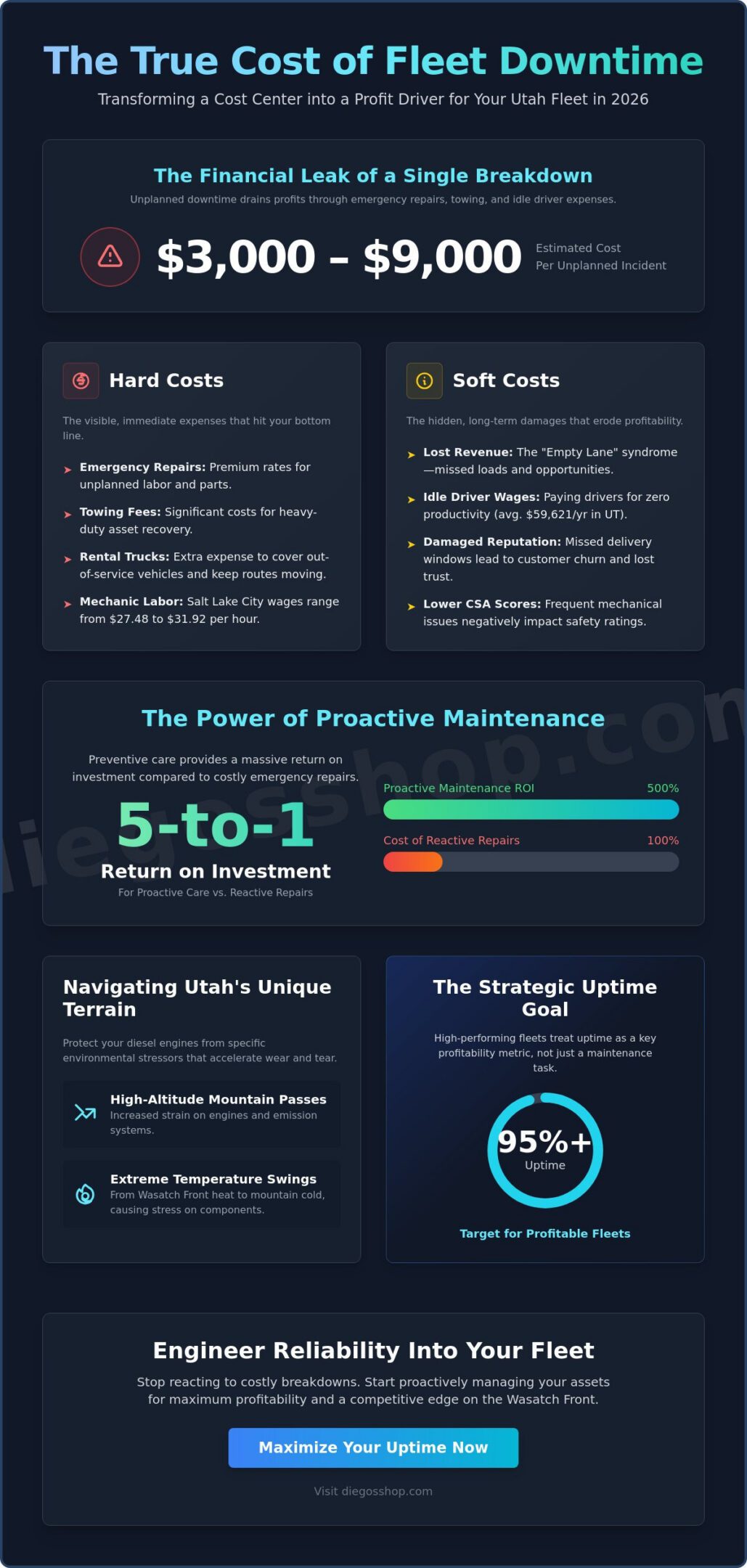
Did you know a single unplanned breakdown in 2026 can drain between $3,000 and $9,000 from your bottom line? When you factor in emergency repairs, towing, and driver expenses, the simple act of a truck sitting idle becomes a massive financial leak. For many operators, calculating fleet downtime cost utah is the first step in realizing that a stationary vehicle costs far more than just the shop bill. It represents lost opportunities and damaged client trust.
You’re likely tired of unpredictable emergency bills and the stress of missing delivery deadlines along the Wasatch Front while paying idle drivers to wait in the shop. It’s frustrating to watch your profit margins shrink because of mechanical issues that feel out of your control. We understand that in the trucking industry, dependability is your most valuable currency. You need a fleet that works as hard as you do, without the constant threat of a surprise breakdown.
This guide will show you how maximizing vehicle uptime transforms your fleet from a burdensome cost center into a powerful driver of company profitability. We’ll provide a clear framework for measuring the true impact of idle assets. We will also explain the transition from reactive to proactive maintenance and show you how better asset utilization secures your competitive edge in a tightening market.
Key Takeaways
- Identify the critical difference between “hard costs” like labor and the hidden “soft costs” that drain your revenue during an unexpected breakdown.
- Use our 2026 framework for calculating fleet downtime cost utah to account for unproductive driver wages and missed delivery windows.
- Discover why proactive emission system care and preventive maintenance provide a five-to-one return on investment compared to emergency shop visits.
- Learn how to protect your diesel engines from Utah’s specific environmental stressors, including extreme temperature swings and high-altitude mountain terrain.
- Transform your fleet operations by treating vehicle uptime as a strategic lever for increasing profit margins rather than a simple maintenance metric.
The Financial Weight of Fleet Uptime in 2026
Vehicle uptime is the percentage of time your trucks are ready to work. It’s the pulse of your business. In 2026, calculating fleet downtime cost utah requires looking at more than just a repair bill. With diesel mechanic wages in Salt Lake City ranging from $27.48 to $31.92 per hour, the labor alone for unplanned repairs is a significant burden. When you add the rising cost of parts and the $3 billion lost annually to Utah traffic congestion, every hour your truck sits in a bay is an hour your company loses its competitive edge.
Modern fleet management has shifted. It’s no longer about reactive repairs; it’s about availability. High-performing Utah fleets now aim for 95% uptime or higher. They treat their vehicles as revenue assets that must stay in motion to survive. If your trucks aren’t hitting the road, you aren’t just losing money; you’re losing market share. This shift from reactive maintenance to availability-based strategy is what separates profitable operators from those struggling to keep up with rising overhead.
Uptime as a Revenue Multiplier
There is a direct link between engine hours and your billing cycles. Every hour a diesel engine runs is an hour you can bill a client. Consistent uptime allows you to bid more aggressively on high-stakes contracts in Utah County. When clients know your trucks won’t fail, they’re willing to sign longer agreements. Reliability isn’t a soft benefit. It’s a hard financial multiplier that scales your growth. In an industry where 1 in 15 Utah jobs is tied to trucking, being the most dependable provider is your best marketing tool.
The ‘Empty Lane’ Syndrome
Imagine your truck sitting idle in Springville while a competitor pulls the load you were supposed to carry. This is the “Empty Lane” syndrome. It’s a visual representation of lost opportunity. Beyond the immediate revenue loss, calculating fleet downtime cost utah involves accounting for the stress on your dispatchers and the frustration of your drivers. In a world of just-in-time logistics, there is no margin for mechanical failure. One missed delivery can ruin a relationship that took years to build. Reliability is the only way to ensure your lanes stay full and your reputation remains intact.
Quantifying the Revenue Impact: Beyond the Repair Bill
Quantifying the true impact of a sidelined vehicle involves more than just reading a shop receipt. For a Utah business, calculating fleet downtime cost utah must account for a complex web of direct and indirect expenses. While the bill for parts and labor is easy to track, the hidden erosion of your profit margins often happens in the administrative offices and on the customer service lines. You aren’t just paying for a fix. You’re paying for the absence of an asset.
The ‘Driver Factor’ is a primary example of this hidden drain. In 2026, average wages for trucking jobs in Utah are approximately $59,621 annually. When a truck breaks down, you’re often paying a driver to sit idle for zero productivity. This is a fixed cost that yields no return. When you add the administrative time spent rerouting loads and calming frustrated clients, the cost per hour of downtime can easily triple the actual mechanic’s hourly rate. To find your fleet’s specific Cost Per Hour, add your average hourly revenue per truck to the driver’s hourly wage and your estimated administrative overhead. This total reveals the true price of every hour your truck isn’t moving.
The Direct Costs of Mechanical Failure
The immediate financial hit of a breakdown includes emergency premiums that far exceed the cost of scheduled expert diesel engine repair. Emergency towing for heavy-duty diesel assets has also seen price hikes, often becoming a major expense before the truck even reaches a bay. If you need to keep a route moving, short-term rental costs to cover out-of-service assets further drain your reserves. These ‘Hard Costs’ are the most visible, but they are only the beginning of the financial narrative.
The Indirect Revenue Erosion
The ‘Soft Costs’ of downtime are where the real damage to your Utah business occurs. Customer churn is the most significant risk. In a market where reliability is everything, one missed delivery window can end a multi-year contract. Frequent mechanical issues also negatively impact your CSA scores. This leads to higher insurance premiums and more frequent scrutiny from regulators. A single failed DOT truck inspection can trigger a series of revenue-killing audits. Keeping your fleet in peak condition through a dependable maintenance program is the only way to avoid these compounding losses.
Why Preventive Maintenance is a Profit Center, Not an Expense
Maintenance isn’t a bill; it’s an investment in your company’s future. If you spend $1 on scheduled care today, you’re likely saving $5 in emergency repairs later. In the context of 2026 logistics, this math is non-negotiable. When calculating fleet downtime cost utah, the most successful fleets recognize that every dollar spent on fleet maintenance is a hedge against the $9,000 catastrophe mentioned earlier. You’re buying insurance against a crisis that could derail your entire quarter.
Modern diesel engines are intricate machines governed by sensitive electronics and complex aftertreatment systems. Proactive care for sensors and emission components prevents the “limp mode” scenarios that paralyze your operations. Beyond immediate uptime, this level of care extends the total life of your asset. In the 2026 resale market, a truck with documented, rigorous maintenance records commands a significantly higher price. You aren’t just fixing a truck; you’re preserving your capital and ensuring your fleet retains its value over time.
The common refrain from busy owners is “I can’t afford to have my truck off the road for a day.” Our answer is simple: you definitely can’t afford to have it off the road for a week. Scheduled shop time is controlled and predictable. Unscheduled downtime is a crisis that dictates its own terms, often at the worst possible moment for your customers. Taking control of your maintenance schedule is the only way to take control of your revenue.
The Anatomy of a Proactive PM Program
A real preventive program goes much deeper than a standard oil change. It requires comprehensive system health checks that look for the subtle signs of impending failure. This includes inspecting high-wear components like turbochargers and braking systems before they reach a breaking point. We emphasize the value of warrantied repair work because it provides financial predictability. For modern fleets, technical mastery of EGR and DPF systems is essential. These systems are often the primary cause of unplanned downtime; ignoring them is a recipe for revenue loss.
ROI of the ‘Diego Method’
Our approach relies on advanced diagnostics to identify “ghost codes.” These are faults that haven’t yet triggered a dashboard light but indicate a component is struggling. By catching these early, we prevent the derate conditions that leave drivers stranded. Local Utah fleets following this structured logic have reported reducing their annual downtime by 30%. This isn’t just about turning wrenches; it’s about providing the peace of mind that comes from a master craftsman’s oversight. When we handle your fleet, you can stop worrying about the shop and start focusing on your growth.
Strategies for Maximizing Uptime on the Wasatch Front
Operating a fleet in Utah requires a strategy that respects the local geography. The Wasatch Front isn’t just a high-traffic corridor; it’s an environment that punishes diesel engines with extreme temperature swings and high-altitude climbs. When calculating fleet downtime cost utah, you have to account for these environmental variables. A truck that runs fine in the flatlands of the Midwest will face different stress levels on the 6% grades of our mountain passes. Ignoring the “Utah Factor” leads to premature component failure and lost revenue. A comprehensive approach to calculating fleet downtime cost utah must include the hidden expenses of mountain-specific wear and tear.
Reliability here depends on a partnership with a diesel repair Utah specialist who understands these specific conditions. Beyond the mechanical stress, staying ahead of Utah County DOT requirements is essential. Between the registration fees for heavy trucks, which can reach $213.30 for 80,000 lbs vehicles, and the 1.5% uniform fee in lieu of property tax, your assets are expensive to own. You cannot afford to let them sit idle because of a preventable compliance issue or a mountain-induced breakdown.
Winterization and High-Altitude Care
Utah’s winters demand specific maintenance protocols. Cold-start challenges can drain batteries and gel fuel, leading to immediate morning downtime. We focus on ensuring your cooling systems are pressurized and ready for the grueling Parley’s Canyon climb. We also define a specific “Wasatch Wear” factor. This is the accelerated degradation of heavy-duty suspensions and braking systems caused by constant mountain routing. Frequent inspections of your turbochargers are also vital. These components work significantly harder in our thin mountain air to maintain power, making them prone to faster fatigue.
Local Parts Availability
Wait times are the enemy of uptime. Choosing a shop with a robust local parts connection is a strategic advantage. While national backorders can sideline a truck for weeks, we prioritize local Springville inventory to get you back on the road. Whether you manage Peterbilt, Kenworth, or Isuzu fleets, streamlining your supply chain is critical. We eliminate the middleman and the shipping delays that keep your drivers in the breakroom instead of on the I-15. To secure your fleet’s reliability and protect your margins, schedule your fleet maintenance with Diego’s Shop today.
Diego’s Shop: Engineering Reliability for Utah’s Commercial Fleets
At Diego’s Shop, we don’t just fix trucks; we engineer reliability. We’ve spent years mastering the intersection of traditional craftsmanship and modern diesel technology. For business owners in Springville and across the Wasatch Front, this means having a partner who understands that a truck in the shop is a direct hit to your bank account. When you’re busy calculating fleet downtime cost utah, you need more than a software report or a generic checklist. You need a master technician who takes personal accountability for the durability of every repair performed on your equipment.
We speak the language of local business owners because we are one. We know that your reputation is built on the promises you keep to your customers. Our approach is grounded in honesty and technical excellence. We don’t hide behind jargon or unnecessary filler. Instead, we provide clear, direct communication about the state of your assets. This transparency builds the trust and peace of mind you need to manage a complex operation. Our commitment to warrantied repair work isn’t just a policy; it’s a promise of quality that we stand behind personally.
Comprehensive Fleet Support
Our expertise spans the entire spectrum of commercial vehicles. Whether you manage a fleet of light-duty Ford work trucks or a line of heavy-duty long-haulers, we have the specialized knowledge to keep them running. We utilize advanced diagnostics that eliminate the guesswork often found in less experienced shops. By identifying the root cause of a mechanical issue rather than just treating the symptoms, we prevent the “comeback” repairs that further inflate your downtime. We’re dedicated to keeping Utah’s economy moving, one truck at a time, by ensuring every vehicle that leaves our bay is road-ready and reliable.
Take Control of Your Revenue Today
Now is the time to audit your fleet’s uptime performance. Don’t wait for a $9,000 emergency breakdown to realize that your current maintenance strategy is leaving money on the table. When calculating fleet downtime cost utah, the data usually points toward a need for better proactive oversight. The first step toward transforming your fleet into a powerful driver of profitability is a comprehensive fleet health assessment. We’ll help you identify hidden risks and create a schedule that fits your specific operational needs. Stop reacting to mechanical crises and start driving your revenue forward with a strategy built on master craftsmanship. Request a custom fleet maintenance plan from Diego’s Shop and experience the difference that personal accountability makes for your bottom line. Quality work. Honest service. That is our promise.
Secure Your Fleet’s Financial Future
Uptime is the engine of your business growth. We’ve explored how shifting from reactive repairs to a proactive availability model protects your profit margins from the hidden costs of idle drivers and missed deadlines. When you master the process of calculating fleet downtime cost utah, the necessity of a structured maintenance program becomes undeniable. You aren’t just maintaining trucks; you’re safeguarding your reputation and your contract bidding power along the Wasatch Front.
Our master-level diesel technicians in Springville, UT, specialize in the durable, high-stakes work required to keep Peterbilt, Kenworth, and Isuzu fleets in peak condition. We provide the technical mastery and warrantied repair work your business deserves to stay competitive in a tightening market. Dependability is a choice you make every time you schedule a health check instead of waiting for a breakdown. It’s about taking total control of your assets.
Take the lead in your market by turning mechanical reliability into your greatest competitive advantage. We’re here to provide the peace of mind that comes from expert oversight and honest accountability. Schedule your fleet health assessment at Diego’s Shop today. Let’s keep your business moving forward with the durability your work demands.
Frequently Asked Questions
How much does truck downtime cost per day on average in 2026?
Industry reports from February 2026 indicate that the average daily cost of downtime ranges from $448 to $760 per vehicle. This estimate covers lost revenue and basic operational overhead. However, a single major unplanned breakdown can cost between $3,000 and $9,000 when you factor in emergency towing, driver expenses, and the high price of last-minute repairs.
What is a good target percentage for fleet vehicle uptime?
High-performing fleets should aim for an uptime target of 95% or higher. Maintaining this level of availability ensures your assets are consistently generating revenue and meeting delivery deadlines. If your uptime falls below 90%, it’s a clear signal that your maintenance strategy needs an immediate audit to prevent significant profit erosion.
How does preventive maintenance directly increase company revenue?
Preventive maintenance acts as a profit center by eliminating the waste of paying idle drivers during unexpected breakdowns. By keeping trucks on the road, you maintain consistent billing cycles and avoid the high costs of emergency logistics. This reliability also allows your business to bid on more lucrative, time-sensitive contracts that require guaranteed performance.
Can telematics software alone solve my fleet downtime issues?
Telematics software is a valuable diagnostic tool, but it is not a complete solution. While software can alert you to “ghost codes” or engine stress, it requires a master craftsman to perform the physical repairs and preventive care. Real uptime is achieved through a combination of data-driven insights and hands-on mechanical expertise.
What are the most common causes of unplanned diesel engine downtime in Utah?
The most frequent culprits in Utah are aftertreatment system failures, such as DPF and EGR issues, and cooling system stress from mountain terrain. When calculating fleet downtime cost utah, many operators find that extreme temperature swings also lead to cold-start failures and sensor malfunctions. These issues are often preventable with a localized maintenance plan.
How do I calculate the ROI of a new fleet maintenance program?
You can calculate ROI by comparing your total maintenance investment against the money saved from reduced emergency repairs and recovered revenue hours. Most structured programs yield a five-to-one return by preventing catastrophic failures. When calculating fleet downtime cost utah, remember to include the value of extended asset life and higher resale values in your final ROI figure.
Does Diego’s Shop offer warrantied repairs for commercial fleets?
Yes, Diego’s Shop provides warrantied repair work for all commercial fleet services. We take personal accountability for every job we perform, ensuring that our repairs meet the highest standards of durability. This commitment provides the financial predictability and peace of mind that Utah business owners need to manage their operations with confidence.
How often should I schedule DOT inspections to maximize uptime?
While federal law requires an annual check, we recommend scheduling DOT inspections quarterly or during every preventive maintenance service. Frequent inspections help catch minor mechanical defects before they lead to a failed roadside audit or a major breakdown. This proactive approach ensures your fleet stays compliant and your revenue stays protected.