

Fleet Maintenance Cost Per Mile: A 2026 Guide to Benchmarking and Reduction

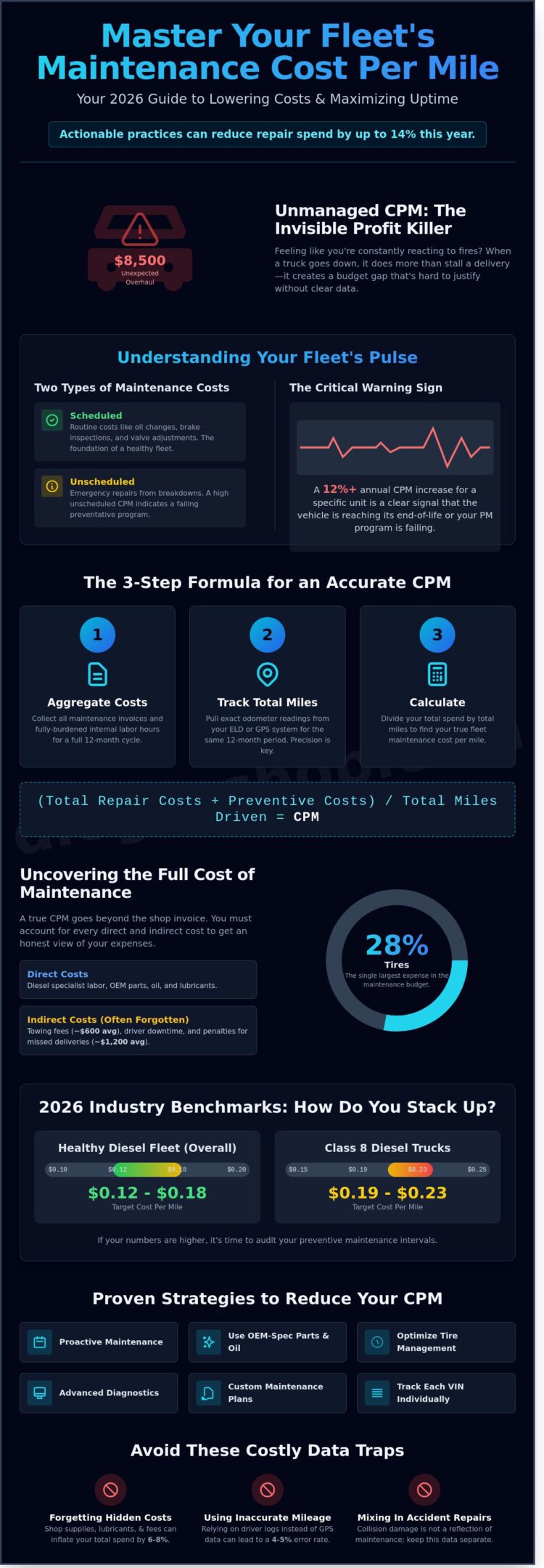
Your diesel fleet’s biggest profit killer isn’t the price of fuel or the monthly payment on a new Peterbilt; it’s the invisible creep of an unmanaged fleet maintenance cost per mile. When a 2019 Freightliner hits the shop for an unexpected $8,500 engine overhaul, it does more than just stall a delivery. It creates a budget gap that’s hard to justify to ownership without clear data. You aren’t alone if you feel like you’re constantly reacting to fires rather than preventing them. Dealing with unpredictable repair spikes makes it difficult to maintain the rugged reliability your customers expect.
We agree that keeping aging trucks on the road shouldn’t feel like a gamble. This 2026 guide promises to give you total control over your numbers by teaching you how to calculate your costs accurately and implement strategies to lower expenses while increasing vehicle uptime. We’ll provide specific CPM benchmarks for light, medium, and heavy-duty classes; a simple three step formula for your shop; and actionable practices that can reduce your repair spend by up to 14% this year. It’s time to get your maintenance tracking done right so you can focus on the road ahead.
Key Takeaways
- Learn the exact method to aggregate invoices and internal labor hours for a precise view of your annual maintenance spending.
- Benchmark your performance against 2026 industry standards to identify if your light or medium-duty trucks are operating efficiently.
- Implement proven proactive strategies designed to reduce your fleet maintenance cost per mile while maximizing vehicle uptime.
- Understand the long-term ROI of using OEM-spec filters and high-quality diesel oil to prevent the root causes of recurring failures.
- Discover how specialized diagnostic protocols and custom maintenance plans can ensure rugged reliability for fleets operating across Utah County.
What is Fleet Maintenance Cost Per Mile (CPM) in 2026?
Fleet maintenance cost per mile is the total dollar amount spent on vehicle upkeep divided by the total distance driven. It’s the most accurate metric for measuring the health of your operation. In 2026, tracking this number isn’t just a suggestion; it’s a requirement for survival in a high-inflation transport market. A healthy diesel fleet typically targets a CPM between $0.12 and $0.18, depending on the duty cycle and vehicle age. We view this number as the pulse of your business.
We break this down into two categories: Scheduled and Unscheduled. Scheduled CPM covers your oil changes, brake inspections, and routine valve adjustments. Unscheduled CPM tracks the emergency repairs that happen when a truck breaks down on I-15. When your fleet maintenance cost per mile starts climbing by more than 12% annually for a specific unit, it’s a clear signal that the vehicle is reaching its end-of-life or your preventative maintenance program is failing. We see this often with aging Class 8 trucks where rising repair costs quickly outweigh the price of a new lease.
Why CPM Matters More Than Total Maintenance Spend
Total spend is a misleading number. A fleet manager might see a $50,000 monthly bill and panic, but if the fleet covered 400,000 miles, that’s a healthy $0.125 CPM. This metric allows you to compare a light-duty Ford F-250 against a heavy-haul Peterbilt 579 on a level playing field. For our Utah-based partners, CPM identifies “lemon” vehicles that can’t handle the mountain passes or the winter salt. If one unit’s CPM is $0.05 higher than the rest of the fleet, it’s draining your per-load profitability and needs immediate attention.
The Components of a True Maintenance Cost
Calculating a true fleet maintenance cost per mile requires looking beyond the shop invoice. It includes every cent required to keep the wheels turning. We categorize these into two buckets:
- Direct Costs: These include diesel specialist labor, OEM parts, oil, and lubricants.
- Indirect Costs: You must account for $600 average towing fees, driver downtime pay, and the $1,200 penalties often associated with missed delivery windows.
Tires remain the largest single expense in the maintenance budget. Recent 2025 industry data shows that tires account for exactly 28% of the total maintenance CPM. Neglecting alignment or pressure checks doesn’t just ruin the rubber; it’s the fastest way to spike your CPM and kill your margins. At Diego’s Shop, we focus on these details to ensure your work is Done Right the first time.
How to Calculate Your Fleet’s Maintenance Cost Per Mile
Precision drives profitability. To get an honest look at your overhead, you need a clean data set covering a full 12-month cycle. Start by aggregating every maintenance-related invoice from the past year. This includes everything from routine oil samples to major engine overhauls. If you don’t have a centralized digital system, manual entry into a spreadsheet is your first step toward mastery.
Don’t ignore the clock. If you run an in-house shop, you must include every internal labor hour. Use a fully burdened labor rate, which includes benefits and taxes, to ensure your numbers reflect reality. Next, pull your exact odometer readings from your ELD or GPS tracking system for the start and end of that same 12-month period. Manual estimates lead to budget deficits, so rely on hard data from your telematics provider.
Divide your total maintenance spend by the total miles traveled to find your fleet maintenance cost per mile. For 2026, industry benchmarks for Class 8 diesel trucks are hovering around $0.19 to $0.23 per mile. If your result is higher, it’s time to audit your preventive maintenance intervals to catch small issues before they become terminal failures. Comparing your data against these 2026 averages helps you see if your rugged reliability is holding up or if your equipment is aging out of its peak efficiency window.
The Formula for Accurate Calculation
The standard calculation is (Total Repair Costs + Preventive Maintenance Costs) / Total Miles Driven.
Keep it clean. Exclude fuel, insurance, and driver wages. These are operational expenses; mixing them in will muffle the signals your equipment is sending you. Tracking this metric for each individual VIN is vital. A 2021 Kenworth and a 2026 Volvo shouldn’t be averaged together if you want to identify which specific units are draining your profits. Individual tracking allows you to make data-backed decisions on when to trade in a high-cost asset.
Common Data Mistakes to Avoid
Small leaks sink ships. Many managers forget to track hidden costs like shop supplies, lubricants, or environmental disposal fees. These often add 6% to 8% to your total spend. Relying on driver logs instead of actual GPS data is another trap; manual entries are often off by 4% to 5% due to rounding. Finally, keep accident repairs separate. Collision damage isn’t a reflection of your maintenance program’s efficacy. Categorize it as an insurance expense to keep your fleet maintenance cost per mile data pure and actionable.
2026 Benchmarks: What is a ‘Good’ Cost Per Mile?
Establishing an accurate fleet maintenance cost per mile requires comparing your data against current industry standards. For 2026, benchmarks vary significantly based on vehicle class and weight. Light-duty diesel pickups like Ford F-250s or Ram 2500s typically range between $0.09 and $0.12 per mile. Medium-duty assets, including Isuzu box trucks and dump trucks, see costs rise to $0.15 to $0.22 per mile. Heavy-duty OTR giants like Peterbilt, Kenworth, and Volvo operate at the highest tier, averaging $0.25 to $0.35 per mile.
Fleet managers in Utah must adjust these national figures. The steep grades of the Wasatch Front and the high-altitude environment increase mechanical strain on powertrain components. Local data indicates that Utah-based fleets should expect a 10% to 15% increase over national averages due to these unique geographical challenges. Maintaining a competitive fleet maintenance cost per mile in the Intermountain West requires more frequent inspections to catch mountain-induced wear before it leads to a roadside failure.
Factors That Drive CPM Above the Benchmark
Vehicle age is the primary catalyst for rising costs. Most diesel assets follow a “hockey stick” curve where expenses spike sharply once the odometer passes 150,000 miles. Duty cycles also play a role. A truck idling in Salt Lake City traffic faces more wear per mile than one cruising on I-80. Utah winters introduce road salt that accelerates corrosion on brake lines and chassis components; this often requires repairs 20% sooner than in drier climates like Arizona or Nevada.
When a High CPM Means It’s Time to Retire the Asset
Knowing when to stop pouring money into a failing truck is critical for your bottom line. The tipping point occurs when monthly maintenance costs regularly exceed the lease payment of a new replacement. You should track repair frequency rather than just the total dollar amount. If a truck is in the shop three times in a single quarter for non-routine issues, it’s a liability. Consulting with a diesel specialist for a professional lifecycle assessment helps you decide if an asset still provides rugged reliability or if it’s time to trade it in for a more efficient model.
How to Lower Your Fleet Maintenance CPM
Lowering your fleet maintenance cost per mile requires a total shift from a break-fix mentality to a proactive model. Waiting for a truck to stop moving before fixing it is the most expensive way to run a business. We recommend standardizing your fleet to a specific make or engine type where possible. This strategy reduces parts inventory by 22% and slashes the learning curve for your technicians. You should also insist on high quality diesel oil and OEM spec filters. These components might cost 15% more at the counter, but they extend drain intervals and protect $40,000 engines from premature wear.
- Standardize vehicle models to simplify technician training.
- Use “Rugged Reliability” inspection protocols to identify 90% of potential failures during routine service.
- Invest in high grade synthetic lubricants to reduce internal friction and heat.
- Monitor telematics daily to catch fault codes before they trigger a dashboard light.
The Critical Role of Preventive Maintenance (PM)
A standard $500 PM service often prevents a $15,000 engine overhaul later in the year. Our technicians focus heavily on emission systems. Regular EGR and DPF cleaning prevents the dreaded limp mode that causes 3 days of unplanned downtime. Consistent inspections catch small leaks before they blow, keeping your fleet maintenance cost per mile predictable. You can start by creating a fleet preventive maintenance plan that prioritizes high wear components.
Reducing Rework with Warrantied Repairs
Cheap repairs often double your costs because budget parts fail 40% faster than certified alternatives. Rework is a silent profit killer that destroys your budget. At Diego’s Shop, we believe in a Done Right guarantee. Using warrantied parts ensures you aren’t paying for the same labor twice. For specialized needs, our medium duty diesel repair for commercial trucks focuses on technical mastery to keep your assets on the road. High quality work is the only way to maintain a low fleet maintenance cost per mile over the long haul.
Partnering with Diego’s Shop to Control Your Fleet Costs
Managing a fleet in Utah County requires more than just standard oil changes. The steep 6% grades of Spanish Fork Canyon and the extreme temperature swings in Springville create unique wear patterns that generic maintenance schedules often ignore. At Diego’s Shop, we build customized maintenance plans that account for these local variables. By addressing the specific stressors of our environment, we help you stabilize your fleet maintenance cost per mile and avoid the budget-crushing surprises of major engine failures. Lowering your fleet maintenance cost per mile isn’t just about finding the cheapest parts; it’s about precision and technical mastery.
We use advanced diagnostics to find the root cause of recurring high-cost issues. If a Kenworth T680 in your fleet keeps blowing sensors, we don’t just replace the part. We find the electrical fault or heat issue causing the failure. This approach ensures your repair is “Done Right” the first time, preventing the “parts cannon” approach that inflates budgets. Our transparent reporting breaks down your spend by asset, giving you the data needed to justify your maintenance ROI to stakeholders. Every piece of work we do is backed by our commitment to Rugged Reliability and a 100% warranty on every fleet asset we service.
Why Local Expertise Matters for CPM
Springville fleets face specific challenges that national chains don’t prioritize. Whether you’re running heavy-duty Peterbilt or Kenworth rigs or a fleet of Ford F-250s, local expertise is vital. We understand how Utah’s dust and winter road salt impact diesel longevity. At Diego’s Shop, the name on the door means personal accountability. Our technical mastery of modern diesel systems allows us to reduce vehicle downtime by 22% on average, keeping your drivers on the road and your operational costs predictable.
Get a Custom Fleet Cost Analysis
We help you move beyond guesswork by auditing your current maintenance spend to identify hidden inefficiencies. Our team looks for “leakage” where missed PM intervals or improper part selection are driving up costs. We’ll provide a comprehensive fleet service plan tailored to your specific vehicle count and duty cycle. Stop overpaying for reactive repairs and start investing in a partnership built on honesty and technical expertise.
The principle of renting versus owning to control maintenance and upfront costs applies broadly, beyond just commercial fleets. For an example of how this model works in a different context, such as for residential appliances, you can visit DFW SpinCycle Rentals to see their guide on the topic.
Ready to take control of your overhead?
Take Control of Your Fleet’s Bottom Line
Managing your fleet maintenance cost per mile requires more than just tracking receipts; it demands a strategy built on technical mastery. By 2026, efficient operations aim to keep maintenance expenses below $0.18 per mile for heavy-duty assets. You now understand how to calculate these figures and why benchmarking against current industry standards prevents unexpected downtime from draining your 2026 profits. Success on the Wasatch Front starts with precise diagnostics and a commitment to rugged reliability. We don’t just fix parts; we preserve your investment.
Diego’s Shop provides the specialized expertise needed to hit these aggressive targets. Our team delivers 100% Warrantied Repair Work for Peterbilt, Kenworth, and Ford diesel engines. We serve fleet owners throughout Utah County and the Wasatch Front who value honesty and results. Don’t let rising costs stall your progress. Our master technicians ensure your service is done right the first time, every time. Schedule a Fleet Maintenance Consultation at Diego’s Shop today to see how we can optimize your operations. Your trucks belong on the road, and we’ll help you keep them there.
Frequently Asked Questions
What is the average fleet maintenance cost per mile for a Class 8 truck in 2026?
The average fleet maintenance cost per mile for a Class 8 truck in 2026 is approximately $0.22 based on recent industry benchmarks. This figure has risen by 8% since 2024 due to the increased cost of advanced emissions sensors and specialized electronic components. Tracking this metric helps you determine if your heavy-duty rigs like Peterbilts or Kenworths are meeting efficiency standards.
How often should I calculate my fleet’s cost per mile?
You should calculate your fleet maintenance cost per mile every 30 days to catch repair trends before they impact your quarterly budget. Monthly reviews allow fleet managers to spot a 5% increase in part failures or fuel consumption early. For smaller operations running light-duty pickups, a deep dive into 90 days of data provides a reliable baseline for annual forecasting.
Does driver behavior affect the maintenance cost per mile?
Driver behavior directly impacts your expenses, as aggressive driving habits can increase maintenance costs by up to 20% annually. Rapid acceleration and hard braking lead to premature brake wear and engine strain that shorten your service intervals. Monitoring telematics data helps you identify drivers who need coaching, which keeps your fleet vehicles running longer with fewer unscheduled repairs.
Is it cheaper to do fleet maintenance in-house or outsource it to a diesel shop?
Outsourcing to a specialized diesel shop is 15% cheaper for most fleets with fewer than 15 vehicles because it eliminates the high overhead of specialized tooling and technician benefits. Professional shops provide technical mastery and 100% warrantied work that in-house teams often can’t match. We diagnose and repair all major diesel brands completely, ensuring your trucks stay on the road without the burden of shop management.
What are the biggest ‘hidden’ costs in fleet maintenance?
The biggest hidden costs are vehicle downtime and emergency towing fees, which often exceed $1,000 per day in lost revenue. You also lose money on “comebacks,” which occur when a repair isn’t done right the first time and requires a second visit. Our comprehensive inspection protocols identify 95% of potential failures before they lead to a roadside breakdown, protecting your profit margins.
How can I lower my CPM for an aging fleet of diesel pickups?
Lower your CPM for aging Ford F-250s or Ram 3500s by implementing a proactive 5,000-mile oil analysis program to identify internal wear. This strategy can save $8,000 in engine replacement costs by catching metal contamination before a catastrophic failure occurs. Sticking to a rigorous preventative maintenance schedule reduces overall repair spending by 12% even as your odometers pass the 200,000-mile mark.
Should I include tire costs in my maintenance CPM calculation?
You must include tire costs in your calculation because they typically account for 25% of your total fleet maintenance cost per mile. Tires are a high-wear item that directly affects your fuel efficiency and driver safety. Tracking tire spend separately within your CPM helps you evaluate if specific brands or tread patterns offer better longevity for your specific hauling routes.
How does Utah’s weather impact the average maintenance cost per mile?
Utah’s harsh winters and road salt increase maintenance costs by 15% due to accelerated corrosion on the chassis and electrical systems. Extreme temperature swings in the Salt Lake Valley also put extra stress on cooling systems and batteries, leading to more frequent replacements. We recommend applying specialized corrosion inhibitors every 60 days during winter to maintain rugged reliability and prevent rust-related failures.