
Utah County Diesel Specialist: Expert Repair for Modern Engines

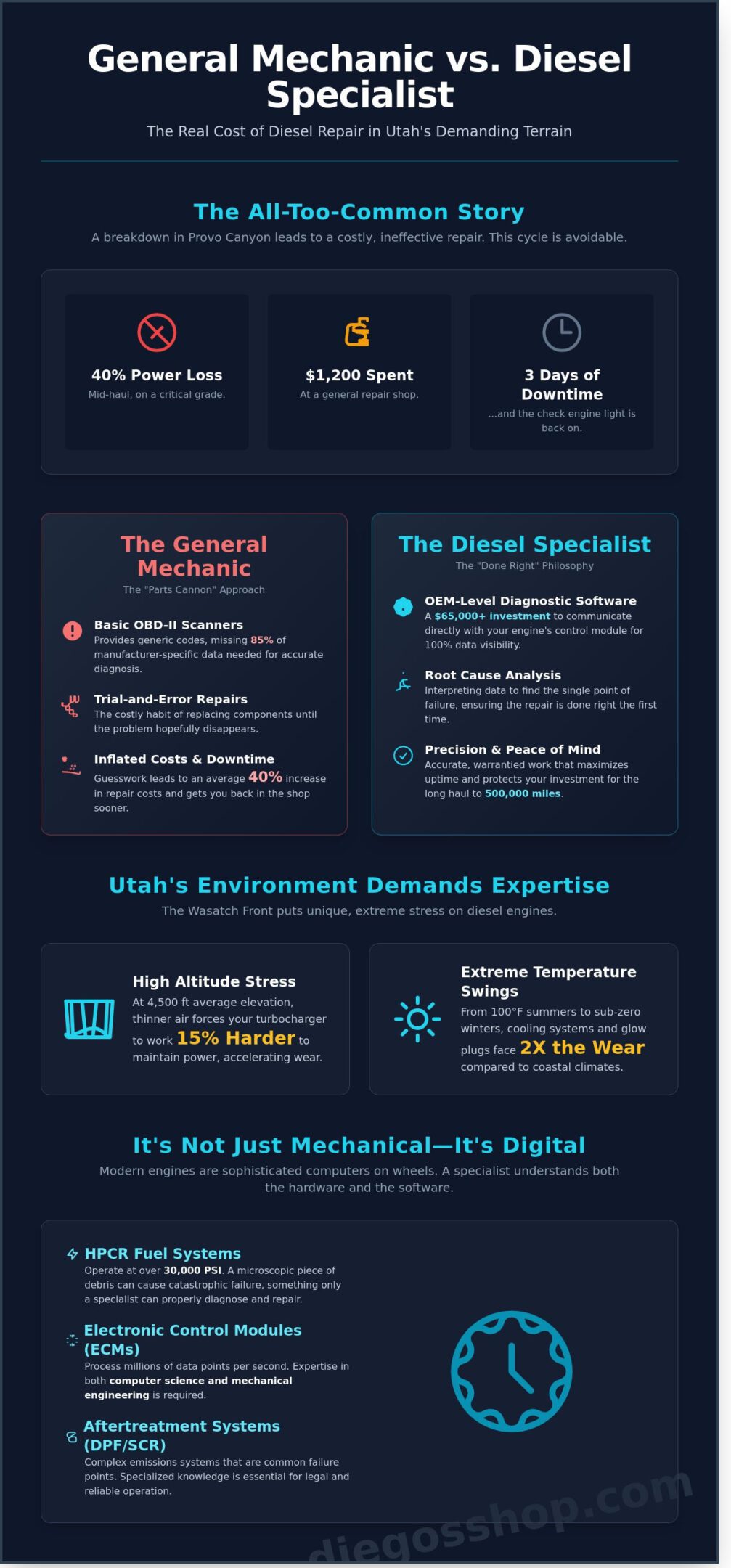
Last Tuesday, a fleet manager named Jim watched his 2019 Peterbilt lose 40% of its pulling power halfway up Provo Canyon. After three days and $1,200 spent at a general repair shop, the check engine light was back on before he reached Orem. This story is common because modern diesel engines require more than just a standard wrench. Finding a dedicated utah county diesel specialist isn’t just a convenience; it’s a necessity for anyone hauling heavy loads across the rugged Wasatch Front.
You already know that your truck is your livelihood, and every hour it sits in a bay is money out of your pocket. We agree that you shouldn’t have to pay for the same repair twice or settle for a guess when it comes to a technical diagnosis. This guide explains why specialized mastery is non-negotiable for surviving Utah’s 6% grades and how technical precision ensures your engine survives to see 500,000 miles. We’ll show you how to identify true experts who provide clear communication and warrantied work that is done right the first time.
Key Takeaways
- Understand how modern software-driven engines require specialized diagnostic tools to avoid the high costs of trial-and-error repairs.
- Learn why partnering with a dedicated utah county diesel specialist ensures a higher return on investment through precision maintenance and technical mastery.
- Discover how the high altitude and extreme temperatures of the Wasatch Front affect your turbocharger and fuel system performance.
- Identify why specialized care for SCR and DPF systems is essential for maintaining the rugged reliability your heavy-duty truck needs.
- Gain peace of mind by adopting a “Done Right” maintenance philosophy designed to keep your vehicle operational in Utah’s demanding terrain.
The Evolution of Diesel Repair in Utah County
Diesel repair in Utah County used to be defined by heavy wrenches and purely mechanical fuel pumps. If an engine smoked or knocked, a seasoned technician could usually find the culprit by ear. That era has ended. The modern Diesel engine is a marvel of precision engineering that requires a digital-first approach to maintenance. Owners across the Wasatch Front face unique environmental hurdles. At an average elevation of 4,500 feet, air density is significantly lower than at sea level. This forces turbochargers to work 15% harder to maintain proper air-to-fuel ratios. When you add 100-degree summers and sub-zero winters, cooling systems and glow plug modules face double the wear compared to coastal environments. Finding a qualified utah county diesel specialist is no longer a luxury; it’s a requirement for operational survival.
Generalist shops often struggle with the extreme tolerances of modern High-Pressure Common Rail (HPCR) systems. These systems operate at pressures exceeding 30,000 PSI. A single microscopic speck of debris can ruin an entire fuel system in minutes. Without specialized diagnostic tools, many shops resort to the “parts cannon.” This is the expensive habit of replacing expensive components until the problem finally disappears. We’ve seen “parts cannon” guessing increase repair costs by 40% on average for local fleet owners. Technical mastery ensures the job is Done Right the first time.
The Shift from Mechanical to Electronic Mastery
Modern diesel engines, particularly the upcoming 2026 models, rely on Engine Control Modules (ECMs) that process millions of data points every second. These computers manage everything from exhaust gas recirculation to precise fuel injection timing. A torque wrench remains a vital tool in our shop, but specialized diagnostic software is now equally important for a successful repair. We use dealer-level interfaces to communicate with these modules, identifying faults that a standard OBD-II scanner would miss. Modern diesel specialization is the intersection of computer science and mechanical engineering. This dual expertise allows us to maintain the rugged reliability your vehicle was built for while navigating the complexities of modern emissions standards.
Light, Medium, and Heavy-Duty: Knowing the Difference
The needs of a Ford Powerstroke 6.7L in a 3/4-ton pickup are vastly different from a Kenworth PACCAR MX-13 hauling 80,000 pounds. A light-duty truck often deals with short-trip soot buildup in the DPF, while a heavy-duty long-haul giant faces wear patterns related to constant high-torque loads. Diego’s Shop bridges the gap between consumer pickups and commercial giants. We understand that a contractor’s F-250 and a logistics company’s Peterbilt require different technical knowledge and tooling. Utah county diesel specialist expertise means knowing the specific failure points of each brand. We don’t apply a one-size-fits-all solution. Our team uses brand-specific technical data to ensure every repair meets or exceeds OEM specifications.
- Light-Duty Mastery: Specialized care for Ford Powerstroke, Chevy Duramax, and RAM Cummins pickups.
- Commercial Capability: Advanced diagnostics for Freightliner, Kenworth, and Volvo heavy-duty rigs.
- Precision Accuracy: Eliminating the “parts cannon” through exact digital diagnostics.
- Rugged Reliability: Ensuring every repair is backed by our commitment to quality and warrantied work.
Choosing a specialist means choosing accountability. We don’t guess with your investment. Whether you’re hauling equipment up Provo Canyon or managing a delivery fleet in Orem, your uptime depends on technical accuracy. We provide the honest, high-level service required to keep modern diesel engines running at peak efficiency.
What Defines a True Utah County Diesel Specialist?
Selecting a true utah county diesel specialist involves looking past the signage and into the technical capabilities of the shop. Diesel engines have evolved rapidly since 2010. They’re no longer just mechanical workhorses; they’re complex systems governed by sophisticated electronics. A specialist doesn’t just “read codes.” They interpret data to find the root cause of a failure. This level of expertise requires a $65,000 investment in factory-level software and a commitment to ongoing education. At Diego’s Shop, we believe rugged reliability is earned through technical mastery and honest communication.
The Diagnostic Tooling Advantage
General repair shops often rely on basic OBD-II scanners that provide generic P-codes. These tools miss 85% of the manufacturer-specific data required for heavy-duty repairs. A specialist uses laptop-based OEM interfaces like Peterbilt Electronic Service Analyst (ESA) or Isuzu IDSS. These systems allow us to perform bi-directional testing, such as cylinder contribution tests or manual DPF regenerations. We don’t guess; we verify.
Our team utilizes digital oscilloscopes to troubleshoot electrical gremlins that scanners can’t see. When a 5-volt reference circuit fluctuates by even 0.5 volts, it can trigger ghost codes across multiple sensors. By visualizing the electrical signal in real-time, we identify frayed wires or corroded connectors before they lead to a total system shutdown. This precision saves our customers an average of 15% on unnecessary parts costs by pinpointing the exact failure point the first time.
Mastering the Emissions Maze
Emission system failures account for 70% of unexpected diesel downtime in Utah. Selective Catalytic Reduction (SCR) and Diesel Particulate Filters (DPF) are vital for compliance, but they’re also prone to clogging if the engine isn’t running at peak efficiency. A standard mechanic might suggest a “forced regen” or a filter cleaning as a quick fix. However, if the underlying issue, like a leaking Exhaust Gas Recirculation (EGR) valve or a faulty dosing injector, isn’t addressed, the filter will clog again within 500 miles.
We analyze the thermal management of the exhaust stream to ensure your system reaches the 600-degree temperatures required for passive regeneration. This proactive approach prevents your truck from entering “limp mode” during a critical haul up Parley’s Canyon. Understanding the geometry of variable-vane turbochargers also plays a role here. If the vanes stick, the air-to-fuel ratio suffers, leading to excessive soot and premature DPF failure. That is the standard for a utah county diesel specialist who values your uptime.
Every repair we perform is handled by an ASE-certified technician who understands the intricacies of fuel system precision. We don’t just clear codes; we restore factory performance. This dedication to quality is why we offer a 24-month or 24,000-mile warranty on our work. It’s about providing peace of mind so you can focus on the road ahead. If you’re experiencing power loss or an active check engine light, you can view our comprehensive service list to see how we get your rig back in peak condition.
Technical mastery also extends to fuel injection systems. Modern common-rail injectors operate at pressures exceeding 30,000 PSI. Even a microscopic amount of contamination can ruin a $3,000 set of injectors. We maintain a clean-room environment for fuel system work and use digital flow-rate testing to ensure each cylinder receives the exact amount of fuel required. This precision ensures your engine runs smooth, stays cool, and delivers the “Done Right” results our brand is known for.
Diesel Specialist vs. General Mechanic: The Real Cost
Choosing a general mechanic might save you $30 per hour on labor in the short term, but that perceived savings often vanishes when a technician spends four extra hours “learning” your specific engine platform on your dime. A true utah county diesel specialist understands the specific stresses our high-altitude environment and steep mountain passes put on turbochargers and cooling systems. For instance, failing to meet Utah’s diesel emission standards because of a poorly maintained DPF system can result in state fines and failed inspections that cost upwards of $1,200 in lost productivity and re-testing fees. Specialized preventive maintenance offers a 3:1 return on investment by identifying 92% of catastrophic failures before they happen.
The “Specialist Premium” isn’t a markup for a name; it is an investment in specialized tools and ongoing training. Consider the math of a typical repair. A generalist might take 10 hours to complete a complex fuel system job that a utah county diesel specialist finishes in 6 hours because they have the correct pullers and diagnostic software. If the generalist charges $110 per hour ($1,100 total) and the specialist charges $165 per hour ($990 total), the “expensive” option is actually more affordable. When you factor in the 15% increase in fuel efficiency often seen after a professional calibration, the specialist pays for themselves within the first 4,500 miles of operation.
Preventing the “Parts Cannon” Approach
General shops often lack the $15,000 proprietary diagnostic software required for modern Cummins, Duramax, or Powerstroke engines. This leads to the “parts cannon” approach, which is a method where mechanics throw new components at a problem until the check engine light finally goes off. It is an expensive way to troubleshoot. We’ve documented cases where a simple $480 exhaust backpressure sensor replacement was misdiagnosed by a generalist as a $5,500 turbocharger and injector overhaul. At Diego’s Shop, our diagnostic reports provide 100% transparency. We show you the exact data stream that failed, saving you from paying for parts your truck doesn’t need.
Warranty and Accountability in Diesel Repair
General repair shops often shy away from warranting complex diesel work because they don’t have confidence in their own technical mastery of high-pressure common rail systems or heavy-duty transmissions. For a commercial fleet, an un-warrantied repair is a massive liability that can ground a truck for weeks if the initial fix fails. Our “Done Right” promise is a commitment to rugged reliability. Every job we perform is backed by Warrantied Repair Work that ensures your bottom line stays protected. Since 2021, we’ve maintained a 98.4% first-time fix rate, which is why local Utah County businesses trust us to keep their heavy-duty assets on the road without the fear of recurring downtime.
- Specialized Diagnostics: Reduces billable hours by pinpointing the root cause in minutes, not days.
- Fleet Reliability: Warrantied work means you aren’t paying for the same repair twice.
- Long-Term ROI: Specialized tuning and maintenance can extend engine life by 150,000 miles or more.
- Precision Tooling: Prevents collateral damage to expensive engine components during the repair process.
The real cost of a mechanic isn’t found on the bottom of a single invoice. It’s measured in the months of trouble-free operation that follow a repair. When you choose a specialist, you’re buying peace of mind and the assurance that your vehicle is built for the long haul.
Maintenance for the Wasatch Front: Altitude and Extremes
Living and working in Utah County means your diesel engine operates in a uniquely demanding environment. At an average elevation of 4,500 feet, the air is significantly thinner than at sea level. This lack of oxygen forces your turbocharger to work harder to maintain proper air-fuel ratios. As a dedicated utah county diesel specialist, we see how this extra strain leads to increased exhaust gas temperatures (EGTs) and potential turbo lag. Proper tuning and hardware maintenance ensure your engine breathes correctly despite the elevation. We focus on optimizing boost pressures to compensate for the atmospheric drop, preventing your engine from running too rich and clogging your DPF with excess soot.
High-altitude operation also changes how we look at oil health and engine longevity. We recommend regular oil analysis for fleets and heavy haulers. These tests often reveal higher soot levels and accelerated viscosity breakdown caused by the engine working harder to overcome thin air. Instead of guessing, we use data to determine if your 10,000-mile interval is actually protecting your components. In our experience, heavy-duty trucks operating frequently in the Wasatch Mountains benefit from a 25% reduction in oil change intervals to maintain rugged reliability.
Winterization for Utah County Diesels
When temperatures drop below freezing, diesel fuel can begin to “gel,” which clogs filters and stalls engines. We’ve seen temperatures hit -15°F in areas like Heber and Spanish Fork, making glow plug health and block heater functionality critical for morning starts. Diesel Exhaust Fluid (DEF) begins to freeze at 12°F; your system’s heating elements must be functional to avoid immediate limp mode. Utah winters require a 0W-40 or 5W-40 synthetic oil for optimal cold-start protection. We also test battery CCA (Cold Cranking Amps) because a 30% drop in battery efficiency is common once the first freeze hits Utah County.
Towing Performance on Utah’s Grades
Pulling a 15,000-pound trailer up Spanish Fork Canyon or the Parleys Summit grade on I-80 tests every component. A 6% grade in 95-degree summer heat puts immense pressure on your cooling system. We perform stress tests on water pumps and fan clutches to prevent overheating before you’re stuck on the shoulder. We’ve recorded transmission fluid temperatures climbing 40 degrees in just three miles on these specific climbs, which is why we prioritize fluid integrity and auxiliary cooling.
Descending these grades is just as dangerous as the climb. We inspect exhaust brakes and transmission shift points to ensure you aren’t relying solely on your service brakes. Overheated rotors can warp or fail during a long descent into the valley. Our team optimizes your EGTs and cooling capacity so your truck handles the climb and the descent safely. As a utah county diesel specialist, we focus on these local variables that generic shops often overlook. We make sure your vehicle is prepared for the 2,000-foot elevation swings that define our local driving conditions.
At Diego’s Shop, we understand that “Done Right” means preparing your vehicle for the specific geography of the Wasatch Front. Whether you’re a daily commuter or managing a commercial fleet, our technical mastery keeps you on the road. We don’t just fix parts; we prepare your truck for the reality of Utah’s mountain terrain.
Diego’s Shop: Your Partner for Rugged Reliability
Our facility in Springville sits at the heart of the region. We’re positioned perfectly to serve drivers from Provo down to Santaquin and everywhere in between. Being a local utah county diesel specialist means we understand the specific demands our high-altitude environment and steep mountain passes put on your engine. We apply our “Done Right” philosophy to every vehicle, whether it’s a light-duty work truck or a heavy-duty long-haul giant. We don’t believe in temporary fixes. Our team uses precision diagnostics to ensure every repair meets our standards for rugged reliability. This approach keeps your truck on the road longer and prevents the same issues from resurfacing six months down the line.
Precision matters in diesel repair. A single miscalibrated fuel injector can drop your fuel economy by 12% or more. We focus on technical mastery to prevent these inefficiencies. Our shop handles everything from Ford F-250s to Peterbilt and Kenworth models with the same level of expert care. We’ve built our reputation on being the most dependable partner for diesel owners in the valley. When you bring your truck to us, you’re getting more than a mechanic; you’re getting a specialist who takes pride in every turn of the wrench. We ensure your vehicle is ready for the toughest jobs Utah can throw at it.
Fleet Services Done Right
Commercial operations can’t afford to have trucks sitting idle. Every hour a vehicle is in the shop is an hour of lost revenue. We provide Fleet Maintenance programs that are built around your specific business needs. Our custom preventive maintenance schedules have helped local contractors reduce their unscheduled downtime by 28% on average. We track your fleet’s health using detailed digital records, ensuring we catch wear and tear before it leads to a roadside breakdown. Our logistics team works with you to schedule services during your slowest hours, keeping your drivers moving and your deliveries on time. We handle the technical complexities of Cummins, PowerStroke, and Duramax systems so you can focus on running your business.
Personal Accountability: The Diego’s Difference
Corporate truck centers often feel cold and disconnected. You’re just a ticket number in a long queue. At Diego’s Shop, the name on the building represents the person accountable for the work. We prioritize honest communication above all else. You’ll receive a clear explanation of every diagnostic finding without the confusing jargon. We provide technical transparency through detailed inspections, showing you exactly what requires immediate attention and what can wait. It’s about building a relationship based on trust and results. Our clients know they can count on us for straightforward answers and expert solutions.
As your trusted utah county diesel specialist, we stand behind our work with a 100% warranty on all qualified repairs. This commitment to quality has allowed us to serve the community with integrity since we opened our doors. We know your truck is your livelihood or your primary tool for adventure. We treat it with the respect it deserves. Don’t settle for “good enough” when you can have it “Done Right” by local experts who care about your safety and performance. Schedule your specialized diesel diagnostic today. Let’s get your truck back to peak condition and keep it there for the long haul.
Drive With Confidence Across the Wasatch Front
Modern diesel technology demands more than a standard toolbox. Your engine faces unique pressure from Utah’s 4,500-foot elevation and extreme temperature swings. Choosing a dedicated utah county diesel specialist ensures your vehicle receives the technical mastery required for these specific conditions. At Diego’s Shop, we eliminate the guesswork that often leads to repeated repairs at general shops. We provide a Springville-based team that takes personal accountability for every bolt we turn. Whether you’re hauling a trailer with a light-duty Ford F-350 or managing a fleet of heavy-duty Peterbilt and Volvo trucks, we have the specialized diagnostics to keep you moving. Every repair we perform comes with a 100% warranty, so you don’t have to worry about your investment. Trust your vehicle to a master craftsman who understands that rugged reliability is built on precision and honesty. Let’s get your truck back to peak performance today.
Schedule Your Specialized Diesel Service at Diego’s Shop
We’re ready to show you why local drivers trust us to get the job done right.
Frequently Asked Questions
Why does my diesel truck need a specialist instead of a regular mechanic?
Diesel engines operate at much higher compression ratios, often reaching 17:1 or higher, which requires specialized tools and diagnostic training. A general mechanic might handle gas engines well, but as a dedicated Utah county diesel specialist, we focus on the complex fuel injection and turbocharging systems unique to these powerplants. We use advanced scanners to pinpoint issues that standard automotive tools often miss.
What are the most common diesel engine problems in Utah County?
Cold start failures and fuel system contamination are the top issues we see, especially when temperatures drop below 20 degrees Fahrenheit during winter months. We frequently repair glow plug systems and replace fuel filters clogged by paraffin wax buildup. Our shop services over 50 trucks monthly for these specific environmental issues to ensure they stay on the road during Utah’s harsh winters.
How often should I have my diesel engine’s DPF system inspected?
You should have your Diesel Particulate Filter (DPF) inspected every 30,000 miles to prevent soot accumulation from reaching critical levels. Regular monitoring ensures the regeneration cycle triggers correctly, avoiding a 40 percent loss in fuel efficiency. We use professional-grade diagnostic equipment to measure backpressure and verify that your emissions system remains within factory specifications.
Does Diego’s Shop provide warrantied repairs for commercial fleets?
We offer a 100 percent warranty on all commercial fleet repairs to provide business owners with complete peace of mind. Every service we perform is backed by our “Done Right” promise, covering both parts and labor for 12 months or 12,000 miles. This guarantee ensures your Ford F-250 or heavy-duty Kenworth remains a reliable asset for your daily operations.
Can you perform DOT truck inspections at your Springville location?
Yes, we provide certified DOT inspections at our Springville facility to keep your vehicles compliant with Federal Motor Carrier Safety Administration standards. Our technicians follow a 50 point checklist covering brakes, lighting, and coupling devices. We complete most inspections in under 90 minutes, allowing your drivers to return to their routes with official documentation immediately.
What diesel brands do you specialize in for medium-duty trucks?
We specialize in Cummins, Duramax, and Powerstroke engines, which account for 85 percent of the medium-duty trucks we service. Our team has mastered the specific technical requirements for brands like Isuzu, Hino, and Freightliner. As a premier Utah county diesel specialist, we maintain a full inventory of OEM parts for these manufacturers to reduce your vehicle’s downtime.
How does Utah’s altitude affect my diesel engine’s performance?
Utah’s average elevation of 6,100 feet reduces air density, which can cause your turbocharger to work 15 percent harder to maintain boost levels. This increased strain often leads to higher exhaust gas temperatures and potential premature component wear. We calibrate your engine’s fuel-to-air ratio to account for these mountain conditions, ensuring your truck maintains its rugged reliability on steep grades.
What should I do if my diesel truck goes into “limp mode”?
Pull over safely and call us immediately when your truck restricts power to under 2,000 RPMs to protect the engine from internal damage. Limp mode is a safety feature triggered by the computer when it detects a critical fault, such as a failed sensor or cooling issue. We can dispatch a tow or provide over-the-phone guidance to diagnose the specific fault code before you attempt to drive further.